
What DFM Tooling and Machining Capabilities Distinguish China and Vietnam Hubs?
China hubs manage complex DFM tooling engineering, progressive die design, mold flow simulation, and multi-axis CNC machining for high-precision components. Vietnam production hubs focus on heavy stamping presses, robotic welding, die casting, and assembly lines supported by local engineering teams in Ho Chi Minh City and Bac Ninh.
Key Takeaways
- China hubs orchestrate pre-quote DFM tooling engineering, mold flow simulations, powder metallurgy, CQI-9 automotive forging, and AS9100D 5-axis CNC machining.
- Vietnam facilities manage heavy sheet metal stamping, robotic welding, die casting, plastic injection, and assembly of hand pallet trucks and brackets.
- Supply chain migration programs transfer production dies, fixtures, and quality control gauges from China to Vietnam within a 10-month timeline.
- Metrology verification incorporates ZEISS and Mitutoyo 3D CMM metrology labs holding tolerances down to ±0.008 mm spline pitch concentricity.
China engineering operations in centers like Xi'an orchestrate specialized production across powder metallurgy, metal injection molding, oilless bearings, and fluoropolymer parts. Pre-quote engineering utilizes 2D DWG drawings and 3D CAD modeling to complete tolerance stack-up analysis and mold flow simulations before cutting die steel. Driveline automotive parts like CV joint star sleeves, trunnion brackets, and core shafts undergo precision cold and warm forging followed by high-speed hydraulic spline broaching and hard turning on robotic CNC centers.
Vietnam local facilities in Ho Chi Minh City, Binh Duong, Dong Nai, Bac Ninh, and Haiphong deliver turnkey hardware such as CE-marked hydraulic hand pallet trucks and heavy-duty stamped safety brackets. These facilities feature progressive stamping presses up to 315T, OTC and Panasonic welding robots, and laser cutting equipment to produce structural hardware and retail-ready assemblies.
- Cold and warm closed-die forging (160T to 630T presses) with isothermal normalizing for uniform Ferrite-Pearlite grain flow
- Automated internal spline broaching and 136 robotic CNC lathes holding ±0.008 mm raceway concentricity
- Powder metallurgy structural gears, oil-impregnated bronze bushings, and 17-4PH/316L metal injection molding
- Progressive die stamping up to 315T paired with robotic MIG and TIG welding cells
How Do Line Relocation Timelines and Supply Chain Coordination Function Between Regions?
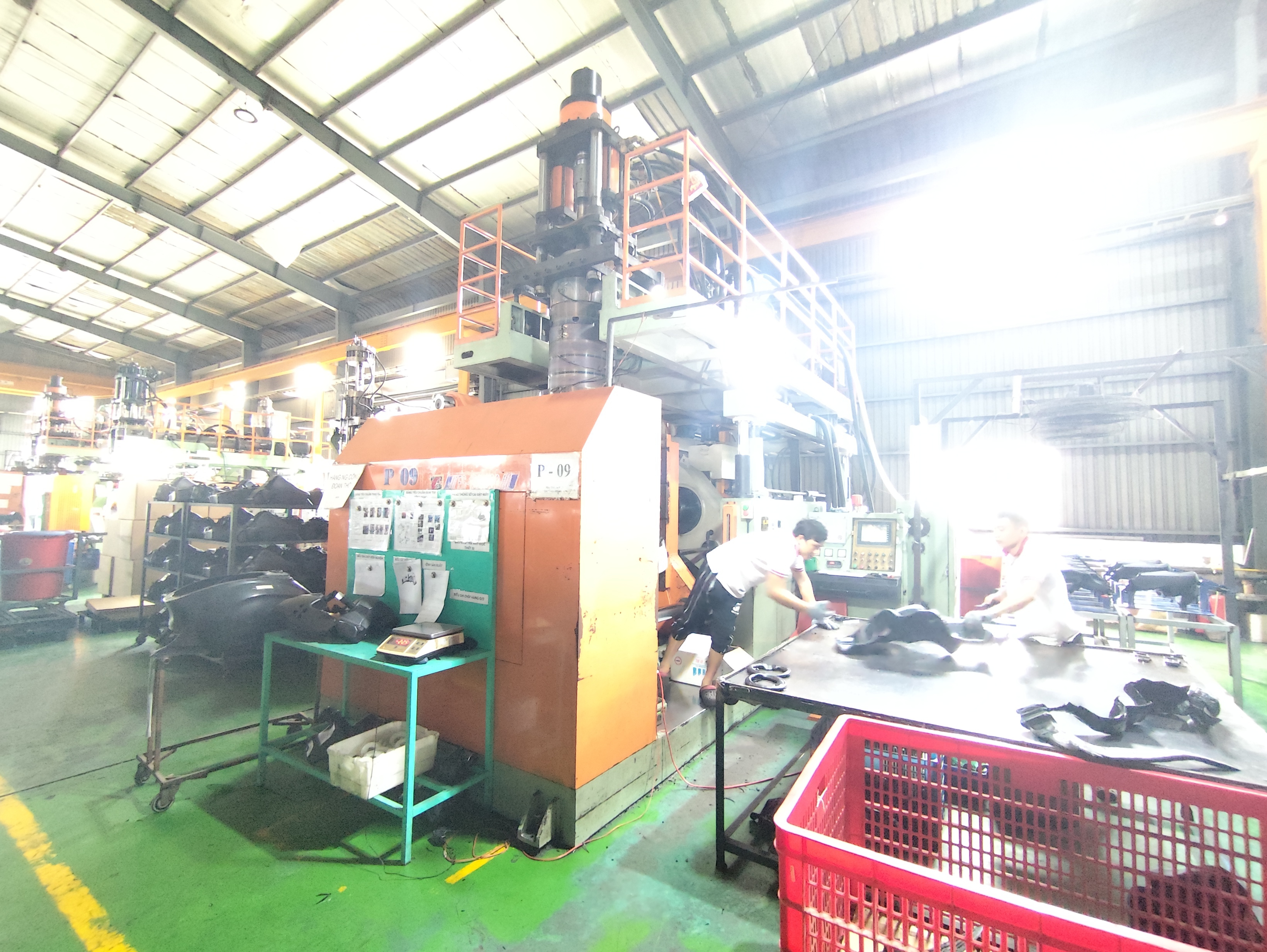
Line relocation protocols enable a 10-month migration of progressive stamping dies, fixtures, and quality control gauges from China to Vietnam without interrupting mass production. On-the-ground engineering centers orchestrate cross-border sub-component synergies while issuing unified documentation and trade origin documentation, such as Form D, EUR-1, and CPTPP certificates.
Transferring serialized manufacturing programs requires structured APQP milestone tracking and resident supplier quality engineering audits. Production relocations utilize proven playbooks to move existing press tooling, welding fixtures, and metrology gauges into local Vietnamese plants. This transition allows continuous supply chain continuity while establishing documented country-of-origin compliance under trade frameworks.
Cross-border production architectures also pair raw precision forgings or sintered blanks from China or Thailand with final precision machining and assembly in Vietnam. Deep-sea shipping corridors, such as the Lach Huyen port gateway in Haiphong, directly link Northern Vietnam industrial zones in Bac Ninh and Hanoi to trans-Pacific and European maritime trade routes.
- 10-month transfer playbook for dies, tooling fixtures, and quality control gauges
- Country of origin compliance documentation including Form D, EUR-1, and CPTPP forms
- Direct deep-water container shipping via Lach Huyen Deep-Water Terminal to global destinations
- Pre-shipment container loading audits featuring moisture and salt-spray protection controls
Which Quality Control and Metrology Standards Apply Across Driveline and Assembly Lines?
Precision quality verification relies on ZEISS and Mitutoyo 3D CMM inspection, CQI-9 heat-treatment controls, and IATF 16949 standards. Integrated metrology labs evaluate metallographic density, case hardness depth, raceway concentricity, surface roughness, and defect rates to maintain quality benchmarks down to 50 PPM across production runs.
Automotive driveline production utilizes a 16-stage closed-loop process flow that combines physical material preparation with rigorous inspection checkpoints. Forged 20CrMnTi and SAE 5120H carburizing alloy steel components undergo controlled normalizing, automated groove grinding, continuous furnace carbonitriding, and 100% eddy-current crack testing before vacuum anti-rust packaging.
Inspection protocols require full Level 3 PPAP documentation, material certificates of analysis (COA), and temperature-controlled CMM dimensional reports. Heavy assemblies like hand pallet trucks undergo 100% hydraulic cast pump oil leak testing, while stamped bracket lines undergo ASTM B117 salt spray testing exceeding 240 hours and UV powder coating evaluations.
- Controlled carbonitriding heat treatment yielding case depths of 0.85 to 1.25 mm at HRC 58 to 62
- 100% eddy-current and magnetic crack detection sorting for critical driveline components
- ZEISS and Mitutoyo 3D coordinate measuring machine lab checks for dimensional and contour metrology
- Metallographic microstructure, surface roughness, and density verification protocols

When Should Procurement Teams Select Dual-Country Sourcing Operations?
Procurement teams implement dual-country sourcing when balancing high-complexity tooling pre-production with localized assembly and duty optimization. Utilizing unified engineering oversight across Singapore headquarters, Xi'an technical centers, and Ho Chi Minh City operations ensures seamless quality control, standardized DFM review, and flexible production allocation across Asian manufacturing hubs.
Dual-sourcing strategies reduce operational risks by establishing redundant manufacturing corridors across China, Vietnam, and emerging regional hubs like Thailand. Complex sintered components, specialized slewing bearings, aerospace 5-axis valve blocks, and fluoropolymer parts can be sourced from established specialized centers, while high-volume sheet metal assembly and finishing occur near regional shipping hubs.
A unified management organization eliminates translation barriers and supply chain blind spots through resident quality engineers. Multi-city coverage allows buyers to scale from initial prototype DFM validation to serialized mass production while utilizing flexible commercial credit terms up to Net 90 days.
- Resident supplier quality engineering audits across 12 Asian manufacturing cities
- Single-contract management with open-account credit terms up to Net 90 days
- Full QCLDM factory scoring, DFM drawing analysis, and pre-quote tolerance reviews
- Parallel production footprints across China, Vietnam, and expanding Southeast Asian facilities
Precision Manufacturing & Sourcing Specification Matrix
| Technical Dimension | Standard Commercial Grade | High-Precision OEM Export Grade | DEWIN Verification Protocol |
|---|---|---|---|
| Machining & Forming Tolerance | ISO 2768-m (±0.10 mm nominal) | ISO 2768-f (±0.01 mm – ±0.025 mm critical bores) | Calibrated 3D CMM & Air/Pin Gauging |
| Surface Roughness & Finish | Ra 1.6 – 3.2 µm as-machined / standard coat | Ra 0.4 – 0.8 µm precision ground / MIL-A-8625 anodized | Profilometer & Coating Thickness Gauge |
| Material & Alloy Certification | Supplier Mill Test Report (MTR) | Independent OES chemical & mechanical verification | EN 10204 3.1 + RoHS/REACH Compliance |
| Batch Inspection & Packaging | ISO 2859-1 (AQL 1.0 Major / 2.5 Minor) | Zero-defect critical features + VCI export crating | Pre-Shipment Inspection (PSI) Report |
Frequently Asked Questions
What specific metrology equipment is used to inspect precision forged spline shafts?
Precision forged spline shafts are inspected using ZEISS and Mitutoyo Crysta-Apex S 3D coordinate measuring machines, contour measurement systems, surface roughness testers, and 100% eddy-current crack detection units.
How long does a typical factory line relocation take when moving dies from China to Vietnam?
Documented factory line relocation playbooks complete the transfer of progressive dies, assembly fixtures, and quality control gauges from China to Vietnam within a 10-month timeline without interrupting active serial production.
What standards and tests apply to custom stamped fire extinguisher brackets?
Stamped steel brackets are manufactured to UL 711 and DOT standards, featuring 2.0 to 4.0 mm gauge SPCC or SS304 steel, quick-release latches rated for 5G vibration, 240-hour ASTM B117 salt spray testing, and 1,500-hour UV powder coating protection.
Which material grades and standards govern automotive powder metallurgy structural parts?
Powder metallurgy parts utilize iron, copper, bronze (SAE841 / Sint B50), and stainless steel alloys like 17-4PH and 316L, produced under IATF 16949:2016 standards with mesh-belt sintering and steam treatment.