Custom Metal Stamping in Vietnam: 2026 Sourcing Guide
February 22, 2026 · 14 min read
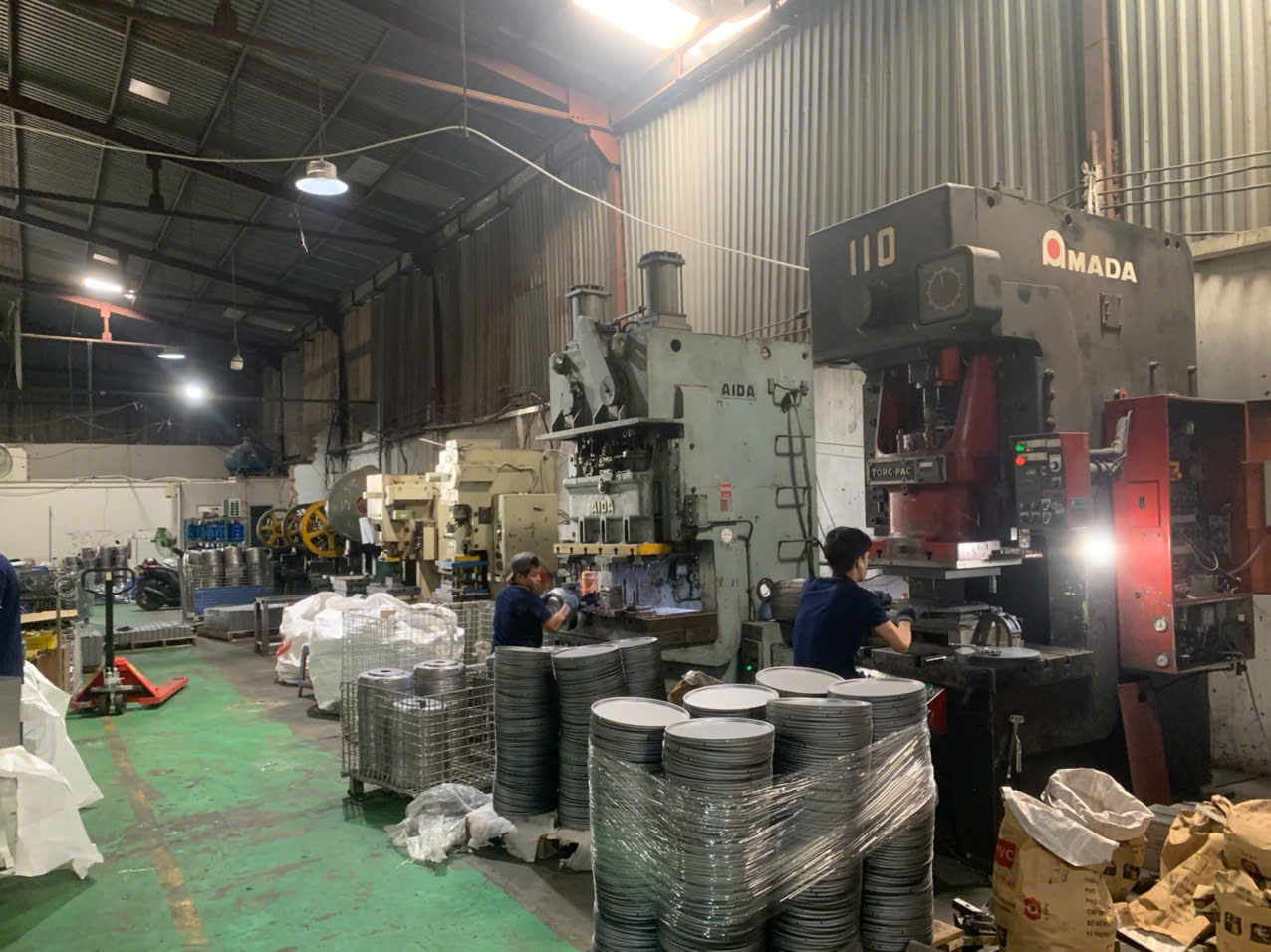
Vietnam has emerged as one of Asia's fastest-growing metal stamping hubs. With tooling costs 40–60% below US prices, no Section 301 tariffs for American importers, and a workforce trained by Japanese precision manufacturers, Vietnam offers a compelling alternative to China for custom stamped parts.
This guide provides real 2026 pricing from our audited stamping partner network across Ho Chi Minh City, Binh Duong, and Dong Nai — plus everything you need to launch a successful stamping program in Vietnam.
Yes — Vietnam produces custom metal stampings with progressive, compound, and transfer dies costing 40–60% less than US tooling; parts enter the US at relief from Section 301 Chinese punitive tariffs for qualifying goods versus China's 25%, on presses run by teams trained in Japanese precision manufacturing.

Top Stainless Steel Pipe Manufacturer in Vietnam
Watch on YouTube
Real footage from an audited DEWIN partner factory in Vietnam.
Why Vietnam for Metal Stamping?
Tariff Advantage: 25% Savings vs. China
Chinese metal stampings face 25% Section 301 tariffs when imported into the US. Vietnamese stampings enter at standard MFN rates — typically 0–3.5% depending on HS classification. For a $0.50 stamped bracket at 100,000 units/year, that's $12,500 in annual tariff savings alone.
Lower Tooling Investment
Die making labor in Vietnam runs $8–15/hr compared to $20–35/hr in China and $35–65/hr in the US. Wire EDM time costs $20–35/hr in Vietnam vs. $50–80/hr in China. Result: a 6-station progressive die that costs $25,000 in China can be built in Vietnam for $12,000–18,000 with equivalent quality.
Japanese Manufacturing Heritage
Japanese companies like Aida Engineering, Komatsu, and Amada have manufactured in Vietnam for over 15 years. Vietnamese die makers trained in these facilities bring kaizen-level precision to domestic shops. Many mid-tier Vietnamese stamping companies run Aida and Komatsu servo presses — the same equipment used in Tier 1 Japanese suppliers.
Domestic Steel Supply
POSCO (Korea) and Formosa Ha Tinh (Taiwan) operate major steel mills in Vietnam producing cold-rolled steel, galvanized sheet, and stainless steel. Domestic sourcing cuts 2–4 weeks from material lead time and saves 10–15% on steel costs vs. importing from Japan or Korea.
Tooling Costs in Vietnam: 2026 Benchmarks
Real quoted ranges from our partner network, all for D2/SKD11 tool steel with hardness 58–62 HRC:
Compound / Single-Hit Dies
For flat blanked parts — washers, gaskets, simple shapes. One stroke, one part.
- Simple (1–2 punch shapes): $800–2,500
- Medium (3–5 punch shapes): $2,500–6,000
- Expected die life: 500,000–1,000,000 strokes (D2 steel)
Progressive Dies
Multi-station dies where strip stock feeds through sequentially. The workhorse of volume stamping.
- 3–4 stations (bracket, simple formed part): $4,000–10,000
- 6–8 stations (connector, EMI shield, complex bracket): $10,000–22,000
- 10+ stations (automotive, multi-feature): $22,000–50,000
- Expected die life: 1,000,000–3,000,000 strokes with maintenance
Transfer Dies
Separate die stations with mechanical transfer between them. For larger parts and deep-drawn components.
- 3–4 station set: $6,000–25,000
- 5–8 station set (deep draw + trimming): $25,000–60,000
- Large-format (500mm+ part): $40,000–80,000
Per-Part Pricing from Vietnam
After tooling is paid, Vietnam's per-part costs are extremely competitive. All prices below assume SPCC cold-rolled steel at 1.0–2.0 mm, FOB Ho Chi Minh City:
After tooling is amortized, simple Vietnamese stampings run roughly $0.04–0.15 each at 500,000 pieces, medium-complexity parts $0.08–0.30, and high-complexity parts $0.20–0.70 — with stainless adding a 2.5–3× material uplift over cold-rolled steel.
Simple Stamped Parts
Brackets, clips, flat blanked parts, washers.
- Qty 5,000: $0.15–0.60/part
- Qty 50,000: $0.08–0.30/part
- Qty 500,000: $0.04–0.15/part
Medium Complexity
Formed brackets, electrical contacts, EMI shields, heat sink fins.
- Qty 5,000: $0.30–1.20/part
- Qty 50,000: $0.15–0.60/part
- Qty 500,000: $0.08–0.30/part
High Complexity
Deep-drawn parts, multi-operation components, tight-tolerance automotive parts.
- Qty 5,000: $0.80–3.00/part
- Qty 50,000: $0.40–1.50/part
- Qty 500,000: $0.20–0.70/part
Stainless steel add: 2.5–3x material cost uplift. Aluminum add: 1.5–2x. Brass/copper: 3–5x. Press tonnage requirements increase 40–60% for stainless, affecting machine time costs.
Materials Available in Vietnam
- SPCC / CRS (Cold Rolled Steel) — Domestically produced by POSCO Vietnam and Formosa Ha Tinh. 0.3–3.2 mm thickness. Lowest cost, fastest lead time. $0.80–1.10/kg local pricing.
- SGCC / Galvanized Steel — Hot-dip galvanized from local mills. Standard for outdoor/corrosive environment parts. $1.00–1.40/kg.
- Stainless Steel 304/301 — Imported from POSCO Korea, Yieh Corp Taiwan, or Tsingshan China. 2–3 week lead for non-stock thicknesses. $2.50–3.50/kg.
- Aluminum 5052-H32 — Imported from Korea or China. Best stamping aluminum. $3.00–4.50/kg. Caution: requires TiN or DLC coated tooling to prevent galling.
- Brass C26000 — Imported, typically from China or Japan. Excellent formability but 4–5x steel cost. Used for electrical and decorative applications.
- Copper C11000 — Available through specialty suppliers. $7–10/kg. For electrical conductivity applications — bus bars, terminals, connectors.
Quality Control for Vietnam Stamping
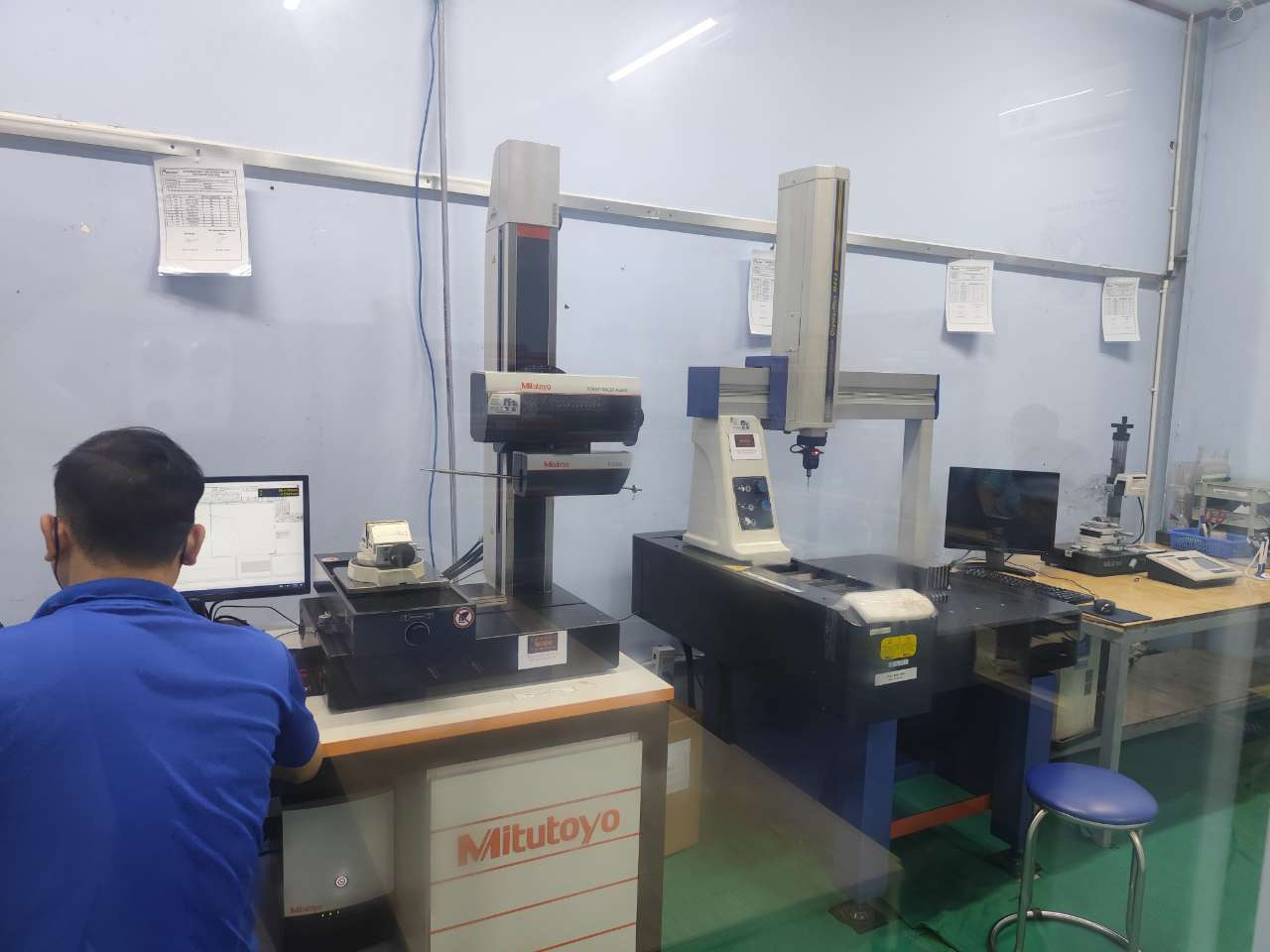
Stamping quality in Vietnam is generally strong — but it requires the same diligence as any offshore sourcing program:
What to Require from Your Supplier
- First Article Inspection Report (FAIR) — Full dimensional report on first 5–10 parts from new tooling. CMM or optical measurement on all critical dimensions. Must be approved before production starts.
- SPC during production — Statistical process control on critical dimensions. Minimum: Cpk ≥ 1.33 for key characteristics. Supplier should provide X-bar and R charts for ongoing runs.
- Die maintenance schedule — Documented preventive maintenance every 50,000–100,000 strokes. Punch sharpening intervals. Die wear tracking on critical stations.
- Material certifications — Mill test certificates for every coil. Verify chemical composition and mechanical properties match your spec. Don't accept "equivalent" without testing.
Common Quality Issues and Prevention
- Burr height creep — Burrs grow as punches wear. Set maximum burr height spec (typically ≤10% of material thickness) and require monitoring.
- Dimensional drift on formed features — Spring-back can change as die components wear. Require gauge checks every 1,000–5,000 parts on formed dimensions.
- Surface scratches — Poor coil handling or die lubrication. Specify surface quality requirements and require protective film on cosmetic surfaces.
- Mixed material — Rare but catastrophic. Require coil-level traceability and first-piece material verification (XRF or PMI) per production lot.
Lead Times: Vietnam Stamping Programs
- Die design + engineering: 1–2 weeks
- Die manufacturing (progressive, medium complexity): 4–8 weeks
- First article + approval cycle: 1–2 weeks
- Production (50,000 pcs): 2–4 weeks
- Secondary operations (plating, painting): 1–2 weeks
- Ocean freight to US West Coast: 18–22 days
- Total program launch (tooling to delivery): 10–16 weeks
Subsequent reorders: 3–6 weeks from PO to US port, depending on quantity and secondary operations.
Design Tips for Stampable Parts
- Maintain minimum bend radius. 1.0t for CRS, 1.5t for stainless, 2.0t for aluminum (where t = material thickness). Tighter bends cause cracking.
- Keep hole-to-edge distance ≥ 1.5t. Holes too close to the edge deform during blanking. For holes near bends: ≥ 2.5t + bend radius from bend line.
- Design for grain direction. Sheet metal has a rolling direction. Bends perpendicular to grain have better formability. If your part has bends in multiple directions, use 45° grain orientation or specify minimum elongation requirement.
- Avoid deep narrow slots. Punch width should be ≥ 1.5t minimum. Narrower punches break frequently, driving up tooling maintenance cost.
- Specify only what matters. Standard stamping holds ±0.1 mm on blanked features and ±0.15 mm on formed features. Tighter tolerances add secondary operations (grinding, coining) that multiply cost.
- Consider the carrier strip. Progressive die parts are connected by a carrier strip. Your part geometry must allow strip feeding — no features that trap the strip or prevent continuous feed.
Get Your Vietnam Stamping Quote
Send us your 3D CAD model and 2D drawing with material specification, annual volume estimate, and any critical tolerances or surface finish requirements. We'll return a detailed quote within 48 hours covering tooling investment, per-part pricing at your volumes, die life estimate, and complete timeline from tooling to first delivery at your US facility.
Frequently Asked Questions
What burr height should I specify on Vietnamese stamped parts?
Maximum burr height of roughly 10% of material thickness is the usual spec, and it should be written into the drawing together with a monitoring requirement. Burrs grow as punches wear, so burr height creep is a production-run problem rather than a first-article one. Pair it with gauge checks every 1,000–5,000 parts on formed dimensions.
How much more does stainless cost than steel for stamped parts?
Stainless steel carries a 2.5–3x material cost uplift over cold-rolled steel, with aluminum at 1.5–2x and brass or copper at 3–5x. Press tonnage requirements also rise 40–60% for stainless, adding machine time cost on top of material. Aluminum has its own catch: it needs TiN or DLC coated tooling to prevent galling.