How do engineering teams coordinate dual-shore component production across Asian hubs?
Engineering teams coordinate dual-shore manufacturing by combining on-the-ground purchasing and technical management centers in Singapore, Xi'an, and Ho Chi Minh City. These teams execute pre-quote DFM reviews, progressive die analysis, and ZEISS CMM inspections across regional specialized factories while maintaining unified supply contracts and structured quality protocols.
Key Takeaways
- Multi-country sourcing pairs specialized Chinese hubs for powder metallurgy and 5-axis machining with Vietnamese assembly plants and Thailand forging facilities.
- Production relocation playbooks manage 10-month transfers of stamping dies, fixtures, and quality gauges from China to Vietnam without disrupting supply chains.
- Closed-loop automotive forging and internal spline broaching hold raceway concentricity to ±0.008 mm with controlled carbonitriding case depths of 0.85 to 1.25 mm.
Managing multi-country component flows requires dedicated engineering oversight at each manufacturing stage. In Xi'an, China, a 26-person team handles pre-quote 2D/3D tolerance reviews, mold flow simulations, and PPAP Level 3 documentation across Tier-1 facilities. Simultaneously, a local team in Ho Chi Minh City oversees regional stamping, welding, and final assembly lines.
This dual-hub structure allows buyers to source high-complexity sub-components—such as sintered structural gears, high-purity PEEK fluoropolymers, or AS9100D aerospace 5-axis CNC parts—from China, while coordinating heavy assembly and shipping out of Vietnam deep-sea ports like Lach Huyen in Haiphong.
- 26-person Xi'an engineering center managing DFM reviews, tooling simulations, and ZEISS CMM dimensional inspection.
- 7-person Ho Chi Minh City team managing local stamping, die casting, welding, and assembly oversight.
- Lach Huyen deep-water container terminal in Haiphong connecting Bac Ninh and Hanoi plants directly to trans-Pacific and European shipping routes.
- Unified Singapore contracting framework providing flexible credit terms across Asian manufacturing nodes.
What technical processes support precision component migration from China to Vietnam?
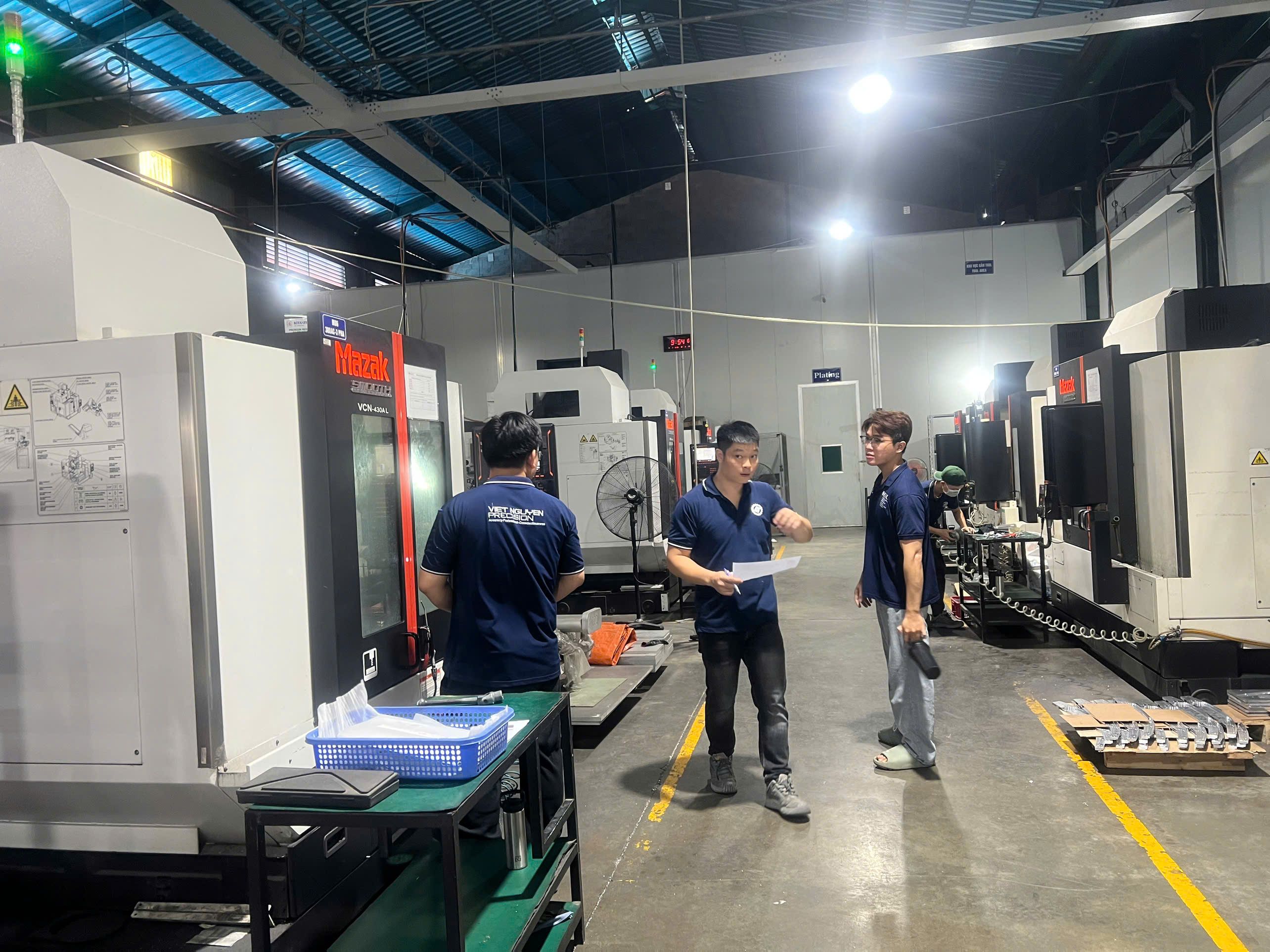
Precision component migration relies on a 10-month transfer protocol that relocates progressive stamping dies, welding fixtures, and validated inspection gauges. On-site engineers conduct pre-transfer DFM reviews, local tooling adjustments, and dimensional verification to maintain continuous output during production transfers between Chinese and Vietnamese manufacturing sites.
Shifting component production between Asian nodes demands rigorous control over tooling and quality parameters. The migration playbook transfers existing progressive stamping tooling, robotic welding cells, and retail-ready packaging systems from Chinese plants to Vietnamese facilities within a 10-month timeline.
Native engineering teams on the ground in Bac Ninh, Binh Duong, and Dong Nai oversee the installation and re-calibration of dies. By validating tooling alignment and conducting CMM metrology reports before serial production launches, suppliers eliminate supply chain blind spots and prevent translation gaps.
- 10-month line relocation process transferring stamping presses, welding cells, and inspection gauges.
- Verification of Form D, EUR-1, and CPTPP country of origin documentation for substantial transformation compliance.
- Heavy stamping and robotic MIG welding support for hardware, desk frames, and fire extinguisher brackets.
- Pre-shipment container loading audits incorporating moisture and salt-spray protection checks at deep-sea ports.
Which manufacturing parameters govern automotive forging and spline broaching in Thailand and China?
Automotive forging and spline broaching rely on a 16-stage vertically integrated process flow that maintains ±0.008 mm raceway concentricity. The sequence combines closed-die cold and warm forging, 136 robotic CNC turning centers, hydraulic pull broaching, CQI-9 controlled carbonitriding, and automated eddy-current crack sorting.
Precision driveline components, including CV joint star-shaped sleeves (#68-3 to #125) and TJ/AAR trunnion brackets, require strict process control across 16 integrated manufacturing steps. Bar cutting, isothermal annealing, and saponification prepare raw steel blanks (such as 20CrMnTi or SAE 5120H alloy steel) for closed-die forging and normalizing.
High-speed hydraulic pull broaching and hard turning on EMAG CNC centers establish tight tolerances down to ±0.008 mm. Following turning and milling, automated continuous furnaces perform CQI-9 carbonitriding to achieve a case depth of 0.85 to 1.25 mm at HRC 58–62 hardness, followed by 100% eddy-current sorting and anti-rust vacuum packaging.
The establishment of the Keminsheng Thailand facility in 2027 mirrors this 25,000 m² Ningbo HQ campus layout, enabling OEMs to validate PPAP tooling in Ningbo and transition serial shipments to Thailand.
- 16-stage integrated process flow from raw bar cutting and warm forging to vacuum anti-rust packaging.
- Raceways and internal spline pitch held to ±0.008 mm concentricity across DIN 5480 and JIS B 1603 specifications.
- CQI-9 controlled furnace carbonitriding achieving HRC 58–62 hardness and 0.85–1.25 mm case depth.
- Quality verification using ZEISS metrology labs, Mitutoyo 3D CMMs, surface roughness testing, and magnetic crack detection.

When should procurement managers integrate powder metallurgy and specialized bearing technologies?
Procurement managers should integrate powder metallurgy and specialized bearings during early DFM stages when designing high-volume structural gears, shock absorber pistons, or self-lubricating assemblies. Powder metallurgy reduces secondary machining, while oilless bronze bushings and spherical plain bearings optimize wear resistance under high mechanical loads.
Powder metallurgy (PM) and metal injection molding (MIM) offer structural efficiency for complex steel, bronze, and stainless steel parts. Facilities utilizing 15T to 500T automatic powder presses and mesh-belt sintering produce high-density sprockets, oil pump rotors, and 17-4PH/316L MIM components with minimal material waste.
For rotating and oscillating assemblies, specialized bearing manufacturing fills key mechanical requirements. Facilities produce SF-1/SF-2 PTFE composite bushings, JF-800 bimetal bearings, and JDB graphite-plugged bronze bearings, alongside large-diameter Ø200–5,000 mm slewing bearings and spherical plain bearings engineered for loads up to 74,620 kN.
- Sintered PM structural gears, shock absorber pistons, and SAE841 / Sint B50 oil-impregnated bronze bushings.
- Vacuum-sintered 304 and 316L stainless steel parts for automotive transmission sprockets and compressors.
- 17-4PH and 316L MIM components for medical, automotive, and smart lock hardware applications.
- PTFE-lined oilless bushings, bimetal bearings, and spherical plain bearings with MoS2 phosphating surface treatments.
Precision Manufacturing & Sourcing Specification Matrix
| Technical Dimension | Standard Commercial Grade | High-Precision OEM Export Grade | DEWIN Verification Protocol |
|---|---|---|---|
| Machining & Forming Tolerance | ISO 2768-m (±0.10 mm nominal) | ISO 2768-f (±0.01 mm – ±0.025 mm critical bores) | Calibrated 3D CMM & Air/Pin Gauging |
| Surface Roughness & Finish | Ra 1.6 – 3.2 µm as-machined / standard coat | Ra 0.4 – 0.8 µm precision ground / MIL-A-8625 anodized | Profilometer & Coating Thickness Gauge |
| Material & Alloy Certification | Supplier Mill Test Report (MTR) | Independent OES chemical & mechanical verification | EN 10204 3.1 + RoHS/REACH Compliance |
| Batch Inspection & Packaging | ISO 2859-1 (AQL 1.0 Major / 2.5 Minor) | Zero-defect critical features + VCI export crating | Pre-Shipment Inspection (PSI) Report |
Frequently Asked Questions
What quality metrology tools are utilized for dimensional verification across Asian plants?
Manufacturing facilities utilize 3D Coordinate Measuring Machines including ZEISS CMM and Mitutoyo Crysta-Apex S systems, contour measurement devices, surface roughness testers, and metallographic microstructure labs to verify part geometry and case depth.
How are surface treatments tested for dual-shore hardware and bracket assemblies?
Hardware products such as custom fire extinguisher brackets undergo ASTM B117 salt spray testing for over 240 hours and UV testing for up to 1,500 hours to ensure outdoor-grade durability on SPCC and SS304 steel components.
What hand pallet truck manufacturing capabilities exist in Northern Vietnam?
The Bac Ninh facility spans 16,000 m² and produces 2.0T to 5.0T hydraulic hand pallet trucks featuring robotic MIG welding, AC/DF integrated cast-iron hydraulic pumps with 100% leak testing, and direct export access through Haiphong deep-sea ports.
How does multi-country manufacturing support aerospace and fluoropolymer components?
Specialized Chinese facilities deliver AS9100D-compliant 5-axis CNC micro-machining for titanium, Inconel, and aluminum aerospace valve blocks, as well as cleanroom-molded PTFE, PEEK, PFA, and FFKM parts for high-purity applications.