I’ve watched too many purchasing managers lose months to the wrong sheet metal fabrication service provider — parts arrive warped, late, or completely off-spec.
Choose a sheet metal fabrication service provider by verifying their technical expertise against your drawings, confirming quality control processes and certifications like ISO 9001, ensuring flexible payment terms, and evaluating their track record on lead time and delivery performance before committing.
The sections below break down each critical decision factor ITAR compliance 1. I will walk you through exactly what our team looks for — and what we advise our U.S. clients to demand — when qualifying a fabrication partner in Asia.
How can I verify that a sheet metal fabricator in Asia has the technical expertise to meet my specific drawing requirements?
A lesson we learned early on: one of our clients sent drawings with tight GD&T callouts 2 to a supplier who quoted aggressively low — only to discover mid-production that the shop lacked a CNC press brake 3 accurate enough to hold ±0.1 mm bends.
Verify a fabricator's technical expertise by requesting a detailed capability matrix, reviewing sample parts against your tolerances, conducting a virtual or on-site audit of their equipment, and confirming they have engineering staff who can interpret GD&T and perform a thorough Design for Manufacturability review.

Start with a Capability Matrix
Before you send a single drawing, ask the fabricator to fill out a capability matrix. This document lists every process they can perform in-house versus what they outsource. You want clear answers on laser cutting, CNC bending, welding (MIG, TIG, robotic), hardware insertion, surface finishing, and assembly. If a shop outsources welding, that adds time and risk to your project.
Here is a basic template I recommend sharing with any potential supplier:
| Process | In-House? | Equipment Model | Max Thickness | Tolerance Achievable |
|---|---|---|---|---|
| Laser Cutting | Yes / No | — | — | ±__ mm |
| CNC Bending | Yes / No | — | — | ±__ mm |
| MIG / TIG Welding | Yes / No | — | — | Per AWS D1.1? |
| Robotic Welding | Yes / No | — | — | — |
| Hardware Insertion | Yes / No | — | — | — |
| Powder Coating / Plating | Yes / No | — | — | Mil thickness? |
| Assembly | Yes / No | — | — | — |
When our team audits a new supplier in Vietnam or elsewhere in Asia, we physically walk the shop floor and match serial numbers on machines to the capability matrix they submitted. It sounds tedious, but it catches exaggeration fast.
Evaluate Their Engineering Team
Equipment technology alone is not enough. You need people who can read your drawings critically. During our supplier qualification process, we send a moderately complex drawing and ask the fabricator's engineers to flag potential manufacturing issues. If they come back with zero questions, that is actually a red flag — it usually means nobody studied the print carefully.
Good fabricators will ask about material selection alternatives, suggest radius changes for easier bending, or flag tolerance stacks that could cause assembly problems. This kind of design assistance up front saves enormous cost downstream.
Request Sample Parts
Nothing replaces a physical sample. Ask for a first-article inspection report 4 with dimensional data mapped to every critical feature on your drawing. Compare their measurement results to your nominal values. If they cannot provide a structured FAI report, their fabrication capabilities may not match your mid-to-high quality requirements.
Prototype Before Production
Whenever possible, start with a prototype run. This lets you evaluate not just dimensional accuracy but also surface finish quality, weld appearance, and hardware press-fit integrity. Our experience exporting custom metal fabrication to the U.S. has shown us that a prototyping investment can prevent a production disaster.
What should I look for in a partner to manage my quality control and final inspections on the ground?
When we opened our Vietnam office seven years ago, the very first role we hired was a quality inspector — not a sales rep. That decision shaped everything about how we serve our U.S. clients today.
Look for a partner with a dedicated local inspection team, documented quality control processes aligned to ISO 9001, structured PPAP and first-article procedures, in-process checkpoints, and final inspection with photographic evidence and dimensional reports before any shipment leaves the factory.
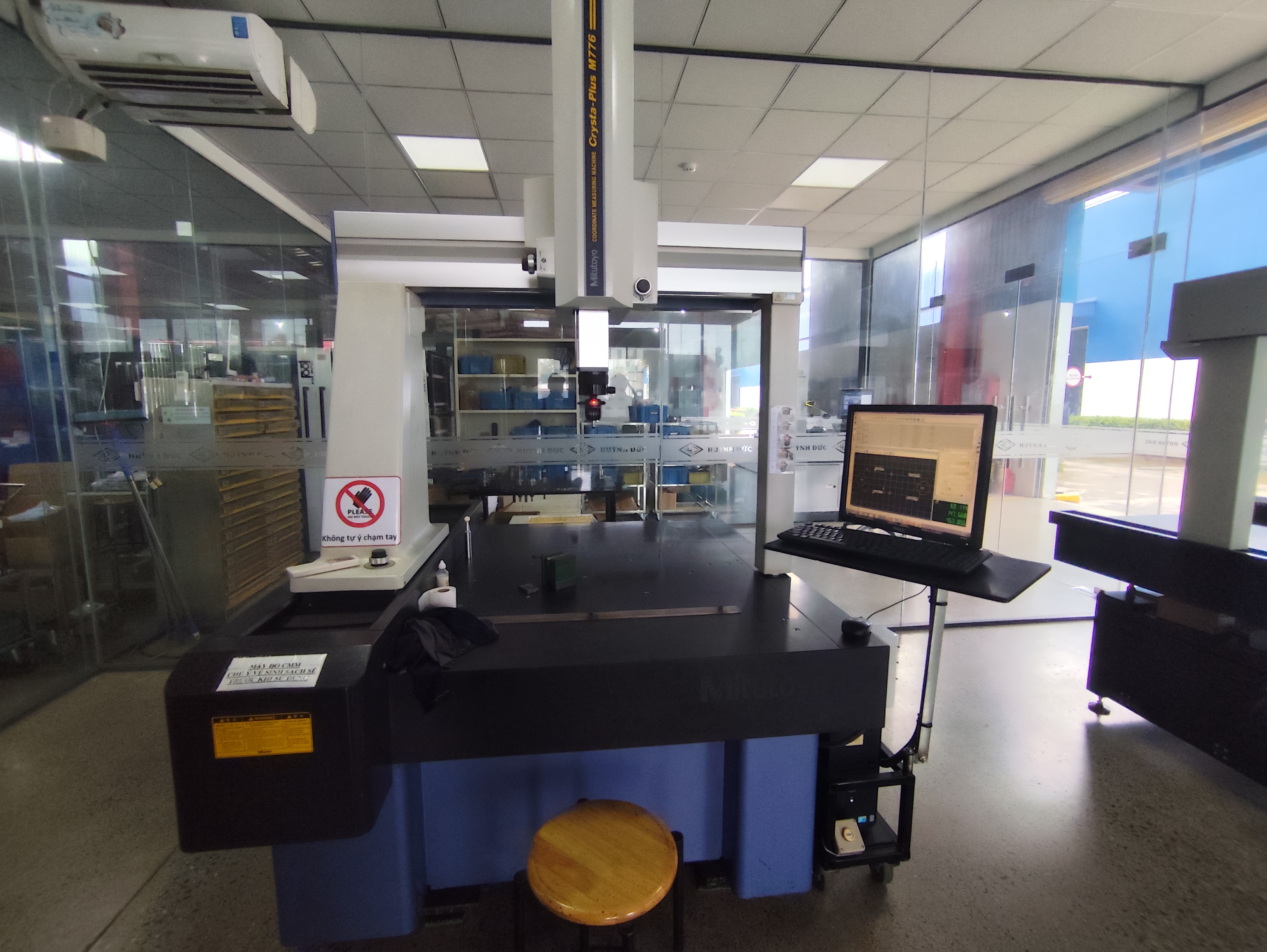
Why "On the Ground" Matters
Remote quality management sounds convenient. But sheet metal parts have nuances that photos alone cannot capture — weld penetration, burr edges, coating adhesion, hardware pull-through strength. Having inspectors physically at the factory lets you catch defects before they ship across the Pacific. Our team in Vietnam and China performs in-process checks at bending, welding, and finishing stages, not just a final gate inspection.
Industry Certifications Are Your Baseline
At minimum, your fabrication partner or their quality management partner should hold ISO 9001 5 certification. For aerospace or defense work, AS9100 6 or ITAR compliance may be required. These industry certifications are not just wall decorations. They impose documented procedures for incoming material verification, in-process control, calibration of measurement tools, and corrective action tracking.
| Quality Milestone | What to Verify | Why It Matters |
|---|---|---|
| Incoming Material | Mill certs, material grade verification | Wrong alloy = scrapped parts |
| First Article (PPAP 7) | Dimensional report, photos, material cert | Confirms process is locked in |
| In-Process Inspection | Check sheets at bending, welding, finishing | Catches drift before it compounds |
| Final Inspection | Full dimensional, visual, functional checks | Last gate before shipping |
| Packaging Audit | Correct labeling, protective packaging | Prevents transit damage |
The "Right First Time" Standard
One of the biggest pain points I hear from purchasing managers is rework. Parts arrive out of spec, and suddenly you are three weeks behind schedule negotiating replacements. The solution is building quality into the process — not inspecting it in at the end. That means your quality partner should conduct a Design for Manufacturability review 8 before production, agree on a control plan, and use statistical checks during the run. Our process control methodology focuses on preventing defects rather than just detecting them.
What to Ask During Qualification
Ask for examples of inspection reports from recent projects. Ask how they handle non-conformances. Ask what happens if a defect is found at final inspection — do they have a formal corrective action system? If the answers are vague, keep looking. A strong quality partner documents everything and communicates proactively. For a deeper dive into the qualification process, see our guide on how to evaluate sheet metal fabrication supplier capabilities and qualifications.
How do I ensure my custom parts supplier can provide the 60 to 90-day payment terms I need for my business?
A few years ago, a client in the Midwest told me bluntly: "Alan, I can find cheaper suppliers, but none of them will give me open-account terms. My cash is tied up in inventory for 90 days before my customer pays me." That conversation shaped how we structure our financial partnerships.
Ensure your supplier offers 60 to 90-day payment terms by verifying their financial stability, negotiating terms after building trust through initial orders, requesting references from clients who already receive credit terms, and working with a partner whose business model is designed to support open-account trade.
Why Payment Terms Matter for Importers
Most factories in Asia demand 30% deposit before production and 70% before shipment. That means you, the buyer, pay the full cost months before your end customer pays you. This cash flow gap is real and painful — especially for small and mid-size sourcing companies.
Open-account terms (net 60 or net 90) shift that burden. You receive the goods, sell them or deliver them to your customer, and pay the supplier afterward. It is a powerful tool for cost efficiency at the business level, not just the unit-price level.
How to Qualify for Credit Terms
Suppliers do not hand out credit to strangers. Here is a realistic path to earning extended terms:
- Start with standard payment terms. Pay T/T 30/70 or letter of credit on your first two or three orders.
- Build a track record. Pay on time every time. Communicate clearly. Show you are a reliable, repeat buyer.
- Request a credit application. A professional supplier will have a formal process — they may ask for trade references, a D&B report, or a credit limit request form.
- Negotiate incrementally. Start with net 30, then move to net 60, and eventually net 90 as the relationship deepens.
What to Look for in a Supplier's Business Model
Not every fabricator can offer credit terms. A small family-run shop with thin margins simply cannot finance your inventory. You need a partner with a business model built to support international trade finance. Our Singapore-based operation, for example, was structured from the start to provide open-account terms to qualified U.S. and European clients. We carry that working capital so our clients do not have to.
| Payment Term Type | Cash Flow Impact on Buyer | Typical Supplier Willingness |
|---|---|---|
| 100% Prepaid | Highest buyer risk | Very high — any supplier |
| 30% Deposit / 70% Before Ship | High buyer risk | Standard in Asia |
| Net 30 (Open Account) | Moderate relief | Select suppliers only |
| Net 60 (Open Account) | Significant relief | Few suppliers offer this |
| Net 90 (Open Account) | Maximum buyer flexibility | Rare — requires trust + structure |
Red Flags
If a supplier offers net 90 terms on your very first order without any credit check, be cautious. That may indicate desperation, not generosity. Legitimate credit terms come with a documented agreement, clear invoicing, and a mutual understanding of consequences for late payment.
What are the best ways to evaluate a provider's ability to prevent delivery delays and manage my supply chain logistics?
The most expensive part we ever shipped was a $200 bracket — because the delivery delay it caused shut down our client's assembly line for three days. That bracket cost our client tens of thousands in lost production time.
Evaluate a provider's delivery reliability by reviewing their on-time delivery rate over at least six months, confirming they maintain buffer stock for long-lead materials, auditing their production scheduling system, and verifying they offer end-to-end logistics management including freight forwarding and customs documentation.
Measuring Lead Time and Delivery Performance
Supplier reputation for on-time delivery is one of the most critical factors — and one of the hardest to verify before you place an order. Start by asking for their on-time delivery percentage. Any serious fabrication partner tracks this metric. If they cannot give you a number, that tells you something.
Here is how I break down lead time into its components so clients understand where delays actually happen:
| Lead Time Component | Typical Duration | Common Delay Causes |
|---|---|---|
| Material Procurement | 5–15 days | Specialty alloys, MOQ issues |
| Production (Cutting, Bending, Welding) | 7–20 days | Machine downtime, capacity overload |
| Surface Finishing | 3–7 days | Outsourced finishing queues |
| Quality Inspection | 2–5 days | Rework from failed inspections |
| Packing and Domestic Freight | 1–3 days | Packaging material shortages |
| Ocean Freight to U.S. | 18–35 days | Port congestion, vessel delays |
| Customs and Last-Mile Delivery | 3–7 days | Documentation errors, holidays |
Project Management Is the Differentiator
The best way to prevent delivery delays is proactive project management. That means your provider should send you weekly status updates — not wait for you to ask. They should flag potential delays the moment they see them, not two days before the ship date.
When we manage a production order, our team creates a detailed timeline at order confirmation. Every milestone — material arrival, first-article approval, production completion, inspection, packing, and shipping — has a target date. If material procurement slips by even two days, we escalate immediately and adjust downstream dates.
End-to-End Logistics Management
Many fabricators consider their job done when parts leave their loading dock. But for a U.S. buyer, the supply chain extends all the way to your warehouse door. Look for a partner who handles or coordinates freight forwarding 9, export documentation, customs clearance support, and even container loading supervision. This door-to-door logistics management eliminates the gaps where shipments get lost or delayed.
Risk Mitigation and Contingency Planning
Ask your provider what happens if their primary material supplier cannot deliver. Do they have backup sources? What if a machine breaks down mid-run? Do they have redundant equipment or partner shops they can shift work to? These contingency plans separate a professional supply chain partner from a shop that simply reacts to problems after they happen.
Good providers also maintain safety stock of common materials like SUS304, SGCC, or SPCC sheet in standard thicknesses. This can shave a week or more off your lead time for repeat orders. If you are sourcing sheet metal fabrication for the first time, understanding these logistics factors early will save you significant headaches down the road.
Conclusion
Choosing the right sheet metal fabrication service provider comes down to four pillars: verified technical expertise, rigorous quality control processes, flexible financial terms, and proven delivery reliability — evaluate all four before you commit.
Frequently Asked Questions
How can I verify that a sheet metal fabricator in Asia has the technical expertise to meet my specific drawing requirements?
A lesson we learned early on: one of our clients sent drawings with tight GD&T callouts 2 to a supplier who quoted aggressively low — only to discover mid-production that the shop lacked a CNC press brake 3 accurate enough to hold ±0.1 mm bends.
What should I look for in a partner to manage my quality control and final inspections on the ground?
When we opened our Vietnam office seven years ago, the very first role we hired was a quality inspector — not a sales rep. That decision shaped everything about how we serve our U.S. clients today.
How do I ensure my custom parts supplier can provide the 60 to 90-day payment terms I need for my business?
A few years ago, a client in the Midwest told me bluntly: "Alan, I can find cheaper suppliers, but none of them will give me open-account terms. My cash is tied up in inventory for 90 days before my customer pays me." That conversation shaped how we structure our financial partnerships.
Footnotes
1. Explains the International Traffic in Arms Regulations (ITAR) and compliance requirements. ↩︎
2. Authoritative source for Geometric Dimensioning and Tolerancing (GD&T) standards. ↩︎
3. Explains the working principles and applications of press brakes. ↩︎
4. Defines First Article Inspection (FAI) and its importance in quality control. ↩︎
5. Official information on the ISO 9001 quality management standard. ↩︎
6. Official information on the AS9100 quality management standard for aerospace. ↩︎
7. Replaced with a detailed explanation of the Production Part Approval Process (PPAP) from a quality consulting and training firm, as the original AIAG link was broken. ↩︎
8. Provides an overview of the Design for Manufacturability concept and its benefits. ↩︎
9. Provides a comprehensive definition and role of freight forwarding in logistics. ↩︎