
Every week, I review RFQs where the surface treatment choice alone can swing the unit price by 30% — and the wrong pick quietly destroys margins through warranty claims and field failures.
To compare sheet metal fabrication surface treatment durability and cost, evaluate each finish against your part’s service environment, base material, and total lifecycle cost — then validate supplier claims with standardized tests like salt spray, adhesion, and wear simulations before committing to production.
This guide breaks down the major surface treatments side by side. It covers real cost data, durability rankings, testing protocols, and supplier audit strategies. Whether you are sourcing powder-coated steel brackets or anodized aluminum enclosures, the framework below will help you make a confident decision.
How do I accurately compare the cost-to-durability ratio of powder coating versus plating for my custom parts?
A buyer we work with in the Midwest once asked us to quote the same mounting bracket in both powder-coated steel and zinc-plated steel. The price difference was small. The performance gap, however, was dramatic — and it only showed up after six months in the field.
To accurately compare cost-to-durability ratios, calculate the total lifecycle cost — initial finishing price plus expected maintenance, rework, and replacement — then map each option's proven performance in salt spray hours, abrasion cycles, and environmental exposure against your part's actual service conditions.

Start With the Service Environment
Before you compare any numbers, define where the part lives. A bracket inside a climate-controlled data center faces different threats than one bolted to the underside of an agricultural vehicle. Corrosion resistance 1 matters most outdoors. Wear resistance matters most for moving assemblies. Electrical conductivity matters for electronic enclosures.
I always ask our clients three questions first: Will the part see moisture or chemicals? Will surfaces slide against each other? Does the part need to conduct current or be grounded? The answers narrow the field fast.
The Big Four Treatments at a Glance
Here is a baseline comparison we share with clients during the quoting phase:
| Property | Powder Coating 2 | Type 2 Anodizing | Type 3 Anodizing (Hard Coat) | Zinc Plating 3 |
|---|---|---|---|---|
| Typical Thickness | 0.002″–0.006″ | 0.0002″–0.001″ | 0.001″–0.003″ | 5–25 µm |
| Corrosion Resistance | Excellent | Excellent | Excellent | Good (sacrificial) |
| Abrasion Resistance | Excellent | Good | Superior | Moderate |
| Electrical Conductivity | Insulative | Insulative | Insulative | Conductive |
| Relative Cost | Lowest | Mid-range | Highest | Mid-range |
| Best For | Steel & aluminum general use | Aluminum precision parts | Aluminum high-wear parts | Steel in harsh environments |
Calculating the Real Cost-to-Durability Ratio
Unit price alone is misleading. On our projects, we track what we call the "finish failure rate" — how often a treated part is rejected at incoming inspection or returned from the field. A finish that costs 15% less but fails twice as often is not cheaper. It is more expensive.
Here is a simplified formula we use:
Lifecycle Cost = (Unit Finish Cost) + (Failure Rate × Rework Cost) + (Replacement Frequency × Unit Cost)
For a steel bracket exposed to outdoor weather, powder coating often wins on initial cost and abrasion resistance. But if the part gets scratched during installation, the exposed steel corrodes quickly. Zinc plating, while slightly more expensive, offers sacrificial protection. The zinc layer corrodes instead of the steel, even at scratch points. This self-healing behavior is why many of our U.S. clients choose zinc plating for field-installed hardware.
For aluminum parts, the calculus shifts. Anodizing aluminum with a Type 2 process gives you a clean aesthetic, tight dimensional control, and solid chemical resistance at a mid-range price. Type 3 hard coat anodizing costs more, but it is the safest all-around choice when you need both corrosion and wear resistance. We have seen Type 3 parts survive over 1,000 hours of salt spray testing 4 without visible degradation.
When Powder Coating Fails — and When It Doesn't
Powder coating creates a thick, tough barrier. It handles UV, rain, and general abrasion well. For production volume runs of steel enclosures and housings, it is hard to beat on cost. Lead times tend to be shorter because the process is straightforward and widely available.
But powder coating is a barrier coating, not a sacrificial one. Once the barrier is breached — by a deep scratch, a chip, or a fastener hole — the underlying metal is fully exposed. In corrosive environments, this leads to rapid, localized corrosion that spreads under the coating. I have personally inspected parts where a single scratch turned into a rust streak across an entire panel within weeks.
The takeaway: powder coating is excellent when physical damage is unlikely. For parts that get handled roughly, shipped without protection, or assembled with self-tapping screws, consider zinc plating or a hybrid approach.
Which surface treatment will provide the corrosion resistance I need without significantly increasing my unit price?
Last quarter, our engineering team in Vietnam reviewed a project for industrial mounting brackets — the exact type of heavy-duty, multi-bend components with pre-drilled mounting holes that you see in precision sheet metal work. The client needed strong corrosion resistance but had a firm target price. We had to find the sweet spot.
The best corrosion-resistant treatment within budget depends on your base metal: for steel, zinc plating or e-coating delivers strong protection at mid-range cost; for aluminum, Type 2 anodizing offers excellent corrosion and chemical resistance without the premium price of hard coat anodizing.
Material Selection Drives the Decision
You cannot separate the finish from the base metal. Galvanizing steel is fundamentally different from anodizing aluminum. Each metal has its own oxide behavior, and each finish bonds differently.
For steel parts, the practical options are:
- Zinc plating — sacrificial protection, mid-range cost, conductive
- Powder coating — barrier protection, lowest cost, insulative
- E-coating — thin, uniform barrier, good for complex shapes
- Zinc + chromate conversion — enhanced corrosion protection with conductivity
For aluminum parts:
- Type 2 anodizing — integral oxide layer, mid-range cost, excellent corrosion resistance
- Type 3 anodizing — thicker oxide, highest cost, best wear and corrosion resistance
- Chromate conversion — very thin, conductive, moderate corrosion protection
Matching Corrosion Protection to Environmental Exposure
Not all corrosion environments are the same. Indoor dry environments need minimal protection. Coastal or chemical-plant environments demand aggressive treatment. Here is how we guide clients through material selection:
| Environment | Steel Recommendation | Aluminum Recommendation | Expected Salt Spray Hours |
|---|---|---|---|
| Indoor, climate-controlled | Powder coating or chromate | Chromate conversion | 96–200 |
| Indoor, occasional moisture | Zinc plating | Type 2 anodizing 6 | 200–500 |
| Outdoor, temperate climate | Zinc plating + chromate | Type 2 anodizing | 500–750 |
| Outdoor, coastal or chemical | E-coating + powder coating | Type 3 anodizing | 750–1,500+ |
| Submerged or constant wet | Hot-dip galvanizing | Type 3 anodizing + sealant | 1,500+ |
The Hidden Value of Surface Preparation
One lesson I learned early: the best finish in the world fails if the surface preparation is poor. Before any coating or plating, the base metal must be clean, free of oils, and properly etched or blasted. In our supplier audits, surface preparation is the first thing we check. A supplier who rushes this step will produce parts that look fine initially but delaminate or blister within months.
For the electroplating process, surface prep includes degreasing, acid pickling, and sometimes mechanical abrasion. For powder coating, it includes chemical wash and sometimes sandblasting. Each step matters. Skipping one can cut the salt spray performance in half.
Budget-Conscious Strategies
If your budget is tight, consider these approaches:
- Use zinc plating instead of hot-dip galvanizing for steel parts — you get 80% of the corrosion protection at 50% of the cost.
- Specify Type 2 anodizing instead of Type 3 for aluminum parts that do not need extreme wear resistance.
- For high-production volume runs, powder coating is almost always the cheapest per-unit option and still delivers excellent corrosion and chemical resistance.
- Ask your supplier about e-coating for complex geometries — the electrocoat reaches inside channels and recesses that powder coating cannot cover evenly.
How can I verify that my supplier is performing the correct durability tests to prevent quality issues down the line?
During a recent supplier audit at a plating facility in Vietnam, I asked to see their salt spray test records. The quality manager handed me a folder of results — but the test duration was only 24 hours. The client's specification called for 500 hours. That single discrepancy could have caused a full container of rejected parts.
To verify correct durability testing, require your supplier to share certified test reports referencing specific standards — such as ASTM B117 for salt spray, ASTM D3359 for adhesion, and ASTM G99 for wear — and cross-check test parameters including duration, temperature, and acceptance criteria against your own part specifications.
The Three Core Tests You Must Require
Every surface treatment should be validated by at least three types of tests. Here is what each one tells you:
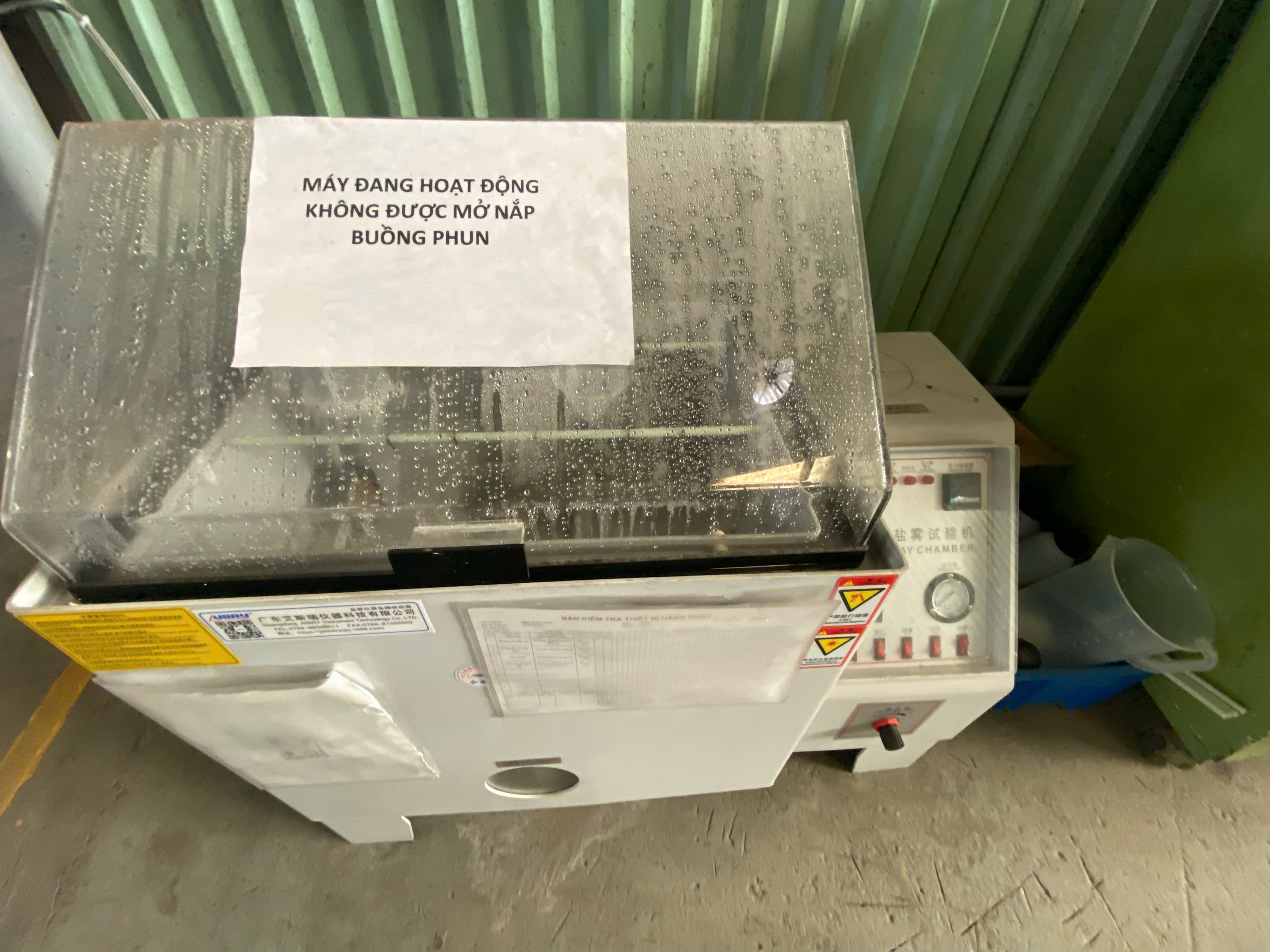
Salt Spray Testing (ASTM B117): This is the standard corrosion resistance test. Parts are placed in a chamber with a continuous salt fog at 35°C. The test runs for a specified number of hours — typically 96, 200, 500, or 1,000 — and the parts are inspected for red rust (on steel) or white corrosion (on aluminum). The longer the part survives without corrosion, the better the finish.
Adhesion Testing (ASTM D3359 — Cross-Cut Method): A grid pattern is cut through the coating with a sharp blade, adhesive tape is pressed onto the grid, and then pulled off. The amount of coating that lifts with the tape indicates adhesion quality. Adhesion Testing 7 A rating of 4B or 5B means excellent adhesion. Anything below 3B is a red flag.
Wear/Abrasion Testing (ASTM G99 or Taber Abrasion): A controlled abrasive wheel or pin is pressed against the coated surface under a set load. The weight loss or wear depth after a set number of cycles indicates wear resistance. This is critical for parts with sliding contact. Wear/Abrasion Testing 8
What to Look for in Test Reports
Not all test reports are equal. When our team reviews supplier documentation during PPAP, we verify:
- The test standard referenced matches the client's specification
- The test duration and conditions are clearly stated
- The number of samples tested is statistically meaningful
- Pass/fail criteria are defined and met
- The testing lab is accredited or the equipment is calibrated
A supplier who cannot produce these details is either not testing properly or not testing at all.
Real-World Validation Beyond Lab Tests
Lab tests simulate conditions, but they do not replicate real life perfectly. I always recommend that clients request a small pilot batch of finished parts and expose them to their actual service conditions for a defined period. For outdoor brackets, this might mean bolting a few samples to an outdoor structure and inspecting them monthly. This kind of field validation catches issues that no accelerated test can predict — such as galvanic corrosion from contact with dissimilar metals, or coating damage during normal assembly.
Our process control approach includes requiring first-article inspection with full test data before mass production. This gives both us and the client confidence that the finish will perform as expected in the field.
What are the most effective ways for me to audit a supplier's surface treatment process to ensure long-term reliability?
The most revealing moment in any factory audit is not the tour of the production floor. It is the conversation about rejected parts. When I ask a supplier, "Show me your last three rejection reports for surface treatment," the response tells me everything about their quality culture.
The most effective audit methods include reviewing the supplier's process control documentation, inspecting their surface preparation and coating equipment, verifying calibration records for testing instruments, evaluating their corrective action history, and confirming relevant certifications such as ISO 9001 or NADCAP for specialty processes.

Building Your Audit Checklist
A thorough surface treatment audit covers five areas. Here is the checklist we use when qualifying suppliers across Vietnam and other Asian sourcing markets:
| Audit Area | Key Questions | What to Verify |
|---|---|---|
| Process Documentation | Is there a written procedure for each treatment? | Standard operating procedures, work instructions, flow charts |
| Equipment Condition | Is equipment maintained and calibrated? | Calibration stickers, maintenance logs, oven temperature charts |
| Chemical Management | Are bath chemistries monitored? | Titration records, replenishment schedules, drag-out controls |
| Quality Records | Are test results traceable to specific lots? | Salt spray logs, adhesion test records, lot tracking systems |
| Corrective Actions | How does the supplier handle failures? | 8D reports, root cause analyses, customer complaint logs |
Process Control Is the Differentiator
Any supplier can buy a powder coating line or an anodizing tank. What separates a reliable supplier from a risky one is process control. This means they monitor critical variables — bath temperature, coating thickness, cure time, chemical concentration — and they react when something drifts out of range.
On our supplier visits, we look for control charts posted at workstations. We check if operators know their tolerance ranges. We ask to see the last time a batch was held or reworked due to an out-of-spec reading. Suppliers with strong process control catch problems before they ship. Suppliers without it rely on final inspection, which is too late.
Environmental and Regulatory Compliance
Surface treatment processes generate chemical waste. Responsible suppliers treat and dispose of waste properly. They also comply with environmental regulations such as REACH and RoHS, which restrict hazardous substances in finished products. For U.S.-bound parts, this compliance is not optional — it is a requirement.
During audits, we verify that the supplier holds valid environmental permits and that their wastewater treatment system is operational. We also confirm that chromate conversion coatings, if used, comply with current hexavalent chromium restrictions. Many buyers overlook this area, but non-compliance can result in shipment delays, customs holds, or product recalls.
The Repair and Rework Question
One topic buyers rarely raise — but should — is the ease of repair. If a coated part is damaged during shipping or assembly, can the finish be touched up? Powder coating can be spot-repaired with some effort, but the repaired area may not match the original in thickness or adhesion. Anodized surfaces are extremely difficult to repair locally. Zinc plating can sometimes be re-plated, but it requires stripping the original layer first.
Understanding repairability affects your total lifecycle cost calculation. It also influences how you package and handle finished parts. We build packaging specifications into every project specifically to minimize coating damage in transit, because prevention is always cheaper than rework.
Conclusion
Comparing sheet metal fabrication 10 surface treatment durability and cost requires a disciplined framework — match the finish to your service environment, validate with standardized tests, and audit your supplier's process control to ensure long-term reliability.
Frequently Asked Questions
How do I accurately compare the cost-to-durability ratio of powder coating versus plating for my custom parts?
A buyer we work with in the Midwest once asked us to quote the same mounting bracket in both powder-coated steel and zinc-plated steel. The price difference was small. The performance gap, however, was dramatic — and it only showed up after six months in the field.
Which surface treatment will provide the corrosion resistance I need without significantly increasing my unit price?
Last quarter, our engineering team in Vietnam reviewed a project for industrial mounting brackets — the exact type of heavy-duty, multi-bend components with pre-drilled mounting holes that you see in precision sheet metal work. The client needed strong corrosion resistance but had a firm target price. We had to find the sweet spot.
How can I verify that my supplier is performing the correct durability tests to prevent quality issues down the line?
During a recent supplier audit at a plating facility in Vietnam, I asked to see their salt spray test records. The quality manager handed me a folder of results — but the test duration was only 24 hours. The client's specification called for 500 hours. That single discrepancy could have caused a full container of rejected parts.
Footnotes
1. Provides a clear definition and explanation of corrosion resistance. ↩︎
2. Provides a comprehensive definition and overview of powder coating. ↩︎
3. Describes a common electrochemical process for corrosion protection. ↩︎
4. Describes the standard method for evaluating corrosion resistance. ↩︎
5. Defines the comprehensive cost over a product’s entire life. ↩︎
6. Explains a standard sulfuric acid anodizing process for aluminum. ↩︎
7. Describes the standard method for evaluating coating adhesion. ↩︎
8. Describes the standard method for evaluating resistance to wear. ↩︎
9. International standard for quality management systems. ↩︎
10. Provides a clear definition and overview of sheet metal fabrication. ↩︎