

Last quarter, a client sent us brackets that needed a brushed matte face and a zinc-nickel plated back — and their previous supplier had ruined two production runs because the plating chemicals attacked the brushed finish.
To confirm multiple surface treatment options from a stamping parts supplier, you must audit their masking and protection strategies, verify process sequencing through DFM reviews, request salt spray testing and coating thickness data, and validate quality with First Article Inspection reports — not just check a capability list on their website.
This guide walks you through every step of that verification process ISO 9001 1. We will cover how to evaluate real capability, what to put in your RFQ, how to validate quality before mass production, and the right questions to prevent delays.
How Do I Know Which Surface Treatment Options a Stamping Supplier Can Actually Deliver?
A buyer once told me he picked a supplier because their website listed twelve finishing options. Then he learned they outsourced ten of them to shops with no quality controls.
You confirm a supplier's real surface treatment capability by auditing their in-house equipment, inspecting their sub-contractor partnerships, reviewing IATF 16949 or ISO 9001 certifications, and requesting documented process flows — including masking, cleaning, and drying protocols — for each specific treatment they claim to offer.

Why a "Menu" Does Not Equal Capability
Many stamping suppliers list services like anodizing, powder coating finishes, electroplating specifications, and passivation process options on their brochure. But listing a service and delivering it at production scale are two different things.
When we audit suppliers across Vietnam and China for our U.S. clients, we look beyond the menu. We check chemical bath concentrations, filtration systems, temperature controls, and rack maintenance logs. A supplier who cannot show you their bath monitoring records probably cannot hold consistent coating thickness across a 50,000-piece run.
In-House vs. Partnered Services
Some suppliers handle deburring and cleaning in-house but outsource plating or e-coating. That is not automatically a problem — but it creates a gap in traceability. You need to verify who the sub-contractor is, what certifications they hold, and how the stamping supplier manages the handoff.
| Capability Area | In-House Advantage | Partnered Advantage |
|---|---|---|
| Electroplating | Tighter process control, faster turnaround | Access to specialized bath chemistries |
| Powder Coating | Consistent color matching across batches | Lower capital investment for the stamper |
| Passivation | Direct integration with stamping line | Specialized expertise for exotic alloys |
| E-Coating | Uniform coverage control | Dedicated ovens and conveyor systems |
The Certification Baseline
For automotive or high-reliability sectors, IATF 16949 2 certification is the minimum. But do not stop there. A second-party audit that inspects die maintenance, First Article Inspection rigor, and nonconforming product handling tells you far more than a certificate on a wall.
We also verify coil or blank traceability. If a supplier cannot link a specific part to a specific material lot, you cannot confirm material compatibility with the chosen surface treatment. That is a basic requirement, and it surprises me how many suppliers fail it.
Pre-Plating vs. Post-Plating: A Real Decision
Pre-plating means treating the raw coil or blank before stamping. It is often cheaper and faster for high volumes. Post-plating treats the finished stamped part. It costs more but delivers better appearance and corrosion resistance for harsh environments.
| Factor | Pre-Plating | Post-Plating |
|---|---|---|
| Cost | Lower | Higher |
| Appearance Quality | Moderate (stamping may scratch coating) | Superior (treats final geometry) |
| Corrosion Resistance | Adequate for mild environments | Better for harsh or outdoor use |
| Tolerance Impact | Minimal (coating applied before forming) | Must account for added coating thickness |
| Best For | High-volume commodity parts | Appearance-critical or high-corrosion parts |
The right choice depends on function, environment, and cost — a formula we walk through with every client during project kickoff.
What Should I Include in My RFQ to Compare Surface Treatment Options Accurately?
During a recent project involving mounting brackets for an industrial electronics enclosure, we discovered that the client's original RFQ said only "zinc plating." Three suppliers quoted three completely different processes — electrogalvanizing, hot-dip galvanizing 3, and zinc-nickel plating — with wildly different costs and performance.
Your RFQ should specify the exact surface treatment method, required coating thickness range, salt spray testing hours, adhesion test standards, surface roughness values, RoHS compliance requirements, and any ASTM standards — so every supplier quotes against the same measurable criteria.
The Cost of Vague Specifications
When an RFQ says "corrosion-resistant finish," it invites confusion. One supplier quotes a basic clear zinc at $0.02 per part. Another quotes zinc-nickel at $0.12 per part. Both technically meet the vague spec, but the performance gap is enormous. You lose the ability to make an apples-to-apples comparison, and you risk selecting a supplier whose low price reflects an inadequate treatment.
What Specific Data Points to Include
Here is what we recommend every RFQ contain for each surface treatment option:
- Treatment method: Name the exact process (e.g., "trivalent chromium passivation over zinc electroplating" — not just "zinc plating").
- Coating thickness: Specify a range in microns (e.g., 8–12 µm for electrogalvanizing).
- Salt spray testing requirement: State the minimum hours (e.g., 720 hours for zinc-nickel per ASTM B117 4).
- Adhesion standard: Reference the cross-cut test per ASTM D3359 5 or a pull-off test.
- Surface roughness: Provide Ra or Rz values if the surface is functional or visible.
- Environmental compliance: State RoHS compliance 6, REACH, or any restriction on hexavalent chromium.
- Hydrogen embrittlement relief: For high-strength steels undergoing electroplating, require baking certification (typically 190°C for 4+ hours within 4 hours of plating).
A Comparison Table for Your RFQ
This table helps you benchmark what to expect from common treatments. Include it in your RFQ as a reference so suppliers understand your performance expectations.
| Treatment | Typical Thickness (µm) | Salt Spray Hours | Relative Cost | Best Application |
|---|---|---|---|---|
| Electrogalvanizing (EG) | 5–20 | 240–500 | Low | Indoor, mild environments |
| Hot-Dip Galvanizing | 45–85 | 1,000–2,000 | Medium-High | Outdoor, structural |
| Zinc-Nickel Plating | 8–15 | 720–1,000 | High | Automotive, under-hood |
| E-Coating | 15–25 | 500–1,000 | Medium | Uniform coverage, complex shapes |
| Powder Coating Finishes | 60–120 | 500–1,500 | Medium | Aesthetic + corrosion protection |
DFM Integration Saves Money
Surface treatment options must be discussed during the Design for Manufacturability phase. If you wait until after tooling is cut, you may discover that a tight tolerance zone cannot accommodate the 60–120 µm build-up of powder coating. Or that a bend radius is too sharp for uniform e-coat coverage.
We build this DFM discussion into every project timeline. Our engineers review drawing tolerances against the added thickness of each proposed treatment. This step alone has prevented costly rework on dozens of programs. When you include surface treatment requirements in your RFQ from day one, suppliers can factor them into tooling design, material selection, and pricing — all before a single die is cut.
How Can I Verify Consistent Quality Across Different Surface Finishes Before Mass Production?
One lesson that stays with me: we once received sample brackets where the zinc plating looked perfect on flat surfaces but had bare spots inside a tight 90-degree bend. The supplier had passed their own internal visual inspection. Our team caught it during a cross-sectional metallographic analysis.
You verify consistent quality by requiring First Article Inspection reports for each surface finish, conducting salt spray testing and adhesion tests per ASTM standards, measuring coating thickness with calibrated gauges on critical zones, and checking surface roughness with a profilometer — all before approving mass production.

The Four Tests You Cannot Skip
Every surface treatment requires a specific set of validation tests. Visual inspection alone is not enough. Here is the minimum testing protocol we enforce at our inspection offices:
1. Coating Thickness Measurement
Use magnetic or eddy-current thickness gauges on multiple points — flat areas, bends, edges, and recesses. Coating thickness often varies dramatically across complex geometries. For hot-dip galvanizing, you expect 45–85 µm on flat areas but possibly much less on sharp edges.
2. Salt Spray Testing
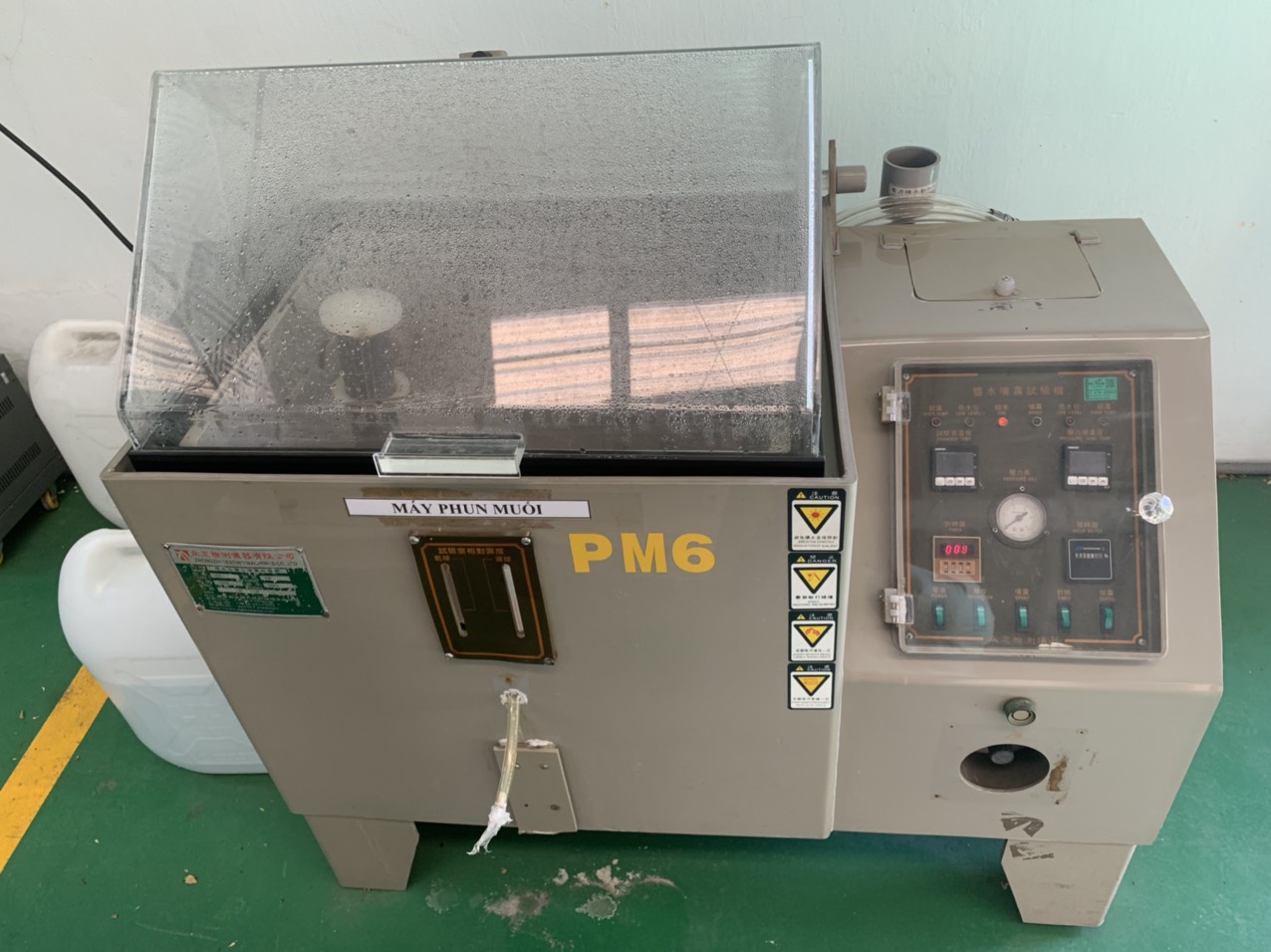
This is the standard for evaluating corrosion resistance. Parts are placed in a salt fog chamber per ASTM B117. The number of hours before white rust or red rust appears determines the rating. Always ask: "Has the powder coating passed the salt spray test? For how many hours? Can you share the lab report?"
3. Adhesion Testing
A cross-cut test (ASTM D3359) or pull-off test confirms the coating bonds properly to the substrate. Poor cleaning before treatment — failure to remove stamping compounds and mill oils — is the number one cause of adhesion failure.
4. Surface Roughness Measurement
For parts where the surface finish is functional (friction surfaces, sealing areas) or visible (consumer-facing brackets), measure Ra, Rz, and Rmax values with a profilometer. Contact stylus methods work for machined or stamped surfaces. Optical methods are better for delicate coatings that could be scratched by a stylus.
Masking and Multi-Finish Validation
When a part needs two different finishes — say, a brushed aesthetic face and a zinc-plated corrosion barrier on the back — the masking protocol becomes critical. The supplier must demonstrate:
- What masking material they use (tape, plugs, liquid mask, custom fixtures)
- Where the mask boundaries fall and how they prevent chemical bleed-through
- How they inspect the boundary after the second treatment
We ask for photos of the masked parts during production, not just the final result. This gives us confidence that the process is repeatable.
AQL Sampling for Production Runs
For high-volume stamping parts, implement an Acceptable Quality Level sampling plan. We typically use AQL 1.0 for critical surface defects (bubbles, cracks, peeling, pinholes) and AQL 2.5 for minor cosmetic variations. Inspectors must wear clean gloves and use proper lighting — we have caught defects that were invisible under factory fluorescents but obvious under angled LED inspection lamps.
Emerging Trend: Surface Intelligence
The industry is shifting toward quantifying chemical surface quality — measuring molecular bonding ability rather than relying on visual checks alone. Contact angle measurement 7 and surface energy testing are becoming standard tools in advanced quality programs. This trend helps predict adhesion performance before coating application, catching problems at the cleaning stage rather than after finishing.
What Questions Should I Ask to Avoid Delays When Multiple Surface Treatments Are Involved?
A trade-off we weigh on nearly every multi-finish project: speed versus risk. Rushing a dual-treatment bracket through production without confirming the process sequence once cost a client six weeks of delay and a full batch scrap.
Ask your supplier about their exact process sequence for multiple treatments, lead time for each step including curing and baking, capacity constraints at sub-contractors, hydrogen embrittlement relief protocols for high-strength steels, and their contingency plan if one treatment fails quality checks mid-production.

The Right Questions, in the Right Order
Here are the specific questions we have learned to ask — and the reason each one matters:
Q1: What is your exact process sequence for this part?
The cleaning-sealing-rinsing-drying sequence must happen before any coating. If a part needs both mechanical polishing and electroplating, the order matters. Polishing after plating destroys the plating. The supplier should provide a written process flow showing every step.
Q2: What is the lead time for each treatment step, including curing?
Powder coating requires oven curing at 180–200°C for 10–20 minutes. E-coating needs a separate bake cycle. Zinc-nickel plating on high-strength steel requires a hydrogen embrittlement 8 bake at 190°C for at least 4 hours within 4 hours of plating. Each step adds time. If the supplier outsources even one step, transit time between facilities adds more.
Q3: Do you have capacity constraints at your sub-contractors?
This is the question most buyers forget. Your supplier may have plenty of stamping capacity, but if their plating partner is running at 95% utilization, your job gets pushed back. We always ask for the sub-contractor's current capacity utilization and their commitment to your timeline in writing.
Q4: How do you handle a quality failure mid-production?
If the first 5,000 parts pass plating but the next 2,000 fail adhesion, what happens? Does the supplier have a nonconforming product procedure? Can they segregate, rework, or re-plate? Or does the entire batch ship and become your problem? This question separates professional suppliers from risky ones.
Q5: Are you compliant with "Green Finishing" standards?
Regulatory requirements are tightening. The transition from hexavalent chromium 9 to trivalent chromium is already mandated in many automotive programs. RoHS compliance is non-negotiable for electronics. Ask upfront. Discovering a compliance gap after production is far more expensive than asking the question during quoting.
The 4-Step Cleaning Sequence That Prevents Most Failures
Nearly every surface treatment failure we have investigated traces back to inadequate cleaning. The correct pre-treatment sequence is:
- Cleaning: Remove all stamping compounds, mill oils, and metal fines using alkaline or solvent-based cleaners.
- Sealing: Apply an organic or inorganic sealer appropriate for the substrate and subsequent treatment.
- Rinsing: Use deionized water to remove all chemical residues.
- Drying: Oven dry or forced-air dry to eliminate moisture before coating.
If a supplier cannot describe this sequence in detail for your specific part, that is a red flag.
Hydrogen Embrittlement: The Hidden Killer
For high-strength steel stampings (typically above 1,000 MPa tensile strength) that undergo electroplating, hydrogen embrittlement is a real risk. Hydrogen atoms absorbed during the plating process can cause delayed brittle fracture — sometimes weeks after the parts are installed. The solution is a mandatory baking step. Always require a hydrogen embrittlement relief certification for affected parts. This is not optional; it is a safety-critical requirement.
Conclusion
Confirming multiple surface treatment options from a stamping parts supplier requires more than reviewing a brochure. Audit their real processes, specify measurable criteria in your RFQ, validate quality with testing data, and ask the tough operational questions before production begins. For a deeper look at the best surface treatment options for sheet metal fabrication, understanding which finishes suit your application is essential. You can also learn more about how to evaluate plating and anodizing capabilities when sourcing sheet metal fabrication to strengthen your supplier assessment process. And if appearance is a key requirement, reviewing which surface treatments best meet OEM stamping parts appearance requirements will help you align finish selection with end-use expectations.
Frequently Asked Questions
How Do I Know Which Surface Treatment Options a Stamping Supplier Can Actually Deliver?
A buyer once told me he picked a supplier because their website listed twelve finishing options. Then he learned they outsourced ten of them to shops with no quality controls.
What Should I Include in My RFQ to Compare Surface Treatment Options Accurately?
During a recent project involving mounting brackets for an industrial electronics enclosure, we discovered that the client's original RFQ said only "zinc plating." Three suppliers quoted three completely different processes — electrogalvanizing, hot-dip galvanizing 3 , and zinc-nickel plating — with wildly different costs and performance.
How Can I Verify Consistent Quality Across Different Surface Finishes Before Mass Production?
One lesson that stays with me: we once received sample brackets where the zinc plating looked perfect on flat surfaces but had bare spots inside a tight 90-degree bend. The supplier had passed their own internal visual inspection. Our team caught it during a cross-sectional metallographic analysis.
Footnotes
1. Official ISO page defining the quality management certification mentioned for suppliers. ↩︎
2. Explains the automotive quality certification referenced as a supplier capability baseline. ↩︎
3. Background on this specific zinc coating process listed among treatment options. ↩︎
4. Direct standard reference for the salt spray testing method discussed repeatedly. ↩︎
5. Standard specification for the adhesion cross-cut test method cited in the article. ↩︎
6. Official European Commission landing page for the RoHS directive and hazardous substance restrictions. ↩︎
7. Explains the surface science technique used in emerging quality intelligence testing. ↩︎
8. Background on the metallurgical failure mechanism central to the plating safety discussion. ↩︎
9. Official OSHA resource detailing health risks and safety standards for industrial hexavalent chromium exposure. ↩︎