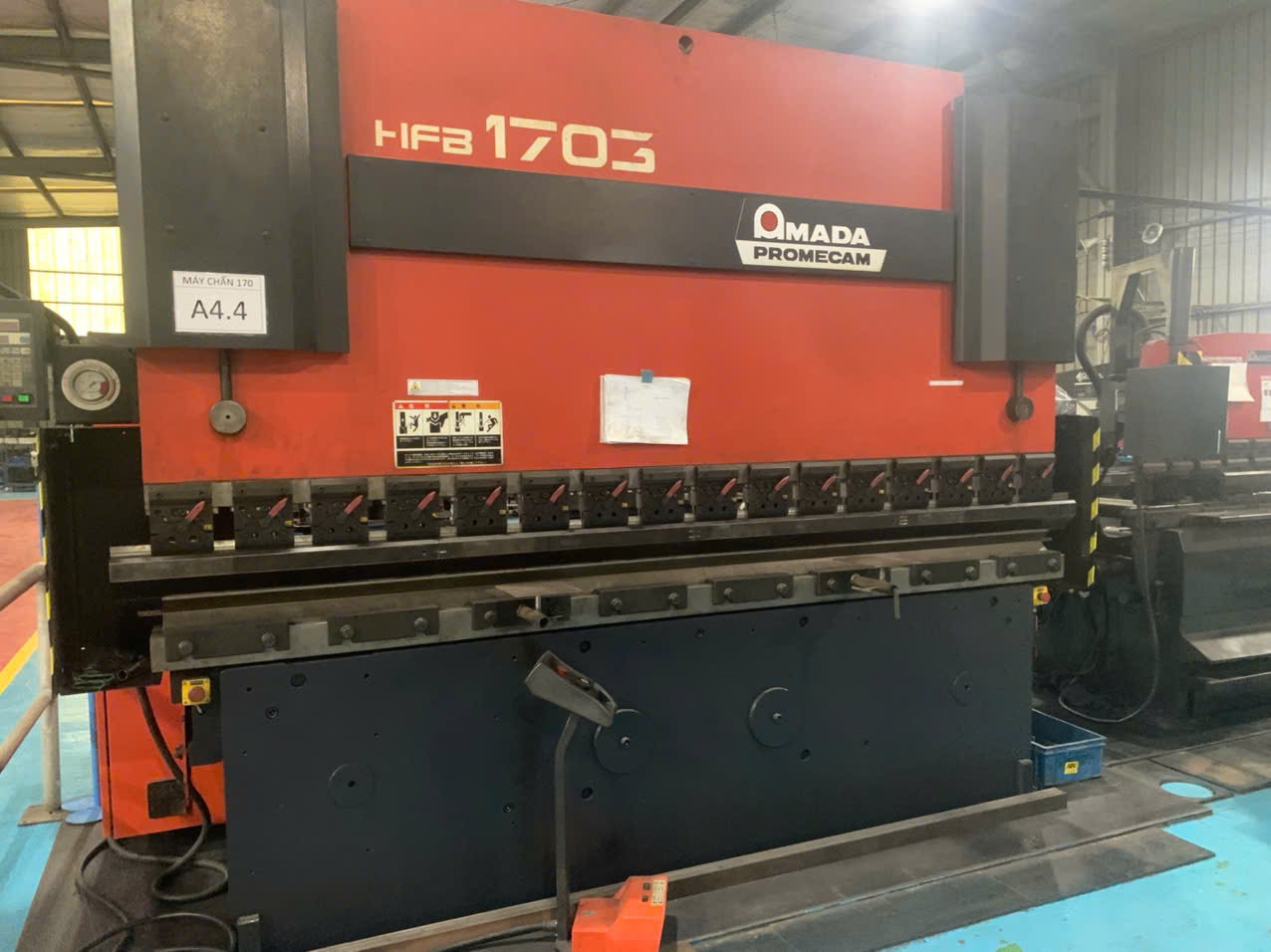

Evaluating CNC press brake tonnage and stroke is a question that hits our desks at DEWIN almost weekly, especially from U.S. purchasing managers sourcing heavy-gauge brackets and deep-box enclosures from Asian suppliers first-article inspection 1. The problem is real: specify too little tonnage and your parts come back with inconsistent bend angles, cracked flanges, or worse — a supplier who quietly maxes out their machine and ships you borderline product. The agitation compounds when you realize that a single miscalculation on stroke clearance can force an entire production run into rework, eating into your timeline and budget. The solution starts with understanding the math behind forming force calculation 2, matching it against your supplier’s actual equipment, and building a verification checklist before the first piece of metal is bent.
To evaluate CNC press brake tonnage and stroke, calculate the required bending force using material thickness squared, tensile strength, bend length, and V-die opening, then select a machine rated 20–30% above that figure while confirming the ram stroke accommodates your deepest flange height and tool clearance.
Below, we break this process into practical steps you can apply immediately — whether you are reviewing a supplier’s equipment list or specifying requirements in an RFQ.
How do I calculate the exact tonnage my supplier needs to bend my thickest sheet metal parts?
A lesson we learned early when coordinating heavy-gauge bracket production in Vietnam: if you rely on a supplier's word alone for tonnage capacity, you may not discover a shortfall until bent parts arrive out of spec. Running your own numbers first is non-negotiable.
To calculate exact tonnage, use the formula P = 650 × S² × L × (Tensile Strength / 60,000) / V, where S is material thickness in inches, L is bend length in feet, and V is the V-die opening in inches, then add a 20–30% safety margin to account for material variability.

Breaking Down the Core Formula
The formula looks dense at first glance, but each variable maps to something you already know from your part drawing and material specification.
- S (material thickness): Measured in inches. This value is squared in the formula, which means small increases in thickness cause large jumps in required force. Doubling the thickness from 0.125 in to 0.250 in quadruples the tonnage contribution from thickness alone.
- L (bend length): The contact length between punch and die, measured in feet. Longer bends need proportionally more force.
- V (V-die opening): The width of the die opening, measured in inches. A wider opening reduces tonnage but increases the inside bend radius. The standard die selection rule for air bending 3 is 8 to 10 times the material thickness 4.
- Tensile Strength: The material's resistance to being pulled apart, in PSI. Mild steel 5 sits around 60,000 PSI, stainless steel around 85,000–95,000 PSI, and aluminum around 30,000–45,000 PSI.
Step-by-Step Calculation Example
Let's walk through a real scenario similar to a mounting bracket project we managed last quarter.
| Step | Action | Value |
|---|---|---|
| 1 | Identify material | Mild steel, 60,000 PSI tensile |
| 2 | Measure thickness (S) | 0.135 in (10-gauge) |
| 3 | Square the thickness | 0.135² = 0.01823 |
| 4 | Determine bend length (L) | 7.5 ft (90 inches) |
| 5 | Select V-die opening 6 (V) | 1.0 in (≈ 8× thickness) |
| 6 | Apply formula: 650 × 0.01823 × 7.5 × 1.0 / 1.0 | ≈ 88.9 tons |
| 7 | Add 20% safety margin | 88.9 × 1.2 ≈ 107 tons |
So for this job, you need a supplier with at least a 110-ton press brake. If they only have a 100-ton machine, they are operating at the limit — a recipe for inconsistent results and premature tooling wear.
Material Factor Adjustments
Not all metals bend alike. The material factor is simply the ratio of your material's tensile strength 7 to 60,000 PSI.
| Material | Typical Tensile Strength (PSI) | Material Factor |
|---|---|---|
| Mild steel (AISI 1035) | 60,000 | 1.00 |
| 304 Stainless steel | 85,000 | 1.42 |
| 6061-T6 Aluminum | 45,000 | 0.75 |
| High-strength steel (HSLA) | 80,000 | 1.33 |
| Hardox 400 | 125,000 | 2.08 |
Multiply your base tonnage by this factor. For stainless steel brackets, for instance, you need roughly 42% more force than for the same geometry in mild steel. We always flag this in our supplier audits — some shops quote based on mild steel defaults, then struggle when your drawing calls for 304 stainless.
What stroke and daylight requirements should I specify for my deep-box custom designs?
When our engineering team in China reviewed a set of deep-box enclosure drawings from a client in Ohio last year, the first thing we checked was not tonnage — it was stroke. The enclosure had 200 mm flanges, and two of the three shortlisted suppliers had press brakes with stroke lengths that could not physically accommodate the bend depth plus tooling height.
For deep-box designs, specify a ram stroke at least equal to the maximum flange depth plus the combined height of punch and die tooling, plus 50–75 mm of clearance for safe part extraction, and ensure the daylight (open height) allows the finished part to be removed without interference.
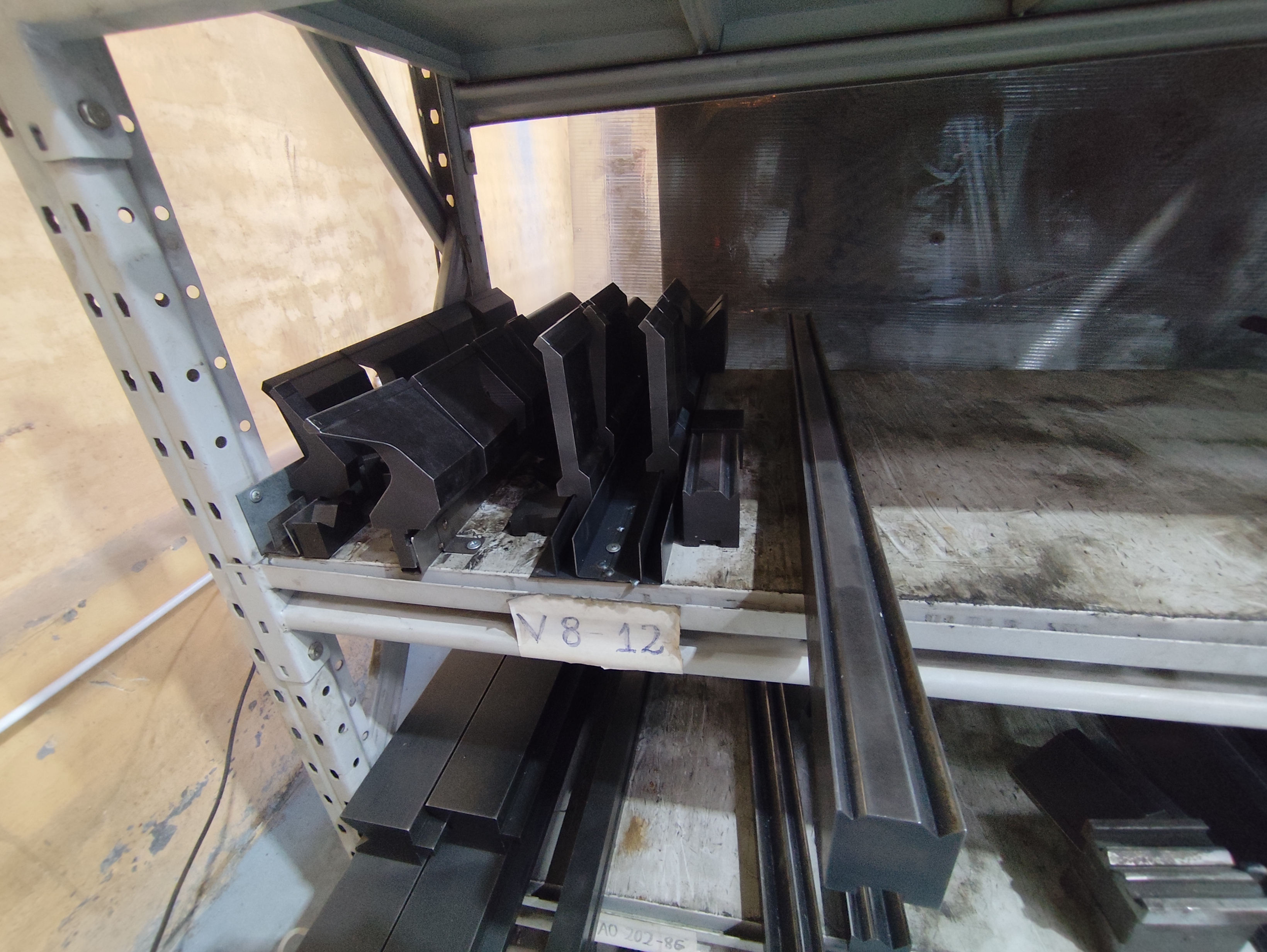
What Is Stroke and Why Does It Matter?
Stroke length is the total downward travel distance of the press brake ram. It determines how deep the punch can penetrate into the die. For shallow bends on flat panels, almost any machine works. But for deep-box shapes — like the gunmetal grey mounting brackets with multiple precise folds shown in our product photos — stroke becomes a hard constraint.
If the stroke is too short, the ram cannot push the punch far enough to complete the bend. The operator might try to compensate by adjusting the die height, but that changes the geometry and risks damaging press brake tooling.
Calculating Required Stroke
Here is a simple method we use internally:
Required Stroke = Flange Height + Punch Height + Die Height + Clearance
For a deep box with a 150 mm flange:
| Component | Typical Value |
|---|---|
| Flange height | 150 mm |
| Punch height | 100 mm |
| Die height | 80 mm |
| Extraction clearance | 60 mm |
| Total required stroke | 390 mm |
If the supplier's press brake has only a 300 mm stroke, this part cannot be formed in a single setup. You would need a machine with at least 400 mm of stroke.
Daylight and Part Extraction
Daylight is the maximum open distance between the ram and the bed when the ram is fully retracted. It must be large enough to insert the workpiece, account for the bent flanges of the finished part, and remove it safely. For parts with tall flanges or complex angular geometry, check that the throat depth — the distance from the frame to the center of the bed — also provides enough clearance for the part width. Understanding what factors limit maximum part size is critical when specifying these requirements.
Bend Allowance and Springback
Deep bends amplify the effects of springback compensation 8. When the ram retracts, the metal springs back slightly toward its flat state. CNC press brakes handle this by over-bending to a programmed angle, but the stroke must have enough range to reach that over-bend position. If your part requires a 90-degree bend with 2 degrees of springback, the ram needs to push to 88 degrees — which demands slightly more stroke than a simple 90-degree target. Bend allowance calculations also shift when flange depths increase, so make sure your supplier's CNC programming accounts for this.
How can I verify that a manufacturer's press brake capacity matches my large-scale project requirements?
During a supplier audit at a factory outside Ho Chi Minh City, I once watched an operator bend a test coupon on a machine whose tonnage plate read 160 tons. The bend looked fine — until we measured the angle at the center versus the ends of a 2-meter piece. There was a 1.5-degree deviation. The machine was old enough that ram parallelism had drifted, and the factory had no calibration records. That visit changed how we vet equipment.
To verify capacity, request the press brake's rated tonnage, maximum stroke, bed length, and throat depth, then cross-check these against your calculated requirements, and conduct a first-article inspection with angle measurements at multiple points along the bend to confirm ram parallelism and consistent forming force.

Your Pre-Order Verification Checklist
Before placing a production order, gather the following data from your supplier and compare it against your part requirements. We use a version of this checklist on every custom project we manage through our offices in Vietnam and China.
- Request machine specifications in writing. Ask for the press brake model, rated tonnage, stroke length, bed length, throat depth, and CNC control system. Do not accept verbal assurances.
- Run your own tonnage calculation. Use the formula from the previous section. Compare your result to the machine's rated capacity. Make sure the machine exceeds your calculated tonnage by at least 20%.
- Check the bed length rule. Press brake tonnage ratings assume the load is distributed across at least 60% of the bed length. If your part is short relative to the bed, the force concentrates in a smaller area. This can overstress the ram or bed locally, even if the total tonnage is within spec.
- Verify stroke and daylight. Compare your required stroke (flange height + tooling + clearance) to the machine's maximum stroke. Confirm the daylight is adequate for part insertion and removal.
- Inspect tooling condition. Worn press brake tooling affects bend radius consistency and increases required tonnage. Ask for photos or inspect in person.
- Request a first-article sample. Measure bend angles at the left end, center, and right end of the longest bend. A deviation greater than 0.5 degrees across the length may indicate ram parallelism issues or uneven tonnage distribution. Understanding the typical bending angle accuracy range in sheet metal fabrication helps you set the right acceptance criteria.
- Review CNC programming capability. For parts with multiple bends, the CNC must sequence bends correctly to avoid collisions between the part and the tooling. Advanced simulation software helps predict and prevent these issues.
Simulation and Adaptive Bending
Modern CNC press brakes with adaptive bending technology 9 use real-time angle measurement sensors. These sensors check the bend angle during the stroke and make automatic corrections. This is especially valuable for long bends on large parts, where sheet metal properties can vary along the length. When evaluating a supplier, ask whether their equipment has this capability. It directly impacts the likelihood of achieving "right first time" results.
Modular Tooling for Flexibility
For large parts that require multiple bend stations along the bed, modular tooling systems allow the operator to set up different punch-and-die combinations side by side. This improves efficiency and reduces setup time. If your project involves several different bend profiles on one part, confirm the supplier uses sectional or modular tooling rather than single-piece tools that limit flexibility.
Will a supplier's tonnage limitations affect the "right first time" quality of my custom sheet metal orders?
A trade-off we weigh on nearly every quote: should we route a job to a supplier whose equipment barely meets the tonnage requirement but offers a lower price, or to one whose machine has headroom but costs more? In our experience exporting to the U.S., the answer is almost always the latter. The hidden cost of rework, returns, and missed delivery dates from operating at a machine's limits far outweighs the per-piece savings.
Yes — tonnage limitations directly affect quality. When a press brake operates at or near its maximum capacity, bend angles become inconsistent, springback increases unpredictably, tooling wears faster, and the risk of cracked flanges or distorted parts rises sharply, undermining "right first time" outcomes.

How Tonnage Shortfalls Manifest in Part Quality
When a machine is undersized for the job, problems appear in several forms:
- Inconsistent bend angles. The ram may slow or stall under heavy load, producing varying angles from part to part. This is the most common complaint we hear from our U.S. clients when a supplier is operating near capacity.
- Excessive springback. Springback compensation works reliably only when the machine delivers consistent force. At the tonnage limit, force fluctuations make springback unpredictable.
- Tooling damage. Die selection rules exist for a reason. Overloading tooling — especially at the bottom of the stroke where most die breakage occurs — leads to cracking, chipping, and premature replacement. This introduces dimensional variation across a production run.
- Surface defects. Insufficient force can cause the material to slip in the die, leaving marks, scratches, or uneven surfaces. For parts with a powder-coated or sandblasted finish, these defects may not show until after finishing, adding rework cost.
Forming Method and Tonnage Multiplication
The forming method dramatically changes the tonnage picture. Air bending is the most forgiving method and uses the least force. Bottom bending and coining require multiples of that force. Understanding the key technical points of bending in sheet metal fabrication helps you anticipate these differences when reviewing supplier capabilities.
| Forming Method | Tonnage Multiplication Factor |
|---|---|
| Air bending | 1.0× |
| Bottom bending | 5.0× or more |
| Coining | 10.0× or more |
| Offset bending | 5.0× |
| Offset bending (thick material) | 10.0× |
| Hemming tool | 4.0× |
| Hat tool | 5.0× |
If your design requires bottom bending for a sharp bend radius on a thick part, the tonnage requirement can jump five-fold compared to air bending. We have seen projects where a supplier quoted based on air bending assumptions, only to discover the drawing specified a tight inside radius that demanded bottom bending. The machine could not deliver, and the entire lot was rejected.
Energy Efficiency and Operational Cost
Large tonnage press brakes consume significant power. Servo-hydraulic 10 and fully electric models are more energy-efficient than older hydraulic machines. While this may not affect your part quality directly, it does affect your supplier's operating cost — and, by extension, pricing sustainability over long production runs. When evaluating suppliers, ask about the drive system. A supplier running modern, energy-efficient equipment is more likely to maintain consistent production quality because their machines generate less heat, require less maintenance, and deliver more precise ram control.
The Oversizing Principle in Practice
The 20–30% oversizing rule is not just a safety buffer. It accounts for real-world variability in sheet metal properties. A batch of mild steel from one mill may have a tensile strength of 58,000 PSI; the next batch from a different mill might measure 65,000 PSI. That 12% variation alone could push a borderline machine over its limit. Oversizing absorbs these fluctuations and keeps every part within tolerance.
Conclusion
Evaluating CNC press brake tonnage and stroke before sourcing large sheet metal parts protects your quality, timeline, and budget. Calculate, verify, and always insist on capacity headroom — your "right first time" results depend on it.
Frequently Asked Questions
What Is Stroke and Why Does It Matter?
Stroke length is the total downward travel distance of the press brake ram. It determines how deep the punch can penetrate into the die. For shallow bends on flat panels, almost any machine works. But for deep-box shapes — like the gunmetal grey mounting brackets with multiple precise folds shown in our product photos — stroke becomes a hard constraint.
How do I calculate the exact tonnage my supplier needs to bend my thickest sheet metal parts?
A lesson we learned early when coordinating heavy-gauge bracket production in Vietnam: if you rely on a supplier's word alone for tonnage capacity, you may not discover a shortfall until bent parts arrive out of spec. Running your own numbers first is non-negotiable.
What stroke and daylight requirements should I specify for my deep-box custom designs?
When our engineering team in China reviewed a set of deep-box enclosure drawings from a client in Ohio last year, the first thing we checked was not tonnage — it was stroke. The enclosure had 200 mm flanges, and two of the three shortlisted suppliers had press brakes with stroke lengths that could not physically accommodate the bend depth plus tooling height.
Footnotes
1. Outlines the process and importance of first-article inspection in manufacturing quality control. ↩︎
2. Explains the mathematical basis for press brake operation and tonnage calculation. ↩︎
3. Explains air bending as a flexible and common method in press brake operations. ↩︎
4. Details how material thickness significantly impacts required bending force and behavior. ↩︎
5. Provides properties and characteristics of mild steel, a common material in metal fabrication. ↩︎
6. Explains the role of V-die opening in press brake bending and its impact on product radius. ↩︎
7. Defines tensile strength and its critical role in sheet metal forming processes. ↩︎
8. Describes springback and methods for compensation in sheet metal forming. ↩︎
9. Describes advanced press brake technology for real-time angle measurement and automatic corrections. ↩︎
10. Replaced with an article explaining how servo-hydraulic presses work from a relevant machinery manufacturer. ↩︎