

Last quarter, a client received a container of custom welded steel frames from Vietnam — and 12% of the joints failed X-ray inspection 1. That single shipment cost weeks of back-and-forth, stalled their production line, and nearly ended the supplier relationship. On our production floor and through our Vietnam office, we have seen this scenario play out more times than we would like to admit AQL 2.5 standards 2. The problem is not that Vietnam lacks capable welding suppliers. The problem is that most buyers skip the upstream safeguards and only discover defects after heavy parts have already crossed the Pacific ISO 3834 3. The agitation is real: rework on a 200-kg steel frame is not like returning a box of plastic clips. You cannot just ship it back economically. The solution? A layered system of inspection, payment structure, documentation, and cultural fluency that catches problems early and gives you real leverage when something slips through.
To handle quality claims and returns when sourcing welding parts from Vietnam, establish multi-stage inspections before shipment, structure payment terms to retain leverage, document every defect with photographic and dimensional evidence, and negotiate local rework options rather than costly international returns.
Below, I walk through the exact processes we use — from first article inspection to final claim resolution — so you can protect your cash flow and your production schedule when sourcing heavy welded assemblies from Southeast Asia.
How can I establish a robust inspection process to prevent welding defects before my order leaves Vietnam?
A purchasing manager we work with in the Midwest once told me, "I'd rather spend $3,000 on inspections in Ho Chi Minh City than $30,000 on scrap in Ohio." That single sentence captures why our Vietnam team runs quality control checkpoints at every critical stage — not just at the end RMA process 4.
Establish a robust inspection process by requiring pre-production sample sign-off, in-line weld inspections during fabrication, and a formal pre-shipment inspection against AQL 2.5 standards, all verified by on-site personnel or accredited third-party inspection services.

Start with the Welding Procedure Specification
Before a single arc is struck, I insist on reviewing the supplier's Welding Procedure Specification (WPS) 5 and Procedure Qualification Records (PQR). These documents confirm the supplier has tested and qualified the exact weld process — wire type, gas mix, amperage range, travel speed — for your specific material and joint geometry. Without a WPS, you are gambling. International welding standards like AWS D1.1 6 or ISO 3834 exist for a reason: they set the baseline for structural integrity.
Multi-Stage Quality Control Pipeline
Quality control in Vietnam for welded parts is not a single gate open account payment terms 7. It is a pipeline. Here is the sequence we follow on every welding project:
| Stage | What We Check | Who Does It | Timing |
|---|---|---|---|
| Pre-production | WPS/PQR review, raw material mill certs, first article dimensional check | Our Vietnam QC team + supplier QA | Before mass production starts |
| In-line | Weld bead profile, penetration (cross-section on sample), fixture alignment, dimensional spot checks | On-site QC inspector | Every 50–100 units or daily |
| Pre-shipment | Full AQL 2.5 sampling, visual weld inspection per AWS D1.1, dimensional report, coating adhesion, packaging check | Third-party inspection service or our team | After 100% of order is completed |
| Lab testing (if required) | Destructive weld testing, X-ray or ultrasonic NDT, salt spray, hardness | Accredited lab | Before or during pre-shipment |
Why Remote Photo Inspections Fail for Welded Parts
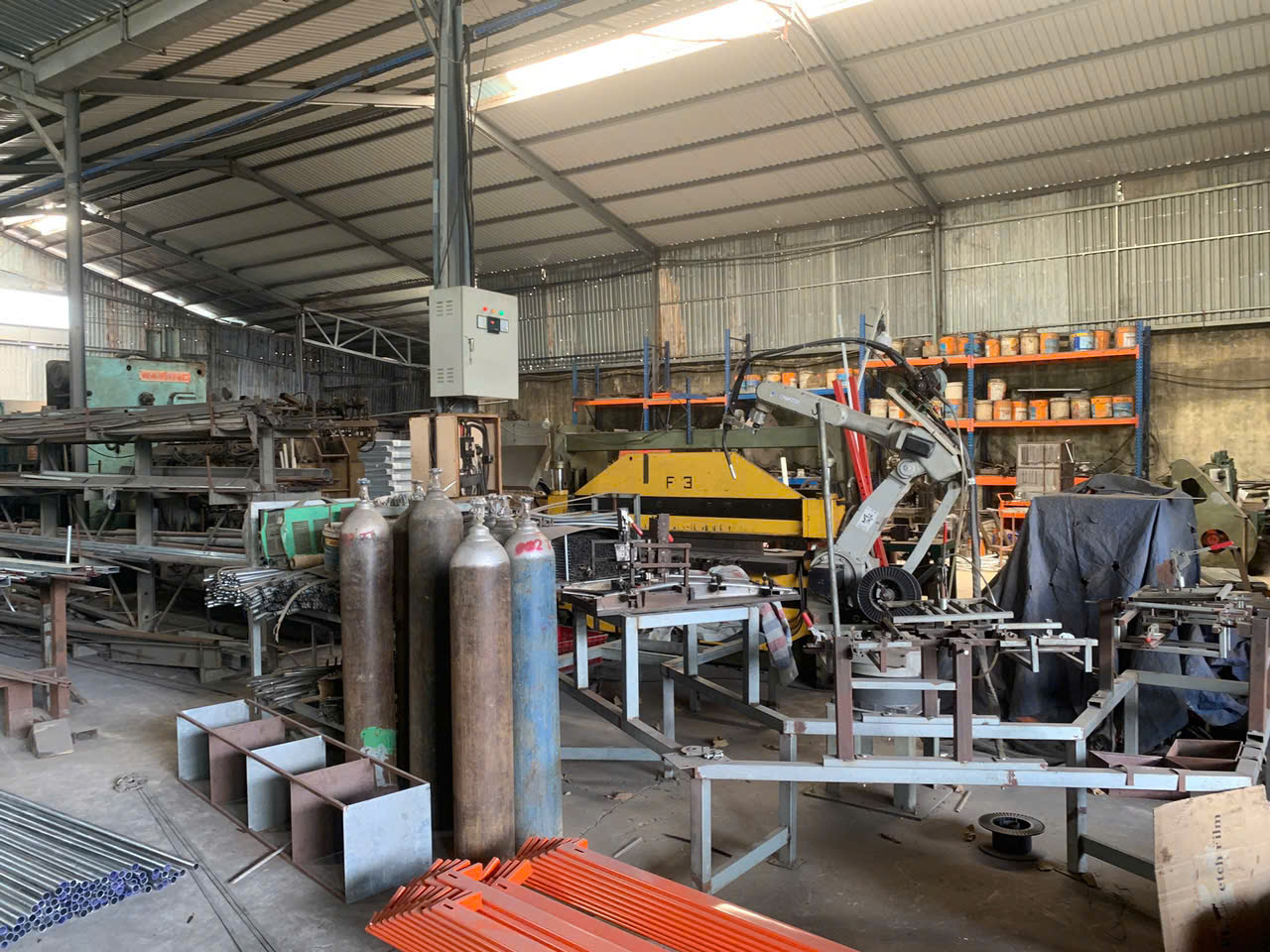
I have seen buyers rely on photos sent by the supplier. This does not work for welding. A photo can hide undercut, porosity, and incomplete fusion. You need someone on the ground who can run a fillet weld gauge along a joint, check for cracks with dye penetrant, and verify that mounting holes align with your CAD model. Our seven-person office in Vietnam exists precisely for this reason. If you do not have local staff, hire a reputable third-party inspection service with experience in metal fabrication — not just soft goods.
Defining Acceptance Criteria Upfront
Every quality assurance protocol depends on clear acceptance criteria. I include these in the purchase order:
- Weld class and inspection level (e.g., AWS D1.1 Class C for structural, Class A for critical)
- Acceptable Quality Limit (AQL 2.5 for major defects, AQL 4.0 for minor cosmetic)
- Dimensional tolerances with GD&T callouts 8 on every critical feature
- Surface finish requirements (e.g., Ra 3.2 or better on mating surfaces)
- Coating specification (powder coat thickness, adhesion cross-hatch test result)
When the supplier knows exactly what "pass" looks like before production starts, the reject rate drops dramatically. Supplier audits conducted before the first order also confirm whether the factory's equipment and workforce can meet these criteria consistently.
What is the most efficient way for me to manage returns or local repairs for heavy welded parts?
Here is a trade-off I weigh on nearly every welding project: the cost of shipping a 150-kg steel frame back to Vietnam versus the cost of fixing it locally in the buyer's country. Nine times out of ten, returning heavy welded parts across the Pacific is economically irrational.
The most efficient approach is to negotiate a local rework allowance or credit note with your Vietnamese supplier rather than returning heavy parts. Establish a clear RMA process upfront, authorize local repairs at the supplier's cost, and reserve returns only for catastrophic, non-repairable defects.

The Economics of Returns vs. Local Repair
Let me put real numbers in front of you. Freight for a single pallet of welded steel frames from the U.S. back to Ho Chi Minh City can cost $800–$1,500 depending on weight and route. Add customs procedures Vietnam requires for re-import, and you lose another two to three weeks. Meanwhile, a certified welder in your city can fix a cracked joint or re-drill a misaligned hole for $50–$200.
| Option | Estimated Cost | Lead Time | Best For |
|---|---|---|---|
| Return to Vietnam | $800–$1,500 per pallet + duties | 6–10 weeks round trip | Catastrophic batch failures (>20% defect rate) |
| Local rework (buyer's country) | $50–$300 per unit | 1–5 days | Minor weld repairs, hole re-drilling, re-coating |
| Credit note / price adjustment | Negotiated per case | Immediate financial resolution | Cosmetic defects buyer can live with |
| Replacement shipment from supplier | Cost of new parts + freight | 4–8 weeks | Specific parts unusable but batch mostly good |
Building the RMA Process Into Your Contract
I draft every supply agreement with a Return Merchandise Authorization (RMA) clause that covers four scenarios: full return, partial replacement, local rework at supplier expense, and credit note. The contract specifies who bears freight cost, who approves the rework shop, and what documentation triggers each path. Without this clause, you are negotiating from scratch every time a defect appears — and that is when trade dispute resolution gets messy.
Supplier Performance Monitoring Drives Continuous Improvement
Defect management does not end when you resolve a single claim. I track supplier performance monitoring data — reject rates, claim frequency, response time, root cause categories — on a simple dashboard. Over three to four orders, patterns emerge. Maybe the supplier's second-shift welders have higher defect rates. Maybe a specific sub-component from a particular raw material batch keeps failing. Sharing this data with the supplier is far more powerful than a single angry email. It turns a complaint into a collaborative improvement project, which aligns with how Vietnamese business culture responds to quality discussions.
When Returns Are Unavoidable
Sometimes the defect is structural and cannot be repaired locally. If the welded frame has wrong dimensions throughout, or if the material grade is incorrect, you have no choice but to reject the batch. In these cases, I coordinate with our logistics team to arrange import regulations Vietnam compliance for the returned goods. The supplier issues a credit or ships replacements. The key is that the pre-shipment inspection should have caught this before the container left the port. If it did not, we also review why our inspection process failed.
How do I use open account payment terms to protect my cash flow when a quality claim arises?
One lesson I learned early in our supply chain work across Asia: the moment you pay 100% before shipment, you lose almost all leverage. A client came to us after wiring full payment to a Vietnamese fabricator, only to discover that half the welded brackets had misaligned mounting holes. The supplier stopped responding for two weeks. That experience taught both of us how critical payment structure is to defect management.
Use open account payment terms — such as net 60 or net 90 after delivery — to retain financial leverage during the inspection and acceptance window. If a quality claim arises, you can withhold or offset the disputed amount against the invoice rather than chasing refunds after the supplier already holds your money.

Payment Structures Compared
Not every buyer qualifies for open account terms. Here is how the most common structures stack up for quality protection:
| Payment Term | How It Works | Quality Leverage | Cash Flow Impact | Who Offers It |
|---|---|---|---|---|
| 100% T/T in advance | Full payment before production | Zero leverage | Maximum cash pressure | Avoid for new suppliers |
| 30/70 T/T split | 30% deposit, 70% after pre-shipment inspection passes | Moderate — you hold 70% until inspection | Better than 100% upfront | Most Vietnam suppliers |
| Open account (Net 60–90) | Pay full invoice 60–90 days after goods arrive | Maximum — you inspect, use, then pay | Best for buyer | Select supply chain partners like us |
| Letter of Credit (L/C) | Bank guarantees payment against conforming documents | High — bank verifies documents | Moderate (bank fees) | Formal trade with larger orders |
Why Open Account Terms Change the Dynamic
When we extend open account terms — typically net 60 or net 90 — our U.S. clients receive the welding parts, inspect them in their own warehouse, even trial-fit them in their assembly, and only then does the invoice come due. If they find a non-conforming weld or a dimensional issue, we resolve the claim before payment clears. There is no awkward chase for a refund. The buyer simply notifies us, we verify the defect, and we agree on a credit note, replacement, or rework plan. The payment is adjusted accordingly.
This is fundamentally different from the 30/70 T/T split, where you have already paid 30% and you are under pressure to release the remaining 70% once the container ships — even if your pre-shipment inspection was rushed or incomplete.
Structuring the Quality Hold
I recommend including a "quality hold" clause in your open account agreement. This clause states that if the buyer submits a documented quality claim within a defined window (usually 15–30 days after delivery), the disputed portion of the invoice is paused until resolution. This protects the buyer's cash flow and motivates the supplier to resolve claims quickly. It is not adversarial — it is simply good trade dispute resolution practice.
Tooling and NRE Payments
One exception: tooling and non-recurring engineering (NRE) charges are typically paid separately, often 50% upfront and 50% upon sample approval. We structure these payments with clear ownership terms — the tooling belongs to the buyer, is marked with the buyer's name, and stays at the factory for production use only. This is standard whether you are forging, casting, or welding custom parts.
What specific evidence do I need to provide my Vietnamese supplier to ensure a quick resolution for non-conforming welds?
During a recent project involving mounting brackets with reinforced gussets and precision-drilled holes, our client discovered three units with incomplete weld penetration at a critical load-bearing joint. Instead of sending a vague complaint, they followed the documentation protocol we had established together. The claim was resolved in four business days. The difference was evidence.
Provide your Vietnamese supplier with annotated photographs showing each defect, a dimensional inspection report referencing the original drawing, the part serial or lot number, the relevant WPS or specification clause that was violated, and a written summary of the defect's impact on function or safety.
The Evidence Package Checklist
I have refined this checklist over dozens of claims. Every piece of evidence serves a purpose: it removes ambiguity, gives the supplier's QA team a clear target for root cause analysis, and speeds up the approval of a corrective action.
-
Annotated photographs: Take close-up photos of each defect. Use arrows or circles to highlight the issue. Include a ruler or caliper in the frame for scale. Photograph the part number marking so the supplier can trace it to a specific production batch.
-
Dimensional inspection report: Use a CMM, calipers, or gauge pins to measure the non-conforming feature. Report the actual dimension next to the nominal dimension and tolerance from the drawing. A simple table works:
| Feature | Drawing Spec | Tolerance | Actual Measured | Status |
|---|---|---|---|---|
| Hole center-to-center distance | 120.0 mm | ±0.5 mm | 122.3 mm | FAIL |
| Fillet weld leg size (joint A3) | 6.0 mm | +1.0 / −0.0 mm | 4.2 mm | FAIL |
| Bracket flatness | 0.5 mm | max | 1.8 mm | FAIL |
| Overall length | 450.0 mm | ±1.0 mm | 450.4 mm | PASS |
-
Lot or serial number: This allows the supplier to trace the defect to a specific shift, welder, or raw material batch.
-
Reference to the violated specification: Cite the exact clause — for example, "Per AWS D1.1 Section 5.24, fillet weld leg size shall not be less than the specified size by more than 1/16 inch." This removes any debate about whether the defect is actually out of spec.
-
Impact statement: Explain what the defect means functionally. "These brackets mount to a vibrating compressor base. Undersized welds at joint A3 will fail under cyclic loading within 6 months." This helps the supplier prioritize the claim and understand the severity.
Cultural Context for Presenting Evidence
When presenting evidence to a Vietnamese supplier, I have found that tone matters as much as data. A collaborative framing — "We found these issues and want to work together to prevent them next time" — gets faster results than a confrontational demand. This is not about being soft. It is about being effective. Vietnamese business culture values face-saving and relationship continuity. When you present clear evidence without blame, the supplier's engineering team engages with the problem rather than defending against an attack. This diplomatic approach accelerates root cause analysis and drives lasting improvements in their quality assurance protocols.
Root Cause Analysis Framework
I push for a formal 8D or 5-Why root cause analysis 10 on every claim. The supplier must identify not just what went wrong, but why it went wrong and what systemic change will prevent recurrence. This moves the conversation beyond simple returns into genuine supplier performance monitoring and continuous improvement.
Conclusion
Sourcing welding parts from Vietnam works when you layer inspections, structure payments for leverage, document defects precisely, and communicate with cultural awareness. These are not abstract principles — they are daily practices our team in Vietnam executes on every custom welding project. If you are also sourcing other fabricated components, learning how to handle shipping damage when sourcing welding parts from Vietnam can further protect your supply chain.
Frequently Asked Questions
How can I establish a robust inspection process to prevent welding defects before my order leaves Vietnam?
A purchasing manager we work with in the Midwest once told me, "I'd rather spend $3,000 on inspections in Ho Chi Minh City than $30,000 on scrap in Ohio." That single sentence captures why our Vietnam team runs quality control checkpoints at every critical stage — not just at the end RMA process 4 .
What is the most efficient way for me to manage returns or local repairs for heavy welded parts?
Here is a trade-off I weigh on nearly every welding project: the cost of shipping a 150-kg steel frame back to Vietnam versus the cost of fixing it locally in the buyer's country. Nine times out of ten, returning heavy welded parts across the Pacific is economically irrational.
How do I use open account payment terms to protect my cash flow when a quality claim arises?
One lesson I learned early in our supply chain work across Asia: the moment you pay 100% before shipment, you lose almost all leverage. A client came to us after wiring full payment to a Vietnamese fabricator, only to discover that half the welded brackets had misaligned mounting holes. The supplier stopped responding for two weeks. That experience taught both of us how critical payment structure is to defect management.
Footnotes
1. Explains X-ray inspection as a key method in non-destructive testing for material integrity. ↩︎
2. Defines AQL 2.5 as an acceptable quality limit for defect rates in product inspections. ↩︎
3. International standard specifying quality requirements for fusion welding of metallic materials. ↩︎
4. Defines RMA as a formal process for managing product returns and exchanges in supply chains. ↩︎
5. Describes WPS as a formal document detailing welding procedures to ensure quality production welds. ↩︎
6. Official standard for structural steel welding, outlining requirements for qualification, inspection, and acceptance. ↩︎
7. Explains open account as a payment method where goods are shipped before payment is due. ↩︎
8. Explains GD&T as a symbolic language for defining engineering tolerances on technical drawings. ↩︎
9. Describes ISO 9001 as a globally recognized standard for quality management systems and its certification process. ↩︎
10. Describes 8D as a problem-solving methodology to find root causes and implement long-term solutions. ↩︎