
When our Vietnam office flagged a three-week delay on a batch of precision mounting brackets, the root cause wasn’t quality — it was a raw material sourcing gap nobody saw coming CE or RoHS compliance 1. That single incident cost our client a production-line shutdown, and it forced us to rebuild how we track every stage of fabrication across borders.
End-to-end supply chain visibility for Vietnam sheet metal fabrication requires solidifying product specifications early, vetting suppliers through audits and certifications, integrating real-time quality control at each production milestone, and deploying digital tracking from raw material procurement through final delivery to your US warehouse.
This article breaks down the specific steps, tools, and strategies I rely on to give our US-based clients full transparency over their Vietnam sheet metal projects documented material traceability 2. Each section tackles a different pain point — from sourcing and production monitoring to shipment tracking and delay prevention.
How can I ensure full transparency when sourcing custom sheet metal parts from Vietnam?
A conversation with a purchasing manager in Ohio last year changed how I think about transparency. He told me his previous supplier never shared sub-tier material certificates, and he only discovered the steel grade was wrong after parts failed testing stateside.
To ensure full transparency when sourcing custom sheet metal parts from Vietnam, prepare detailed CAD drawings and complete bills of materials upfront, vet suppliers through ISO certifications and on-site audits, and require documented material traceability from raw steel procurement through finished part inspection.
Start with Bulletproof Specifications
Transparency begins before you even contact a fabricator. I always tell clients to finalize their 2D and 3D CAD drawings first. detailed CAD drawings 3 Include every tolerance, surface finish requirement, and material grade on the drawing itself. Do not leave anything to verbal agreements.
A complete bill of materials 4 (BOM) should list part numbers, quantities, material specifications, and any secondary processes like powder coating or sandblasting. For the angular mounting brackets we recently produced — the ones with mirrored geometries, multiple pre-drilled holes, and visible weld joints — every bend angle, hole diameter, and surface finish was documented before we sent the RFQ to our vetted fabrication partners.
Vet Suppliers Beyond the Surface
Many buyers search Alibaba or Global Sources and pick a supplier based on price alone. That approach creates blind spots. Our team in Vietnam conducts on-site audits. We check for ISO 9001 certification 5, CE or RoHS compliance where applicable, and documented quality control procedures. We also verify whether the factory actually fabricates in-house or subcontracts critical steps like laser cutting or welding.
| Supplier Vetting Criteria | What to Check | Why It Matters |
|---|---|---|
| Certifications | ISO 9001, CE, RoHS | Proves systematic quality management |
| In-House Capabilities | Laser cutting, CNC bending, welding | Reduces multi-tier supplier visibility gaps |
| Material Traceability | Mill certificates, material test reports | Confirms correct steel grades and alloy composition |
| QC Documentation | Inspection reports, process control plans | Shows the factory catches defects early |
| References | Past export clients, sample shipments | Validates real-world performance |
Understand Vietnam's Material Supply Chain
Vietnam's manufacturing infrastructure is strong for assembly, plastics, and sheet metal. But specialty components and high-spec inputs — certain stainless steel grades, specialty aluminum alloys — still come from China. This is not necessarily a problem, but you need to know about it. If your parts require a specific alloy, ask your supplier where they source it. Build buffer time for cross-border material procurement.
I have seen projects delayed because a fabricator assumed a Chinese steel mill would deliver on time during a holiday period. Knowing the full material supply chain — including Tier 2 and Tier 3 suppliers — gives you the ability to spot risks early and plan accordingly.
Use Digital Tools for Sourcing Visibility
We share a cloud-based portal with clients where they can see the status of material procurement, review mill certificates, and track when raw sheets arrive at the factory. This kind of digital supply chain transformation removes guesswork. Instead of waiting for an email update, clients log in and check the current status themselves.
How do I monitor the quality control and production milestones for my Vietnam fabrication project?
One lesson we learned the hard way: a factory can pass an initial audit with flying colors and still ship non-conforming parts if nobody monitors the actual production run. Quality control standards must be enforced during production, not just verified on paper beforehand.
Monitor quality control and production milestones by implementing a multi-stage inspection process — including first article inspection, in-line checks at critical operations, and a final inspection before container loading — all documented with photos, measurements, and real-time reporting through a shared digital platform.

Define Your Inspection Gates
Not every operation needs the same level of scrutiny. I map out inspection gates based on where defects are most likely and most costly. For complex brackets with sharp bends, cutouts, and welded joints, the critical gates look like this:
| Inspection Gate | When It Happens | What Gets Checked |
|---|---|---|
| First Article Inspection 6 (FAI) | After first 1–5 pieces | Dimensions, tolerances, material verification |
| In-Line Inspection | During production at 25%, 50%, 75% | Bend angles (±0.5°), hole positions (±0.1–0.25 mm), weld quality |
| Surface Finish Inspection | After coating/finishing | Coating uniformity, adhesion test, color match |
| Final Inspection (Pre-Shipment) | Before packing and loading | Full dimensional check, visual inspection, packing integrity |
Tolerance Management Is Non-Negotiable
Typical sheet metal tolerances range from ±0.1 to ±0.5 mm for critical features. Holes and slots often require tighter control — ±0.1 to ±0.25 mm. Bend angles should hold within ±0.5 degrees for repeatable assembly.
Our Vietnam team verifies these at each inspection gate using calibrated measuring instruments. We document every measurement on a standardized report and share it with the client before the next production stage proceeds. If a dimension falls outside tolerance, production stops until we resolve the issue. This approach costs a little more time upfront but prevents expensive rework and returns.
Surface Finishes and Corrosion Resistance
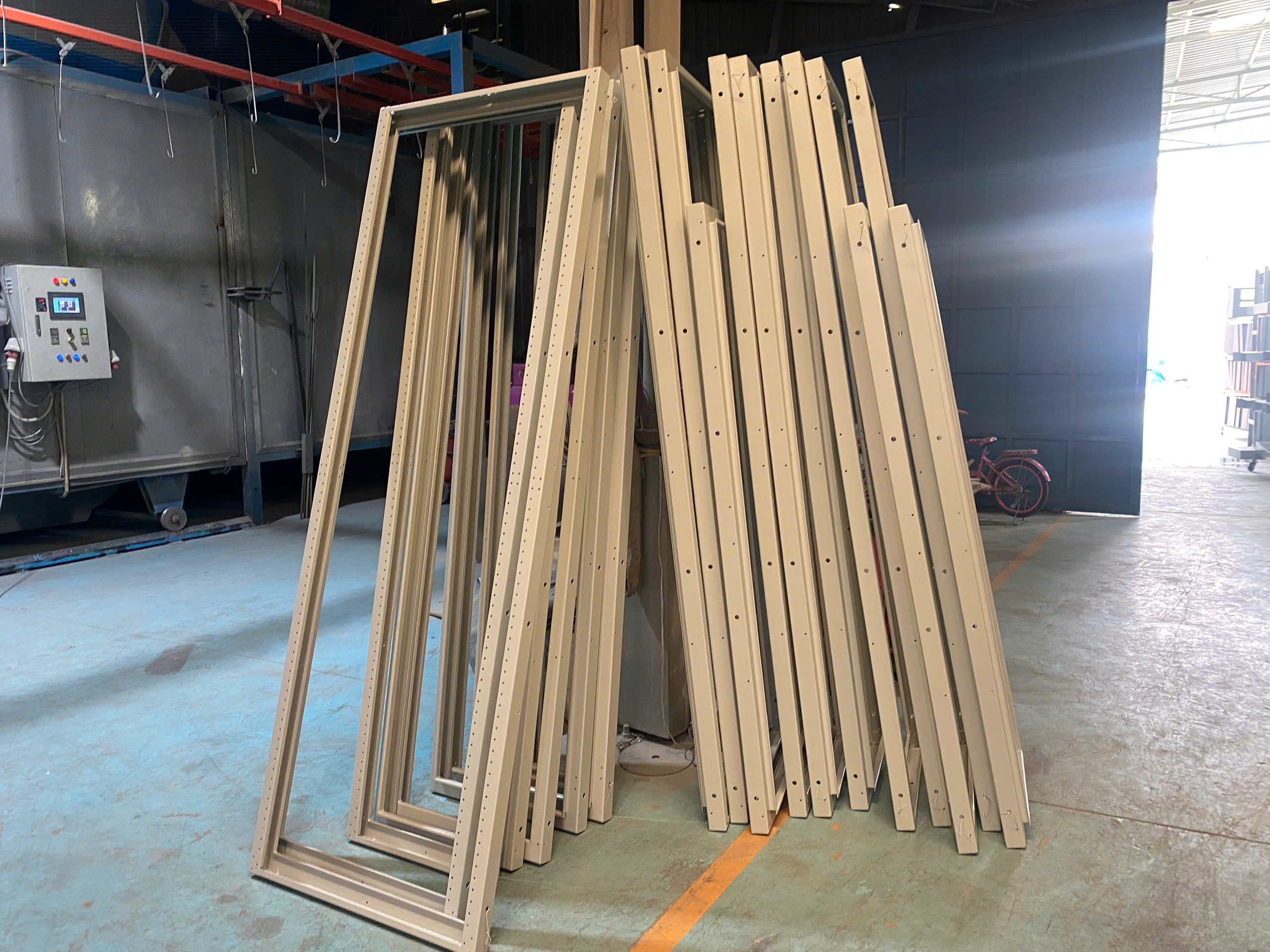
The gunmetal grey, matte finish on the mounting brackets shown in our product line — that smooth, non-reflective texture typical of sandblasted or powder-coated steel — requires specific QA steps. We visually inspect coatings for uniformity, perform adhesion cross-hatch tests, and verify that the finish resists staining and tolerates cleaning chemicals.
For parts exposed to vibration and thermal cycling, we also check mounting integrity. Stiffeners and reinforced corners must hold up under real-world conditions. I have rejected batches where the powder coat looked perfect but peeled during the adhesion test. Catching that at the factory is infinitely cheaper than catching it at the customer's assembly line.
Production Scheduling Optimization
Production scheduling optimization matters just as much as inspection. Our project managers in Vietnam maintain Gantt-chart-style schedules for every order. Clients see estimated completion dates for each operation — laser cutting, bending, welding, finishing, and packing. When a stage runs ahead or behind, the schedule updates automatically. This level of production milestone visibility eliminates the "where's my order?" phone calls.
Lean Principles in Practice
We encourage our factory partners to apply lean manufacturing principles 7. Value stream mapping helps identify bottlenecks. 5S methodology keeps the shop floor organized, which directly reduces quality defects. Just-in-Time inventory practices mean materials arrive when needed, reducing storage costs and the risk of material mix-ups. Continuous improvement through Kaizen events keeps the fabrication process getting better over time.
What is the best way for me to track my sheet metal shipments from the factory to my US warehouse?
Last quarter, a client asked why his container was sitting at Cat Lai port for six extra days. The answer was a customs compliance documentation error that could have been prevented with better pre-shipment preparation. That experience reinforced how important end-to-end shipment tracking really is.
The best way to track sheet metal shipments from Vietnam to your US warehouse is to use a combination of freight forwarder tracking portals, real-time container GPS monitoring, and proactive milestone notifications covering factory departure, port clearance, ocean transit, US customs entry, and final delivery.
Map the Full Logistics Chain
Shipping from Vietnam to the US involves multiple handoffs. Each handoff is a potential visibility gap. Here is the typical journey and what to track at each stage:
| Shipment Stage | Key Milestone | Visibility Tool |
|---|---|---|
| Factory to Port | Container loaded, truck departure | Factory confirmation + photos |
| Vietnam Port | Customs clearance, vessel loading | Freight forwarder portal |
| Ocean Transit | Vessel tracking, ETA updates | Carrier tracking (e.g., Maersk, ONE) |
| US Port Arrival | Customs entry, inspection hold (if any) | US Customs broker updates |
| Last-Mile Delivery | Container drayage to warehouse | Trucking company tracking |
Customs Compliance Preparation
Logistics challenges Vietnam presents often stem from documentation, not physical shipping. Before the container leaves the factory, we prepare the commercial invoice, packing list, certificate of origin, and any required material test reports. For sheet metal parts entering the US, tariff classification 8 matters. Getting the HS code wrong can trigger delays or unexpected duties.
We also help clients navigate trade agreements Vietnam participates in, such as bilateral trade frameworks that may reduce tariff rates for certain metal products. Proper documentation upfront prevents the kind of port delays that erode your delivery timeline. For a deeper look at optimizing shipping decisions, see our guide on how to balance logistics cost and time when sourcing sheet metal fabrication from Vietnam.
Real-Time Container Monitoring
Modern freight carriers offer GPS-based container tracking. I recommend clients bookmark their carrier's tracking page and set up email or SMS alerts for key milestones — vessel departure, transshipment (if applicable), and arrival at the US destination port. Some third-party logistics platforms aggregate tracking data from multiple carriers into a single dashboard.
Our team sends proactive updates at each milestone. We do not wait for clients to ask. If a vessel is delayed due to weather or port congestion, we notify the client immediately and provide a revised ETA. This proactive approach to supply chain risk mitigation keeps everyone aligned.
Packing and Loading Integrity
Visibility does not stop at tracking a dot on a map. How parts are packed and loaded affects whether they arrive in usable condition. For heavy-duty sheet metal brackets, we specify wooden crate or pallet packing with anti-rust VCI paper. We photograph the loading process and share images with the client before the container doors are sealed. This documentation protects both parties if a damage claim arises.
How can I gain better visibility into my supplier's processes to avoid unexpected delays in my supply chain?
A trade-off I constantly weigh is how much process control to demand from a supplier without micromanaging them into inefficiency. The answer is structured visibility — building systems that surface problems early without slowing down production.
Gain better visibility into your supplier's processes by establishing a centralized digital control tower, conducting regular remote and on-site audits, requiring weekly production reports with photographic evidence, and building supplier relationship management practices that incentivize transparency and proactive communication about risks.
The Digital Control Tower Concept
A digital control tower 9 is a centralized platform where all supply chain data converges. It pulls in demand forecasts, material availability, production schedules, quality data, and logistics tracking. For our sheet metal projects, this means a client can see — in one place — whether the steel has arrived at the factory, whether laser cutting is complete, whether bending is on schedule, and whether the container has been booked.
This kind of multi-tier supplier visibility extends beyond the primary fabricator. If the steel comes from a Chinese mill, the control tower should show when that material shipped and when it arrived in Vietnam. If a surface treatment is subcontracted, that status should also be visible.
Build Supplier Relationships, Not Just Contracts
Supplier relationship management is more than signing a purchase order. I invest time in building genuine partnerships with our factory network. We visit facilities regularly — our seven-person Vietnam office makes that practical. We discuss upcoming orders, capacity constraints, and potential bottlenecks before they become crises. For practical advice on structuring these ongoing interactions, see our guide on how to manage communication and reporting with Vietnam sheet metal fabrication suppliers.
When a supplier trusts the relationship, they are more likely to flag problems early. A factory that fears losing the contract will hide a delay until it becomes unavoidable. A factory that sees you as a partner will call you the moment a machine breaks down or a material shipment is late. That early warning is worth more than any tracking software.
Leverage Advanced Technology
Emerging technologies are reshaping how buyers gain process visibility:
- AI-powered machine vision can detect surface defects in real time during sheet metal fabrication, catching problems that human inspectors might miss.
- Digital twin technology creates a virtual replica of the production line, allowing simulation and optimization before physical production begins.
- IoT sensors on CNC machines and press brakes can transmit cycle times, downtime data, and maintenance alerts to the control tower.
- Blockchain-based traceability can create an immutable record of material origins, processing steps, and quality approvals.
Not every project justifies the full technology stack. But even basic digital tools — shared spreadsheets, cloud photo albums, weekly video calls — dramatically improve visibility compared to the traditional "send an email and hope for a response" approach.
Root Causes of Unexpected Delays
Understanding why delays happen helps you build systems to prevent them. Here are the most common causes I have encountered:
| Delay Cause | How to Prevent It |
|---|---|
| Raw material shortage | Require suppliers to confirm material availability before accepting the order |
| Machine breakdown | Ask about preventive maintenance schedules; request backup capacity plans |
| Quality rework | Implement FAI and in-line inspections to catch defects early |
| Customs documentation errors | Prepare all export documents in advance; use experienced customs brokers |
| Port congestion | Monitor port conditions; consider alternative ports or shipping windows |
| Communication gaps | Assign a dedicated project manager; establish weekly reporting cadence |
Manufacturing Control Trumps Location
There is a debate in our industry: does geographic proximity matter more, or does process control matter more? I believe both matter, but if I had to choose one, I would pick process control every time. A well-managed factory with rigorous quality control standards, clear communication, and digital reporting systems will outperform a nearby factory with loose processes.
That said, having our own team on the ground in Vietnam gives us the best of both worlds. We combine geographic proximity — enabling quick site visits and face-to-face communication — with structured process controls that give clients confidence in every shipment.
Conclusion
Managing end-to-end supply chain visibility 10 for Vietnam sheet metal fabrication demands disciplined specifications, rigorous inspections, real-time tracking, and strong supplier partnerships — each reinforcing the other to deliver parts right the first time.
Frequently Asked Questions
How can I ensure full transparency when sourcing custom sheet metal parts from Vietnam?
A conversation with a purchasing manager in Ohio last year changed how I think about transparency. He told me his previous supplier never shared sub-tier material certificates, and he only discovered the steel grade was wrong after parts failed testing stateside.
How do I monitor the quality control and production milestones for my Vietnam fabrication project?
One lesson we learned the hard way: a factory can pass an initial audit with flying colors and still ship non-conforming parts if nobody monitors the actual production run. Quality control standards must be enforced during production, not just verified on paper beforehand.
What is the best way for me to track my sheet metal shipments from the factory to my US warehouse?
Last quarter, a client asked why his container was sitting at Cat Lai port for six extra days. The answer was a customs compliance documentation error that could have been prevented with better pre-shipment preparation. That experience reinforced how important end-to-end shipment tracking really is.
Footnotes
1. Explains product safety and environmental standards like RoHS and CE. ↩︎
2. Highlights the importance of tracking materials from source to finished product. ↩︎
3. Comprehensive guide to engineering drawings, including detailed CAD drawings. ↩︎
4. Defines the essential components of a comprehensive BOM. ↩︎
5. Explains the global standard for quality management systems. ↩︎
6. Describes the initial inspection process to validate production setup. ↩︎
7. Explains the methodology for optimizing production efficiency and reducing waste. ↩︎
8. Authoritative explanation of tariff classification from a customs expert. ↩︎
9. Defines a modern tool for integrated supply chain management. ↩︎
10. Updated definition from the same authoritative domain. ↩︎