When we started helping US buyers source sheet metal fabrication 1 from Vietnam, one question kept surfacing: how do you verify OSHA compliance in a country where OSHA has no authority? The concern is real — your compliance team demands proof, your stakeholders expect safe sourcing, and a single workplace incident at your supplier’s factory can damage your brand overnight.
You cannot verify direct US OSHA compliance for a Vietnamese sheet metal fabricator because OSHA has no jurisdiction outside the United States. Instead, verify OSHA-equivalent safety by requesting ISO 45001 certification, conducting independent third-party audits, and confirming the factory meets international labor standards for machine guarding, lockout/tagout, and hazard communication.
This is not a simple checkbox exercise. It requires understanding what Vietnamese law actually mandates, what gaps exist between local regulations and US expectations, and how to bridge them with practical verification steps ISO 9001 certificates 2. Below, I walk through exactly how our team handles this for US clients sourcing custom parts from Vietnam.
How can I verify that my Vietnamese sheet metal supplier maintains the safety standards required by my US stakeholders?
A lesson we learned early in our Vietnam operations: US purchasing managers often ask for "OSHA certificates" from Vietnamese factories. This request reveals a common misunderstanding that we help clients navigate every week.
You verify safety standards by confirming your Vietnamese supplier holds ISO 45001 certification, complies with Vietnam's Labor Code under MOLISA regulations, and submits to regular third-party inspection services — then you map those results against OSHA's core requirements to satisfy US stakeholder expectations.
The Jurisdictional Reality You Must Understand
OSHA is a US federal agency 3. It enforces workplace safety regulations only within American borders. A factory in Binh Duong, Ho Chi Minh City, or Hanoi is not subject to OSHA inspections, OSHA citations, or OSHA fines. Period.
This does not mean safety is optional. Vietnam's Ministry of Labor, Invalids and Social Affairs (MOLISA) is the governing body for occupational safety and health in Vietnam. The Vietnam Labor Code 4 includes provisions for machine guarding standards, personal protective equipment (PPE) requirements, and hazard communication 5. However, enforcement varies by region and factory size.
The practical solution is to pursue "OSHA-equivalent" verification. This means you take the specific OSHA standards most relevant to sheet metal fabrication and check whether the Vietnamese factory meets them — not through OSHA itself, but through internationally recognized frameworks and independent audits.
Mapping OSHA Standards to International Equivalents
Here is how we translate the most-cited OSHA standards in US metal fabrication into verifiable benchmarks for Vietnam suppliers:
| OSHA Standard (US) | Requirement | Vietnam / International Equivalent |
|---|---|---|
| Machine Guarding 6 (1910.212) | Barrier guards, two-hand trips, electronic sensors on press brakes, stamping presses, CNC machines | ISO 45001 Clause 8.1.2; Vietnam Labor Code Article 138; visual audit of guard presence |
| Lockout/Tagout 7 (1910.147) | Written procedures for disabling hazardous energy during maintenance | ISO 45001 Clause 8.1.2; factory-specific LOTO procedures documented in local language |
| Hazard Communication (1910.1200) | GHS-compliant labeling of chemicals (solvents, powder coating compounds, plating chemicals) | GHS is adopted globally; verify SDS sheets are present and in the correct language |
| Respiratory Protection (1910.134) | Programs for hexavalent chromium and metal fumes from welding/plating | ISO 45001 risk assessment; verify respirator type and fit-testing records |
| Powered Industrial Trucks (1910.178) | Operator training on forklifts and pallet jacks | Vietnam Labor Code training requirements; check operator licenses and training logs |
Our team in Vietnam physically checks each of these items during supplier qualification. We look at the actual shop floor, not just the paperwork.
What to Look for During a Factory Visit
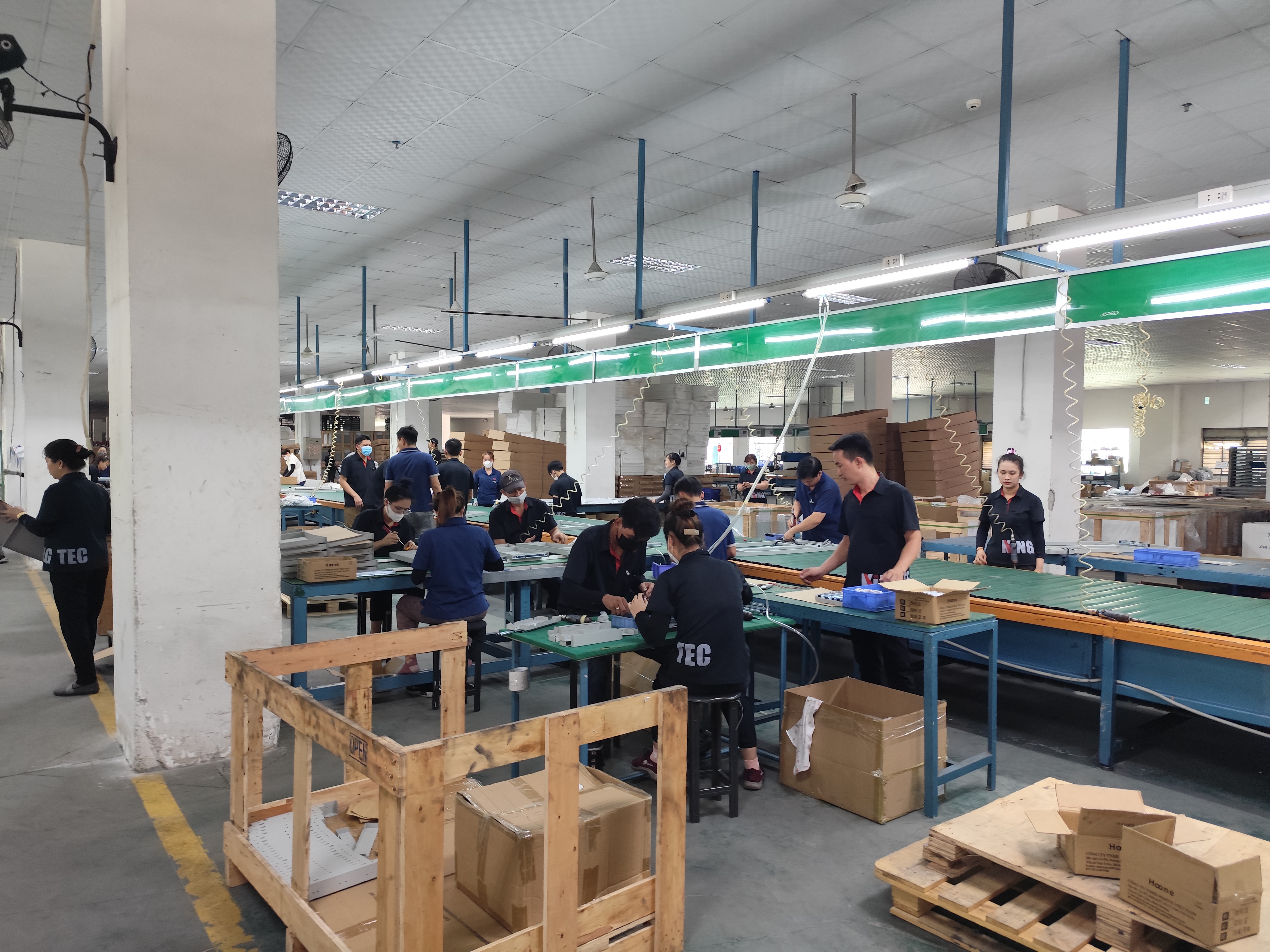
When our Vietnam-based team walks a prospective sheet metal supplier's facility, we follow a structured checklist. We check whether CNC laser cutting machines and press brakes have functioning safety interlocks. We look at the welding stations for proper ventilation and fume extraction. We ask operators about material handling safety protocols. We verify that forklift drivers carry valid training certificates.
These observations matter more than a certificate hanging in the front office. A factory can hold ISO 9001 and still have exposed pinch points on a stamping press. Supply chain due diligence means going beyond surface-level documentation.
What specific documentation should I request to confirm a Vietnam factory's adherence to OSHA-equivalent safety protocols?
A recent conversation with a US purchasing manager highlighted a real gap: he had received a stack of Vietnamese-language documents from a potential supplier and had no idea what to do with them. Documentation is only useful if you know what to ask for and how to evaluate it.
Request ISO 45001 and ISO 9001 certificates, Mill Test Certificates for raw materials, written lockout/tagout procedures, chemical Safety Data Sheets, PPE issuance logs, operator training records, first-article inspection reports, and the results of any recent social compliance audits from recognized third-party inspection services.
The Core Document Stack
Not all documents carry equal weight. Some prove systemic safety management. Others prove specific compliance at the workstation level. You need both.
| Document Category | Specific Documents | What It Proves |
|---|---|---|
| Management System Certifications | ISO 45001, ISO 9001 | Factory has a structured approach to occupational safety and health and quality management |
| Material Traceability | Mill Test Certificates (MTC) for SUS 304, SS400, SGCC | Raw materials meet specification; traceable supply chain |
| Chemical Safety | Safety Data Sheets 8 (SDS) for powder coating chemicals, zinc plating solutions, solvents | GHS-compliant hazard communication; aligns with OSHA 1910.1200 |
| Operator Safety | Training logs, forklift operator licenses, PPE issuance records | Workers are trained on equipment and hazards; material handling safety is addressed |
| Maintenance Safety | Written LOTO procedures, maintenance logs | Hazardous energy control during equipment servicing |
| Product Quality | First-article inspection reports, PPAP documentation, dimensional reports | "Right first time" capability; process control |
| Compliance Audits | Third-party audit reports (SGS, Bureau Veritas, TÜV SÜD) | Independent verification of workplace safety regulations adherence |
How to Evaluate What You Receive
I recommend a three-step evaluation process. First, confirm that certifications are current and issued by accredited bodies — not self-declared. Check the certificate number against the issuing body's online registry. Second, review procedural documents for specificity. A lockout/tagout procedure should name specific machines, list energy sources, and assign responsible personnel. Generic templates are a red flag. Third, cross-reference training records with the equipment on the shop floor. If the factory runs ten press brakes, there should be training records for every operator assigned to those machines.
Our approach at DEWIN is to collect this documentation before we even schedule an on-site audit. If a supplier cannot produce basic safety documents, we do not proceed. This saves everyone time and protects our clients from Environmental, Social, Governance (ESG) risks downstream.
RoHS and Chemical Compliance
For surface treatments like powder coating, nickel plating, and zinc plating, we also request RoHS compliance declarations. This is particularly relevant when finished parts are integrated into products sold in the US and EU markets. Hexavalent chromium — the most common respiratory violation in US metal fabrication — is a critical concern in Vietnamese welding and plating operations. We specifically verify that our suppliers' plating processes use trivalent chromium alternatives or have proper respiratory protection programs in place. For a deeper dive into managing these chemical compliance requirements, see our guide on how to ensure US RoHS and REACH compliance for Vietnam sheet metal fabrication.
How do I ensure my sourcing partner in Vietnam is conducting the rigorous on-site audits my compliance team demands?
The trade-off our clients face is straightforward: you can save significantly by sourcing sheet metal parts from Vietnam, but your compliance team still needs proof that the factory is safe. Paper certificates alone will not satisfy a rigorous US compliance review — and they should not.
Ensure rigorous on-site audits by requiring your sourcing partner to engage accredited third-party firms like SGS, Bureau Veritas, or TÜV SÜD for scheduled and unannounced factory audits, supplemented by your partner's own local audit team conducting regular inspections against a documented OSHA-equivalent checklist.

Why Third-Party Audits Are Non-Negotiable
Factory audits in Vietnam conducted by the supplier themselves have an obvious conflict of interest. This is why independent third-party inspection services exist. Firms like SGS, Bureau Veritas, and TÜV SÜD have auditors on the ground in Vietnam who specialize in social compliance audits and occupational safety evaluations.
However, there is a known challenge: "audit shopping." Some factories work with less rigorous audit firms or prepare specifically for scheduled visits, then relax standards afterward. The countermeasure is a combination of scheduled audits and unannounced spot checks.
A Layered Audit Approach
We use a three-layer verification model for our US clients:
Layer 1 — Qualification Audit: Before onboarding a new sheet metal supplier, our Vietnam team conducts a full-day factory assessment. We walk the production floor and inspect every workstation. We review safety documentation. We interview workers — sometimes through confidential channels via a neutral third party — to gauge the real safety culture. For a detailed walkthrough of how to set up this kind of assessment, see our guide on how to arrange a factory audit when sourcing sheet metal fabrication from Vietnam.
Layer 2 — Third-Party Certification Audit: We require suppliers to maintain ISO 45001 certification 9, which involves annual surveillance audits by an accredited registrar. This provides a baseline of verified compliance with international labor standards.
Layer 3 — Ongoing Spot Checks: During production runs, our local team visits the factory for quality inspections. Every visit includes a brief safety walk-through. We note whether PPE is being worn, whether machine guards are in place, and whether the factory floor is orderly. These observations go into our supplier scorecard.
What to Include in an Audit Checklist
| Audit Area | Specific Check | Pass Criteria |
|---|---|---|
| Machine Guarding | All press brakes, stamping presses, and CNC machines have guards installed and functioning | No exposed pinch points, nip points, or rotating parts accessible to operators |
| Lockout/Tagout | Written LOTO procedures posted at each machine; locks and tags available | Procedures are machine-specific, not generic; energy isolation points are clearly marked |
| Chemical Storage | Chemicals stored in ventilated areas with SDS sheets accessible | All containers labeled per GHS; spill containment in place |
| PPE Usage | Operators wearing appropriate PPE (safety glasses, gloves, ear protection, respirators where needed) | 100% compliance observed during audit; PPE issuance records available |
| Fire Safety | Fire extinguishers charged and accessible; evacuation routes marked | Extinguishers inspected within the last 12 months; exits unobstructed |
| Electrical Safety | Wiring and panels properly enclosed; no exposed conductors | Panels labeled; no evidence of temporary or improvised wiring |
| Ergonomics & Material Handling | Proper lifting equipment for heavy sheet metal; forklift operators certified | No manual lifting of loads exceeding safe limits; forklift training records current |
Addressing Audit Skepticism
Some industry voices argue that audits in Vietnam are unreliable. There is truth in the concern — but the solution is not to abandon audits. It is to make them more rigorous and less predictable. We also look at forward-thinking safety indicators. Some of our partner factories have adopted IoT sensors for air quality monitoring in welding areas and automated safety interlocks on CNC equipment. These technologies reduce reliance on human compliance and align with the growing trend of smart safety management in Vietnamese manufacturing.
Will a supplier's commitment to workplace safety in Vietnam improve the "right first time" quality of my custom parts?
When we first set up our Vietnam office, one of the sharpest observations came from a client's quality engineer: "Show me a factory with a messy safety culture, and I'll show you a factory that ships bad parts." Over the years, that statement has proven true more often than not.
Yes — factories with strong workplace safety cultures consistently produce higher "right first time" quality because the same discipline that enforces machine guarding, proper training, and process control also drives attention to tolerances, surface finish, and dimensional accuracy in custom sheet metal parts.

The Safety-Quality Connection
This is not just a theory. The connection between safety discipline and product quality is observable and practical.
A factory that enforces lockout/tagout procedures before maintenance is a factory that maintains its equipment on schedule. Well-maintained press brakes hold tighter bend tolerances. Well-maintained CNC laser cutters produce cleaner edges. This directly affects the dimensional accuracy of your custom brackets, housings, and mounting components.
A factory that trains its operators on machine guarding standards is a factory that invests in operator skill development. Skilled operators make fewer mistakes. They read drawings more carefully. They catch issues before parts leave the workstation.
A factory that manages chemicals properly — labeling solvents, controlling powder coating processes, monitoring plating bath chemistry — is a factory that delivers consistent surface finishes. Your parts arrive with uniform powder coat thickness, correct color, and no contamination.
What We See in Practice
Our experience managing custom sheet metal projects — parts like precision-engineered brackets with complex angular geometries, multiple bend sequences, pre-drilled mounting holes, and powder-coated or sandblasted finishes — has consistently shown a pattern. Suppliers who score well on our safety audits also score well on first-article inspection pass rates.
The K-factor accuracy for bend development (typically around 0.44 for common materials, ranging from 0.33 to 0.50) is a good example. Getting this right on the first attempt requires disciplined process control. Factories with strong safety cultures tend to document their processes more thoroughly, which means their bend calculations are verified, their tooling is maintained, and their operators follow established procedures rather than improvising.
The Cost Argument — Reframed
Some buyers worry that demanding OSHA-equivalent safety from a Vietnamese supplier will increase costs and erode the price advantage. In our experience, the opposite is true when you account for total cost. A factory with poor safety practices has higher rates of rework, scrap, and worker turnover. These hidden costs eventually show up in your landed cost — through delayed shipments, non-conforming parts, and the expense of managing returns.
Investing in a supplier with strong occupational safety and health practices is not a cost add. It is risk mitigation. It protects your supply chain, your brand reputation, and your compliance posture. For US buyers sourcing sheet metal fabrication from Vietnam, it is the foundation of a sustainable sourcing relationship. Understanding the safety hazards of sharp edges and burrs in sheet metal fabrication further illustrates how quality and safety are inseparable — a factory that controls burrs protects both its workers and your end product.
Conclusion
Verifying US OSHA compliance from a Vietnamese sheet metal supplier requires reframing the question: pursue OSHA-equivalent safety through ISO 45001, rigorous factory audits, proper documentation, and a sourcing partner with boots on the ground in Vietnam.
Frequently Asked Questions
How can I verify that my Vietnamese sheet metal supplier maintains the safety standards required by my US stakeholders?
A lesson we learned early in our Vietnam operations: US purchasing managers often ask for "OSHA certificates" from Vietnamese factories. This request reveals a common misunderstanding that we help clients navigate every week.
What specific documentation should I request to confirm a Vietnam factory's adherence to OSHA-equivalent safety protocols?
A recent conversation with a US purchasing manager highlighted a real gap: he had received a stack of Vietnamese-language documents from a potential supplier and had no idea what to do with them. Documentation is only useful if you know what to ask for and how to evaluate it.
How do I ensure my sourcing partner in Vietnam is conducting the rigorous on-site audits my compliance team demands?
The trade-off our clients face is straightforward: you can save significantly by sourcing sheet metal parts from Vietnam, but your compliance team still needs proof that the factory is safe. Paper certificates alone will not satisfy a rigorous US compliance review — and they should not.
Footnotes
1. Provides a clear definition and overview of the manufacturing process. ↩︎
2. Official information about the international standard for quality management systems. ↩︎
3. Official website of the US federal agency responsible for workplace safety and health. ↩︎
4. Replaced HTTP 403 ILO link with a working, non-PDF link to the full 2019 Vietnam Labor Code from a reputable legal information provider that claims to be the sole distributor of official English translations. ↩︎
5. Replaced HTTP 404 link with the main official OSHA Hazard Communication page. ↩︎
6. Details the OSHA standard for preventing injuries from machine operation. ↩︎
7. Explains OSHA’s standard for controlling hazardous energy during equipment maintenance. ↩︎
8. Explains the purpose and standardized content of documents for chemical hazard information. ↩︎
9. Official information about the international standard for occupational health and safety management. ↩︎