Injection Molding Cost in Vietnam: 2026 Pricing Guide
February 21, 2026 · 14 min read
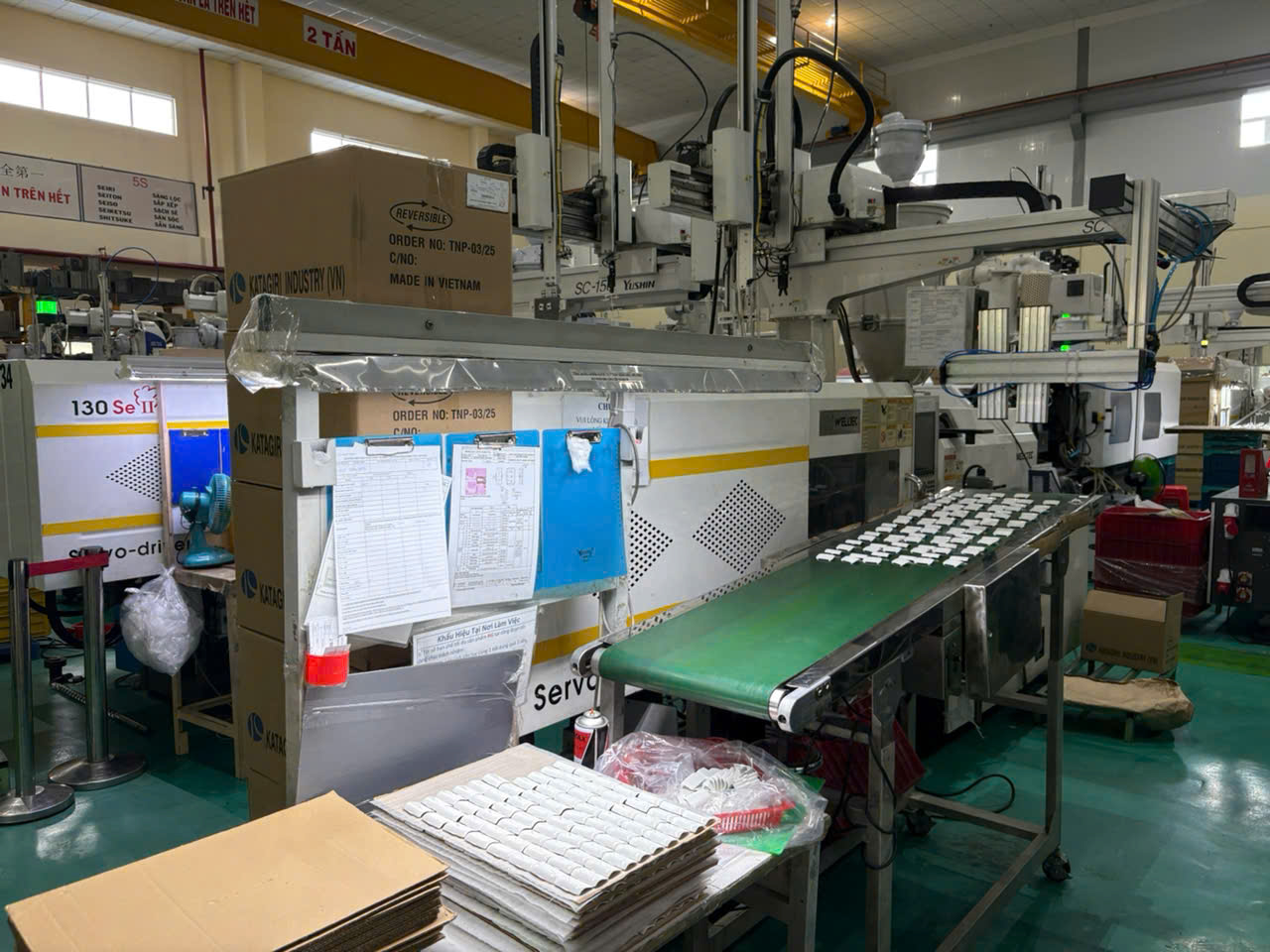
Vietnam's injection molding sector has grown 18% year-over-year since 2022, fueled by manufacturers diversifying away from China. For US buyers sourcing custom plastic parts — housings, connectors, clips, enclosures, or consumer goods — Vietnam now offers tooling costs 30–50% below US domestic shops and 10–25% below China, with exemption from Section 301 Chinese punitive duties exposure.
This guide provides real 2026 pricing from our audited injection molding partners across Binh Duong, Dong Nai, and Long An provinces in southern Vietnam.
Injection molding in Vietnam runs tooling costs 30–50% below US domestic shops and 10–25% below China, with relief from Section 301 Chinese punitive tariffs for qualifying goods on Vietnam-origin parts. Simple production molds start around $3,000, and per-part costs fall to a few cents at high volume.
Inside a Vietnam Factory — Plastic Processing & Die Casting
Watch on YouTube
Real footage from an audited DEWIN partner factory in Vietnam.
Injection Mold Tooling Costs: Vietnam vs China vs US (2026)
Tooling is the largest upfront investment in injection molding. Here's what you'll actually pay in 2026:
Single-Cavity Prototype Molds (Aluminum, 1K–10K shots)
- Vietnam: $1,500–$5,000
- China: $2,000–$6,000
- US domestic: $5,000–$15,000
Production Molds — P20 Steel (100K–500K shots)
- Simple (1 cavity, no slides): Vietnam $3,000–$8,000 | China $4,000–$10,000 | US $12,000–$30,000
- Medium (2–4 cavities, side actions): Vietnam $8,000–$25,000 | China $10,000–$30,000 | US $25,000–$65,000
- Complex (8+ cavities, hot runner, slides): Vietnam $20,000–$60,000 | China $25,000–$70,000 | US $60,000–$150,000
High-Volume Molds — H13/S136 Steel (500K–2M+ shots)
- Multi-cavity (8–16 cav, hot runner): Vietnam $35,000–$90,000 | China $40,000–$100,000 | US $80,000–$200,000+
- Family molds (multiple parts in one tool): Vietnam $25,000–$70,000
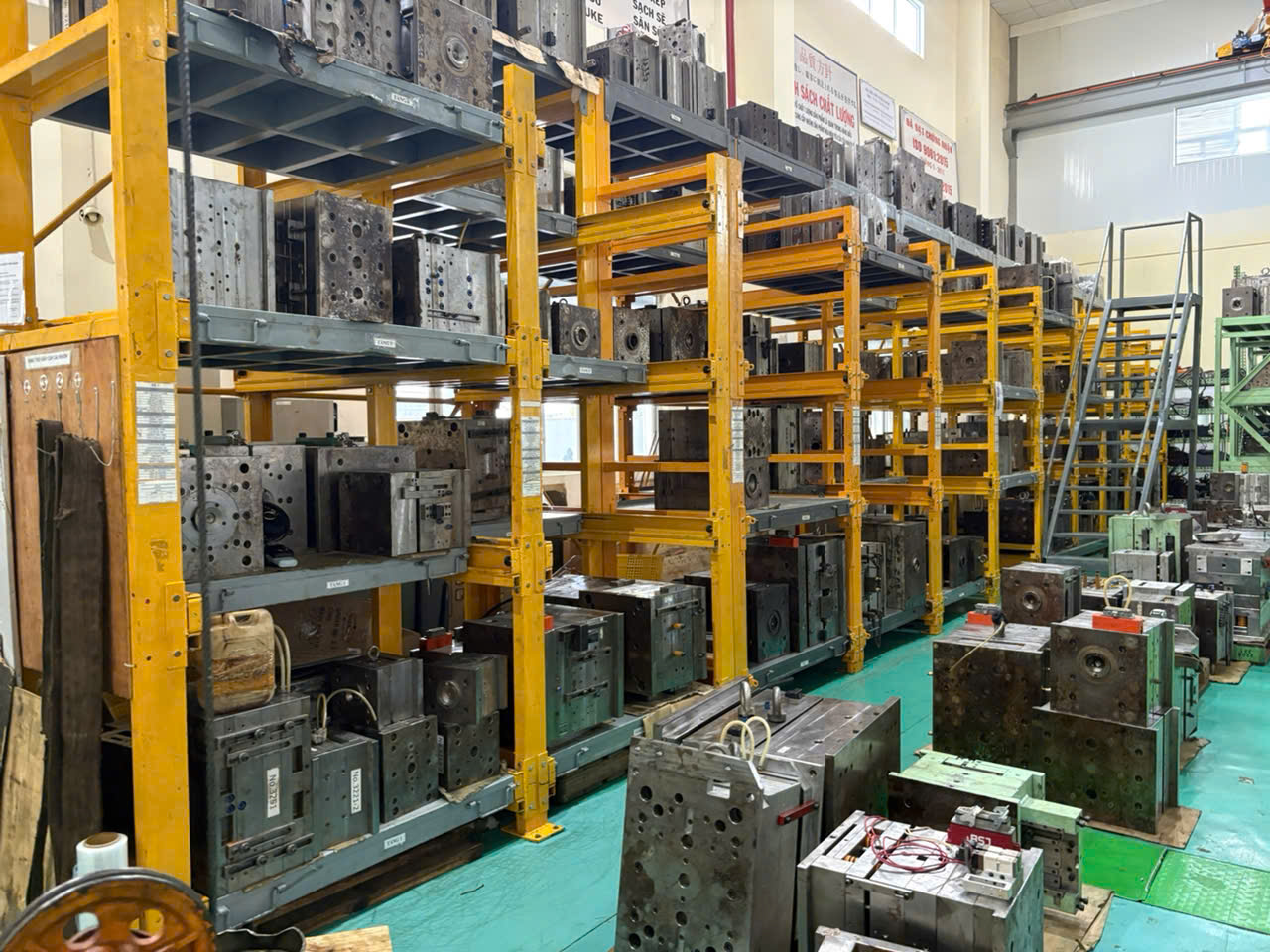
Why Vietnam is catching up on tooling quality: Vietnamese mold makers now use the same Makino, Sodick, and Mitsubishi EDM machines as top Chinese shops. Many senior mold designers trained in Japan or South Korea. Our partners achieve mold surface finishes to SPI A-2 (mirror polish) and tolerances of ±0.01 mm on critical mold dimensions.
For production tooling, expect roughly $3,000–8,000 for a simple single-cavity P20 mold, $8,000–25,000 for a medium mold with side actions, and $20,000–60,000 for complex multi-cavity hot-runner tools — typically 30–50% under US pricing.
Per-Part Injection Molding Costs in Vietnam
Per-part cost = (machine time × machine rate) + material cost + secondary ops. Here are real benchmarks from 2026 quotes:
Machine Hour Rates (2026)
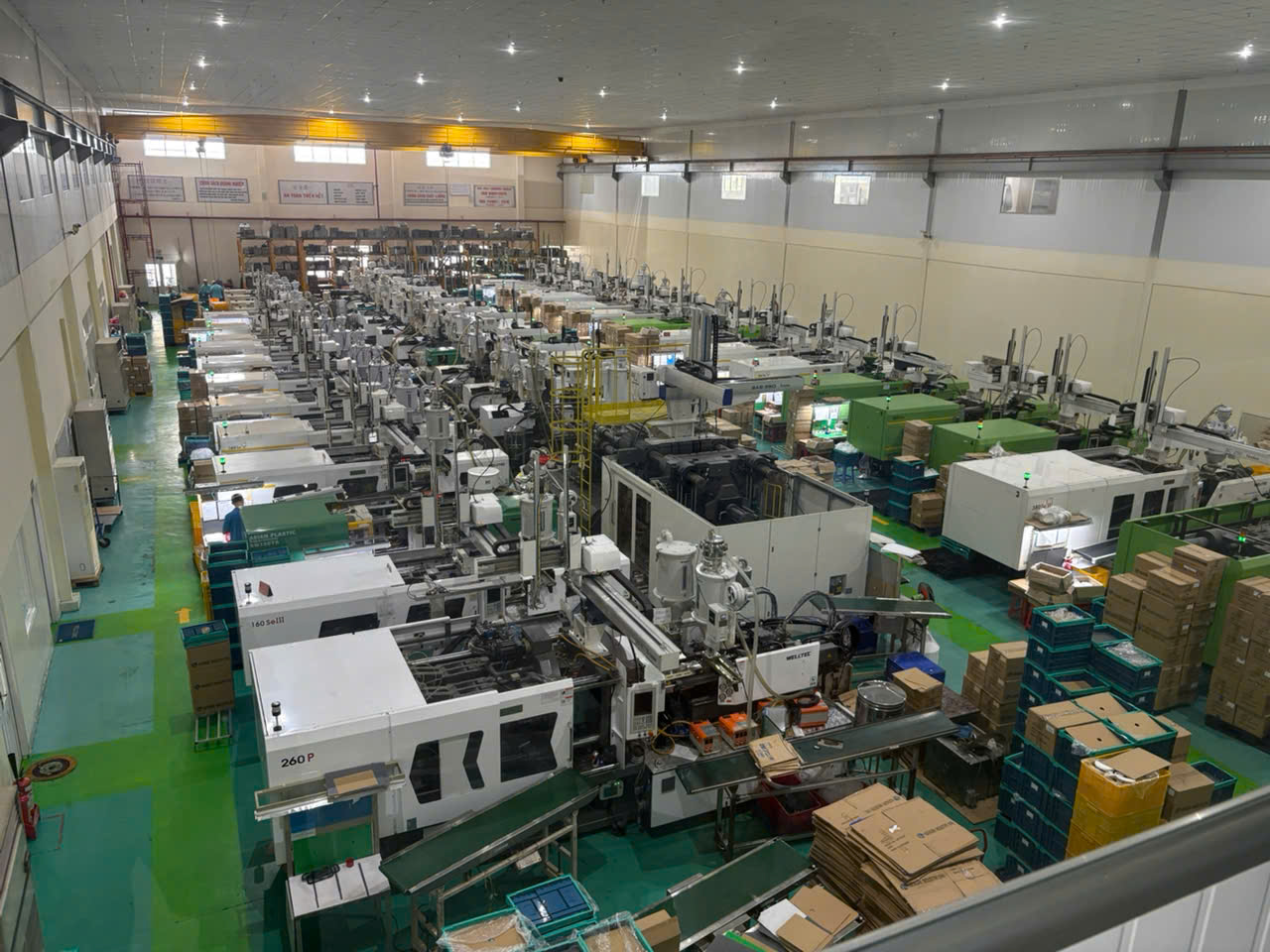
- Small press (50–100T): $12–$20/hr in Vietnam vs $45–$80/hr in the US
- Medium press (150–300T): $18–$30/hr vs $60–$110/hr US
- Large press (400–800T): $28–$50/hr vs $80–$150/hr US
- Large press (1000T+): $45–$75/hr vs $120–$200/hr US
Small Parts (<50g, cycle time 15–25s)
Connectors, clips, buttons, small housings. ABS or PP, 2-cavity mold.
- Qty 1,000: $0.25–$0.60/part
- Qty 10,000: $0.12–$0.35/part
- Qty 100,000: $0.06–$0.18/part
- Qty 1,000,000+: $0.03–$0.10/part
Medium Parts (50–200g, cycle time 25–45s)
Enclosures, covers, brackets. ABS+PC, PA66+GF, POM. 1–2 cavity mold.
- Qty 1,000: $0.60–$1.80/part
- Qty 10,000: $0.30–$0.90/part
- Qty 100,000: $0.15–$0.50/part
Large Parts (200g–1kg, cycle time 45–90s)
Automotive panels, equipment housings, large enclosures. ABS, PP+GF, PC.
- Qty 1,000: $1.50–$4.50/part
- Qty 10,000: $0.80–$2.50/part
- Qty 100,000: $0.45–$1.50/part
Resin Pricing in Vietnam (2026)
Vietnam imports most engineering resins but has competitive pricing due to trade agreements with Japan, South Korea, and ASEAN suppliers:
- PP (polypropylene): $1.10–$1.40/kg — locally produced, cheapest option
- ABS: $1.60–$2.20/kg — imported from South Korea (LG Chem, Lotte) or Taiwan
- PC (polycarbonate): $2.80–$3.60/kg — Covestro, SABIC imports
- ABS+PC blend: $2.40–$3.20/kg — popular for electronic housings
- PA66 (Nylon 66): $3.50–$5.00/kg — BASF, DuPont Zytel grades
- PA66+30%GF: $4.00–$5.80/kg — structural applications
- POM (Delrin/acetal): $2.60–$3.40/kg — DuPont, Polyplastics
- PEEK: $80–$120/kg — aerospace/medical, imported from Victrex/Solvay
Pro tip: Specify resin manufacturer and grade in your RFQ (e.g., "Covestro Makrolon 2407" not just "PC"). Vietnamese molders may substitute cheaper local or Chinese resin if you don't specify, which affects mechanical properties and UL certifications.
Total Landed Cost: Vietnam to US
The true comparison needs to include logistics. Here's a realistic breakdown for a medium-complexity part (150g ABS+PC housing, 50,000 units/shipment):
- Part cost (Vietnam): $0.42/unit
- Packaging & palletizing: $0.03/unit
- Inland freight (factory → HCMC port): $0.01/unit
- Ocean freight (HCMC → Long Beach, ~21 days): $0.08/unit at $2,800/20ft container
- US customs & duties: $0.01/unit (most plastic parts duty-free under HTS 3926)
- Drayage & last mile: $0.02/unit
- Total landed: $0.57/unit
Compare to US domestic molding at $0.85–$1.20/unit for the same part, or China at $0.35/unit + 25% Section 301 tariff = preferential tariff treatment.44/unit + freight ≈ $0.55/unit. Vietnam's landed cost is competitive with tariffed China and 40–50% below US domestic.
Key Cost Drivers to Control in Your RFQ
1. Wall Thickness
Every 0.5 mm of unnecessary wall thickness adds 3–5 seconds to cycle time (longer cooling) and 15–25% more material per part. Maintain uniform walls at 1.5–3.0 mm for most thermoplastics. Our DFM review catches this before tooling begins.
2. Tolerances
Standard injection molding tolerance is ±0.1 mm per 25 mm. Tightening to ±0.05 mm requires higher-precision molds (+15–30% tooling cost) and slower cycles. Only specify tight tolerances on mating surfaces and functional features.
3. Surface Finish
SPI B-1 (semi-gloss) is standard and included. Going to SPI A-1 (mirror) adds $2,000–$8,000 to mold cost and requires S136 or NAK80 steel. Texture (VDI 3400 or Mold-Tech) adds $1,500–$5,000 per texture area depending on depth and pattern complexity.
4. Secondary Operations
Pad printing: +$0.05–$0.15/part. Ultrasonic welding: +$0.08–$0.20/part. Hot stamping: +$0.03–$0.10/part. Insert molding (metal inserts): +$0.10–$0.30/part plus insert cost. Double-shot molding: 40–60% higher tooling but eliminates assembly.
Vietnam vs China: Injection Molding in 2026
- Tariffs: China faces 25% Section 301 tariffs on most plastic parts (HTS 3926, 8473, 8538). Vietnam: 0% additional tariffs, plus CPTPP benefits for certain categories.
- Tooling lead time: Vietnam 4–8 weeks, China 3–6 weeks. Gap has narrowed significantly since 2023.
- Minimum order quantity: Vietnam molders typically accept 1,000+ units. Many Chinese factories require 5,000–10,000 minimum for competitive pricing.
- IP protection: Vietnam enacted updated IP laws in 2023 aligning with CPTPP requirements. Combined with smaller, relationship-based factories, IP risk is materially lower than in China's massive industrial parks.
- Resin availability: China has advantage in commodity resins (PP, PE). Vietnam imports most engineering resins but pricing is competitive due to ASEAN/Japan/Korea trade agreements.
What to Include in Your Injection Molding RFQ
To get accurate quotes from Vietnam suppliers, your RFQ package should include:
- 3D CAD file (STEP preferred, IGES acceptable) — not just 2D drawings
- Material specification with manufacturer and grade (e.g., "SABIC Cycoloy C6600 or equivalent ABS+PC")
- Annual volume estimate and batch sizes — this determines cavity count and mold steel grade
- Tolerance callouts — GD&T on critical dimensions only
- Surface finish requirements — SPI class, texture (Mold-Tech number if applicable), color (Pantone/RAL)
- Testing/certification needs — UL94, RoHS, REACH, FDA contact (if applicable)
- Secondary operations — printing, assembly, packaging requirements
- Shipping terms — FOB Ho Chi Minh City, or DDP to your US warehouse
Get a Quote from DEWIN Vietnam
We connect US buyers with audited injection molding factories across southern Vietnam. Every partner in our network has been factory-audited, quality-scored, and produces T1 samples before production approval. Upload your 3D file and specs — we'll get you competitive quotes within 48 hours.
Ready to get injection molding quotes from Vietnam?
Send your STEP file and specs. We'll match you with the right factory and have quotes back in 48 hours.
Request a Quote →Frequently Asked Questions
What is the minimum order quantity for injection molding in Vietnam?
Vietnam injection molders typically accept orders from 1,000 units, while many Chinese factories require 5,000–10,000 units for competitive pricing. That lower floor makes Vietnam workable for pilot runs and mid-volume programs. Tooling lead time runs 4–8 weeks in Vietnam versus 3–6 weeks in China, a gap that has narrowed significantly since 2023.
How much does tightening tolerance to ±0.05 mm add to mold cost?
Tightening injection molding tolerance from the standard ±0.1 mm per 25 mm to ±0.05 mm adds 15–30% to tooling cost and slows cycle times, because it requires higher-precision molds. Apply the tighter callout only to mating surfaces and functional features; blanket tight tolerances across a drawing inflate the quote without improving how the part works.
Why should I name the resin manufacturer and grade in my RFQ?
Naming the exact resin manufacturer and grade — "Covestro Makrolon 2407" rather than just "PC" — stops a molder substituting cheaper local or Chinese resin. Substitution changes mechanical properties and can affect the UL certifications you depend on. The same discipline belongs on the material line of the RFQ package, alongside the 3D CAD file and annual volume estimate.
What do mirror polish and texture add to injection mold cost?
Upgrading an injection mold from the standard SPI B-1 semi-gloss finish to SPI A-1 mirror adds $2,000–$8,000 to mold cost and requires S136 or NAK80 steel. Texture, whether VDI 3400 or Mold-Tech, adds $1,500–$5,000 per texture area depending on depth and pattern complexity. SPI B-1 is standard and included in Vietnam mold quotes.