How to Write a Manufacturing RFQ for Vietnam Suppliers
February 18, 2026 · 11 min read
A well-structured RFQ is the difference between getting an accurate quote in 24 hours and spending weeks in back-and-forth clarifications. When sourcing from Vietnam, clear communication is even more important — language barriers, time zone differences, and varying technical standards mean that ambiguity in your RFQ translates directly to inflated quotes or misunderstood specifications.
After processing thousands of RFQs for Vietnam manufacturing, we've identified the patterns that get the best results. This guide shows you exactly what to include.
A complete manufacturing RFQ specifies the part, files, material grade, tolerances, quantities, and quality requirements up front. Sending all of it at once lets Vietnamese factories quote accurately in a single pass — often within 24 hours — instead of padding for uncertainty.
Step Inside a Real Vietnamese Factory with Our Sourcing Team
Watch on YouTube
Real footage from an audited DEWIN partner factory in Vietnam.
Why Incomplete RFQs Cost You 20–40% More
Vietnamese manufacturers receiving ambiguous RFQs will either ask questions (adding 3–7 days of back-and-forth across time zones) or assume worst case and pad the quote. Common gaps and their cost impact:
Incomplete RFQs cost 20–40% more because factories fill the gaps with worst-case assumptions — the tightest tolerance, the priciest alloy grade, the smallest quantity tier. Stating tolerances, material grade, and volumes explicitly removes that risk padding from every quote.
- Missing tolerances: Factory assumes tightest reasonable spec → adds 40–60% for precision pricing.
- "Stainless steel" without grade: Factory quotes SS316L ($3.50–5.50/kg) instead of SS304 ($2.50–4/kg) — 40% material cost difference.
- STL file only: No tolerance or feature data. Factory reverse-engineers and assumes conservative specs. Expect 20–30% higher quotes.
- No quantity tiers: Factory quotes safest assumption (100 pcs) when you need 5,000. You miss 50% volume discount.
- "Good finish" instead of Ra value: Factory quotes bead blast + anodize ($5–10/part extra) when as-machined was fine.
The Essential RFQ Sections
1. Part Identification
- Part name and number — Your internal P/N. Essential when quoting multiple parts.
- Revision level — Prevents quoting outdated geometry.
- Application description — "Mounting bracket for servo motor in food packaging line." Context helps Vietnamese engineers suggest DFM improvements appropriate to the application.
2. Technical Files
The most important section. Vietnamese factories can work with:
- 3D CAD (STEP preferred): Universal format. IGES acceptable. Native SolidWorks/Fusion360 is a bonus. Never send STL alone — it's mesh data with no engineering information.
- 2D drawing (PDF): Dimensioned views with GD&T, critical tolerances, surface finish symbols. This is the legal manufacturing document. Vietnamese factories are trained in ASME Y14.5 and ISO standards — use them.
- Flat pattern DXF (sheet metal): Speeds quoting significantly. If not available, note that factory should calculate from 3D model.
3. Material Specification
Be specific about grade and standard. Vietnamese factories work with:
- International standards: ASTM, AISI, JIS, DIN, EN — all understood. JIS standards are particularly common in Vietnam due to Japanese manufacturing influence.
- Good spec: "AL6061-T6 per ASTM B221" or "SS304 per ASTM A240, 2B mill finish"
- Flexibility note: "AL6061-T6 preferred, open to JIS A6061-T6 equivalent if cost advantage >10%." Vietnamese suppliers often source JIS-standard material at better pricing.
- Plastics: Specify resin brand and grade: "ABS Chimei PA-757 or LG ABS HI-121H, natural color." Vietnamese molders stock popular Asian resin brands (Chimei, LG, Lotte, SABIC).
4. Tolerances
- General tolerance block: "All dimensions ±0.1 mm unless otherwise noted." This single line saves 25% vs. ambiguity.
- Critical dimensions: Call out the 3–8 features that matter: "Bore Ø25.000 ±0.012 mm" or "Hole pattern ±0.05 mm true position."
- Surface finish: "Ra 0.8 µm on face A, Ra 3.2 µm elsewhere." — not "smooth finish."
5. Quantity and Schedule
- Multiple tiers: "Quote 100, 500, 1,000, 5,000 pieces." Takes the factory 5 extra minutes but gives you critical data.
- Annual forecast: "8,000–12,000/year in quarterly batches." Enables material bulk-buying and capacity planning for better pricing.
- Lead time expectations: Standard Vietnam lead times: CNC 2–4 weeks, sheet metal 2–3 weeks, injection molding 6–10 weeks (including tooling). Air freight adds 3–5 days; ocean adds 18–35 days depending on destination.
6. Quality Requirements
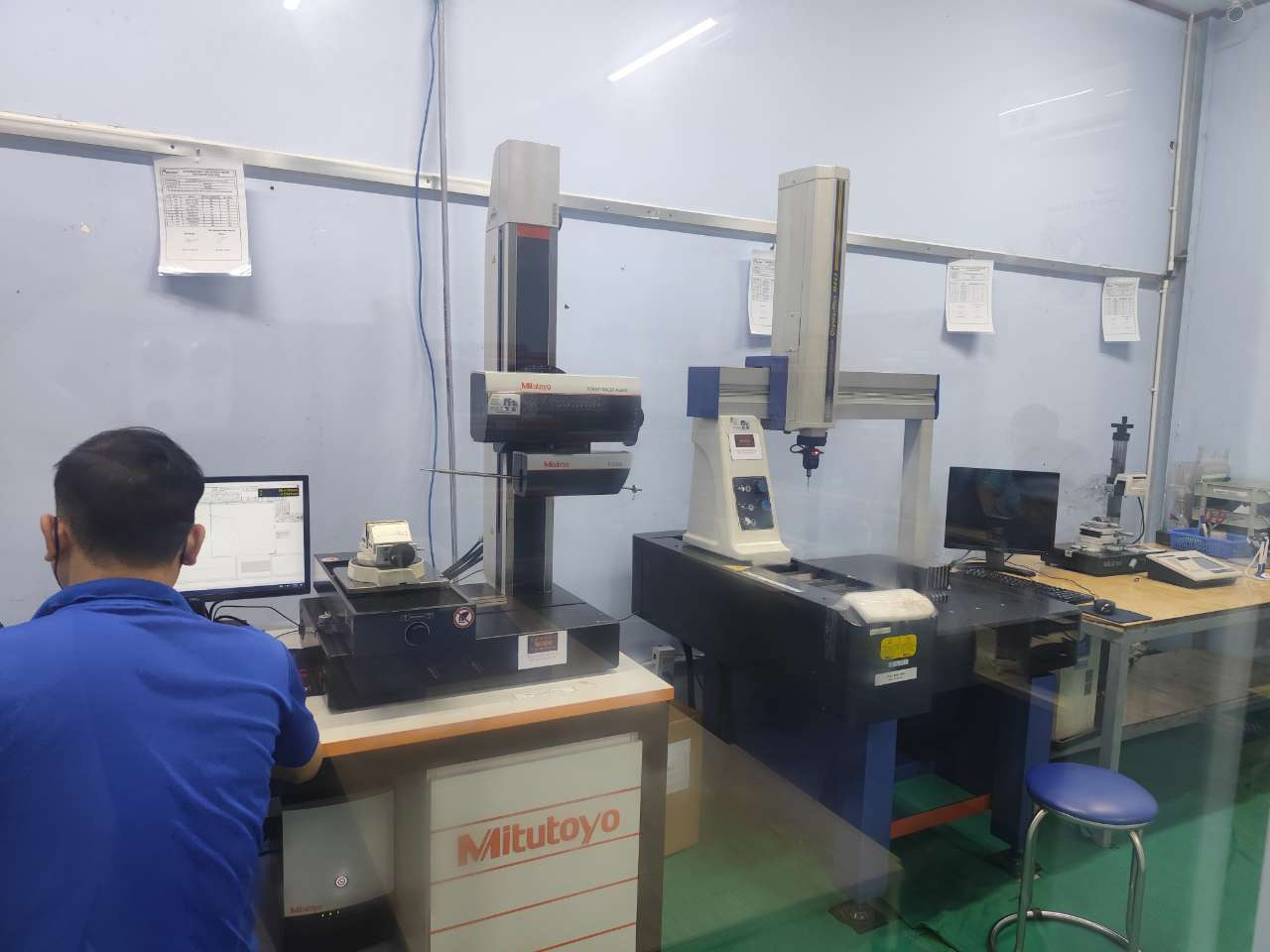
- Inspection: "100% CMM on critical dimensions. AQL 1.0 Level II on general dimensions." Standard and well-understood in Vietnam.
- FAI: "First article inspection per AS9102 before production release." Vietnamese suppliers familiar with AS9102 format — especially those serving aerospace/automotive.
- Material certs: "MTR per EN 10204 3.1 with each shipment." Standard — no extra cost.
7. Packaging and Shipping
- Shipping terms: "Quote FOB Ho Chi Minh City and CIF [your port]." Getting both lets you evaluate freight options.
- Packaging: Specify VCI wrapping for steel parts (prevents ocean transit rust), individual poly bags for cosmetic parts, carton size/weight limits for your receiving dock.
- Labeling: P/N, quantity, lot number, PO number on each carton. Simple request that prevents warehouse chaos.
RFQ Quick Checklist
- ☐ Part name, number, revision
- ☐ STEP file attached
- ☐ 2D drawing (PDF) with tolerances
- ☐ Material grade (not just "aluminum")
- ☐ General tolerance stated
- ☐ Critical dimensions identified
- ☐ Surface finish spec (Ra value or treatment)
- ☐ Quantities (3+ tiers)
- ☐ Annual volume forecast
- ☐ Lead time requirement
- ☐ Prototype or production stated
- ☐ Inspection/quality requirements
- ☐ Packaging and shipping terms
- ☐ Technical contact for questions
Vietnam-Specific RFQ Tips
- Use metric units. Vietnam uses metric exclusively. Sending imperial-only drawings causes conversion errors. Dual-dimension drawings (metric primary, imperial reference) are ideal.
- Reference international standards. ASTM, JIS, ISO, and DIN are all well-understood. Avoid proprietary company standards without explanation.
- Include photos of similar parts. A reference photo communicates finish expectations and assembly context better than text descriptions, especially across language barriers.
- Specify "or equivalent" for materials. Vietnamese suppliers may source JIS-standard equivalents at 10–15% less cost. "AL6061-T6 or JIS A6061-T6" opens this option.
- State Incoterms explicitly. FOB, CIF, DDP — don't assume. Most Vietnam quotes default to FOB HCMC.
- Allow reasonable lead times. Rushing Vietnam production (asking for 1-week CNC turnaround) eliminates cost advantage. Standard 3–4 week production + your chosen shipping method gives the best pricing.
Submit Your RFQ to DEWIN Vietnam
Send your complete RFQ package and DEWIN will match it to the best-fit suppliers from our audited Vietnam network. We handle translation, technical clarification, and factory coordination — you get a single consolidated rapid RFQ response and structured technical quotes with per-part pricing, material options, and DFM feedback.
Frequently Asked Questions
What lead times should I state in a Vietnam manufacturing RFQ?
Standard Vietnam lead times are 2–4 weeks for CNC, 2–3 weeks for sheet metal, and 6–10 weeks for injection molding including tooling. Air freight adds 3–5 days and ocean adds 18–35 days depending on destination. Asking for a one-week CNC turnaround eliminates the cost advantage, so state a realistic required date.
Should I allow JIS-equivalent material substitutions in my RFQ?
Allowing a JIS equivalent is usually worth it, because Vietnamese suppliers may source JIS-standard equivalents at 10–15% less cost. Write the option in explicitly — "AL6061-T6 preferred, open to JIS A6061-T6 equivalent if cost advantage >10%" — instead of leaving substitution to the factory's judgement. JIS standards are particularly common in Vietnam due to Japanese manufacturing influence.
Which Incoterms should I ask a Vietnam factory to quote?
A Vietnam RFQ should ask for both FOB Ho Chi Minh City and CIF your destination port. Getting both lets you evaluate freight options. Most Vietnam quotes default to FOB HCMC if you say nothing, so state the Incoterm explicitly — FOB, CIF or DDP — rather than assuming both sides have the same term in mind.