How does vertical integration control tolerances in driveline forging and broaching?
Vertical integration controls tolerances by combining 16 in-house stages from raw steel bar cutting to vacuum anti-rust packing. Closed-die forging, isothermal normalizing, hard turning on 136 robotic CNC lathes, and hydraulic pull broaching maintain ±0.008 mm spline pitch raceway concentricity, while controlled carbonitriding achieves HRC 58 to 62 hardness.
Key Takeaways
- Dolphin Services orchestrates supplier audits, DFM reviews, and ZEISS CMM inspections across a network of over 300 mapped factories in China, Vietnam, and Thailand.
- Driveline manufacturing utilizes a 16-stage vertically integrated process flow featuring 136 robotic CNC lathes, pull broaching, and CQI-9 heat treatment to hold ±0.008 mm tolerances.
- Specialist facilities supply powder metallurgy, oilless bearings, 5-axis aerospace CNC machining, fluoropolymer molding, and progressive sheet metal stamping with automated robotic welding.
In driveline component production, controlling dimensional variance across high-volume production requires strict step-by-step process management. Facilities such as Ningbo Keminsheng Machinery execute a complete 16-stage manufacturing chain starting with raw steel bar cutting, isothermal annealing, shot blasting, and saponification with phosphating. Precision cold and warm forging blanks are shaped under 160T to 630T closed-die presses and subjected to controlled normalizing to preserve uniform Ferrite-Pearlite grain flow before machining.
Subsequent machining stages utilize 136 robotic CNC lathes, 4 German EMAG hard-turning centers, and high-speed hydraulic pull broaching machines to maintain ±0.008 mm spline pitch concentricity on CV joint star sleeves (#68-3 to #125) and TJ/AAR trunnion brackets. Hardening is accomplished through automated CQI-9 controlled carbonitriding continuous furnaces, followed by 100% eddy-current crack sorting, magnetic particle inspection, ultrasonic cleaning, and anti-rust vacuum packaging.
- Cold and warm precision forging blanks produced via 160T to 630T closed-die forging with isothermal normalizing.
- Internal spline broaching and hard turning using 136 robotic CNC lathes and 4 EMAG hard-turning cells holding ±0.008 mm concentricity.
- CQI-9 controlled carbonitriding heat treatment achieving 0.85 mm to 1.25 mm case depth at HRC 58 to 62.
- In-line quality verification using eddy-current crack sorting and magnetic particle inspection before anti-rust packaging.
What processes and metrology tools support powder metallurgy and micro-machining?
Powder metallurgy and micro-machining rely on specialized tooling, automatic presses, and 3D metrology. Facilities employ 15T to 500T CNC powder presses, vacuum sintering furnaces, 5-axis CNC machining centers, and slow-wire EDM. ZEISS and Mitutoyo 3D CMMs verify structural gear dimensions, density, and surface roughness.
Component fabrication across specialist facilities like Jiande Welfine Technology, Shaoxing Guoteng Auto Parts, and Jiangmen Qiantong Powder Metallurgy combines powder compaction with advanced thermal processing. Production utilizes 15T to 500T automatic powder presses, mesh-belt sintering, steam-treatment furnaces, and catalytic debinding lines. This machinery fabricates sintered structural gears, shock absorber pistons, oil-impregnated bronze bushings (SAE841 / Sint B50), and complex 17-4PH or 316L metal injection molding (MIM) parts.
For complex aerospace and fluidic parts, specialized hubs like Hangtuo Mechanical Technology deploy over 70 sets of 5-axis and 4-axis CNC machining centers, turn-mill compounds, and precision slow-wire EDM. High-purity fluoropolymer components made from PTFE, PEEK, PFA, and PVDF by Zhenjiang RunFun Engineering Plastics undergo cleanroom assembly and DI water cleaning. Quality verification relies on temperature-controlled metrology labs equipped with ZEISS and Mitutoyo Crysta-Apex S 3D CMMs, gear profile testers, and contour measuring instruments.
- CNC powder presses from 15T to 500T for structural gears and oil-impregnated bronze bushings.
- Vacuum sintering and catalytic debinding lines for 17-4PH and 316L metal injection molding (MIM).
- Multi-axis machining via 70+ sets of 5-axis and 4-axis CNC centers and slow-wire EDM for aerospace hydraulic valve blocks.
- Advanced metrology laboratory inspection using ZEISS and Mitutoyo Crysta-Apex S 3D CMMs, contour instruments, and gear profile testers.
Which inspection and assembly steps are used for heavy stamping and turnkey assemblies?
Turnkey stamping programs utilize high-tonnage presses, laser cutting, and robotic MIG welding paired with functional testing. Production includes progressive press lines up to 315T, automated assembly, 100% hydraulic pump leak testing for hand pallet trucks, and 240-hour ASTM B117 salt spray verification for powder-coated equipment brackets.
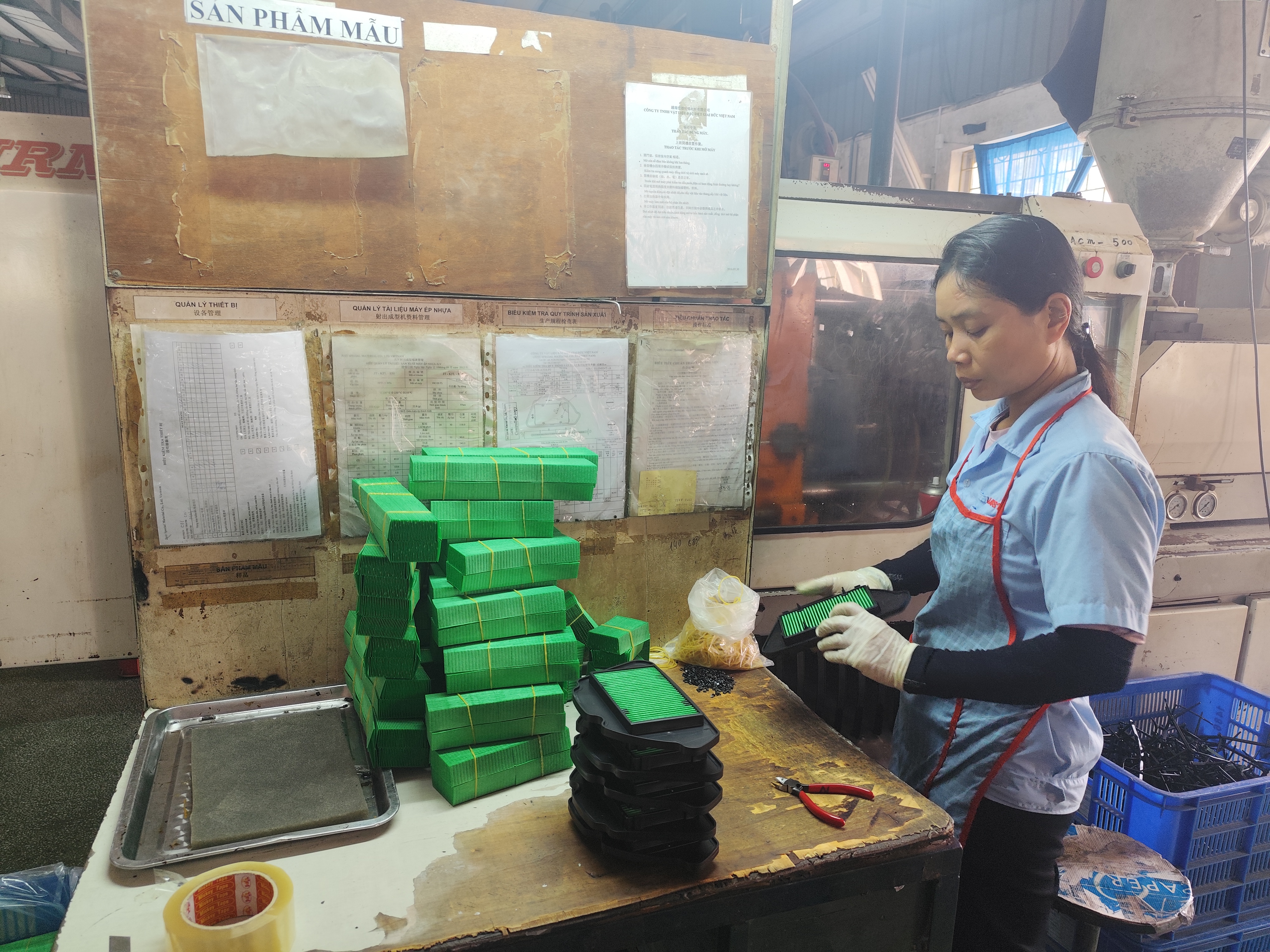
High-volume sheet metal fabrication relies on automated press lines and robotic welding stations. Plants like Ningbo Jiesheng Technology operate 33 stamping presses rated up to 315T, 22 robotic CNC milling machines, laser cutters, and 9 OTC or Panasonic welding robots. These lines manufacture progressive stampings, standing desk frames, TV mounts, and heavy steering brackets that undergo cyclic load testing.
Turnkey manufacturing facilities in Bac Ninh, Vietnam, assemble 2.0T to 5.0T hydraulic hand pallet trucks using robotic MIG welding, integrated AC/DF cast-iron pumps, and PU or nylon rollers, subjecting every unit to 100% pump leak testing. Stamped fire extinguisher brackets built from 2.0 mm to 4.0 mm gauge SPCC or SS304 steel undergo 240-hour ASTM B117 salt spray exposure, 1,500-hour UV powder coat testing, and 5G vibration retention checks.
- High-volume progressive stamping utilizing 33 presses up to 315T alongside 22 robotic CNC milling machines.
- Automated joining using 9 OTC and Panasonic MIG welding robots for heavy structural assemblies.
- Integrated assembly and 100% leak testing on AC/DF cast-iron hydraulic pumps for 2.0T to 5.0T hand pallet trucks.
- Environmental and mechanical stress testing including 240-hour ASTM B117 salt spray exposure, 1,500-hour UV testing, and 5G vibration retention latches.

Precision Manufacturing & Sourcing Specification Matrix
| Technical Dimension | Standard Commercial Grade | High-Precision OEM Export Grade | DEWIN Verification Protocol |
|---|---|---|---|
| Machining & Forming Tolerance | ISO 2768-m (±0.10 mm nominal) | ISO 2768-f (±0.01 mm – ±0.025 mm critical bores) | Calibrated 3D CMM & Air/Pin Gauging |
| Surface Roughness & Finish | Ra 1.6 – 3.2 µm as-machined / standard coat | Ra 0.4 – 0.8 µm precision ground / MIL-A-8625 anodized | Profilometer & Coating Thickness Gauge |
| Material & Alloy Certification | Supplier Mill Test Report (MTR) | Independent OES chemical & mechanical verification | EN 10204 3.1 + RoHS/REACH Compliance |
| Batch Inspection & Packaging | ISO 2859-1 (AQL 1.0 Major / 2.5 Minor) | Zero-defect critical features + VCI export crating | Pre-Shipment Inspection (PSI) Report |
Frequently Asked Questions
What quality inspection methods verify precision forged and machined spline shafts?
Forged spline shafts undergo dimensional checks on ZEISS and Mitutoyo 3D CMMs, contour analysis, surface roughness verification, 100% eddy-current crack sorting, magnetic particle inspection, and metallographic hardness checking to ensure compliance with HRC 58 to 62 standards.
How are custom sheet metal brackets tested for environmental durability?
Custom stamped brackets made from 2.0 mm to 4.0 mm SPCC or SS304 steel undergo 240-hour ASTM B117 salt spray corrosion testing, 1,500-hour UV powder coat exposure verification, and 5G vibration resistance checks for secure latch retention.
Which manufacturing methods produce self-lubricating and bimetal bearings?
Self-lubricating and bimetal bearings are produced using continuous bronze-powder sintering strip lines, automated roll-forming, CNC boring, and graphite-plugging for SF-1/SF-2 PTFE composites, JF-800 bimetals, and JDB bronze bushings.
What equipment is deployed for high-density powder metallurgy and MIM production?
Powder metallurgy and metal injection molding (MIM) utilize 15T to 500T CNC automatic powder presses, 680T hydraulic presses, mesh-belt and vacuum sintering furnaces, and catalytic debinding lines for iron, copper, and stainless steel parts.