Progressive Die Stamping in Vietnam: Cost, Tooling & High-Volume Parts Sourcing Guide
February 27, 2026 · 14 min read

Progressive die stamping is the process that makes high-volume metal parts economically viable. A single press stroke advances a metal strip through 5–30 stations, each performing a different operation — punching, bending, coining, drawing, trimming — producing a finished part every 0.5–3 seconds. At 10,000+ annual volumes, it's typically 60–85% cheaper per part than CNC machining the same geometry.
Vietnam has become a serious contender in progressive stamping, with toolmakers building dies at 40–60% of US or Japanese costs while achieving tolerances of ±0.05mm on critical features. This guide covers everything US buyers need to know about sourcing progressive-stamped parts from Vietnam — from tooling economics to design rules that prevent costly die modifications.
Progressive die stamping advances a metal strip through 5–30 stations in one press, finishing a part every 0.5–3 seconds. Above roughly 10,000 annual units it's typically 60–85% cheaper per part than CNC machining — and Vietnam toolmakers build the dies at 40–60% of US cost.

Top Stainless Steel Pipe Manufacturer in Vietnam
Watch on YouTube
Real footage from an audited DEWIN partner factory in Vietnam.
Progressive Stamping vs. Other Forming Methods: When It Makes Sense
Progressive stamping isn't always the right answer. Here's when it wins and when alternatives are better:
| Method | Best Volume Range | Typical Tolerance | Per-Part Cost (Relative) | Tooling Cost |
|---|---|---|---|---|
| CNC machining | 1–5,000 | ±0.01–0.025mm | $$$ | $0–500 |
| Laser cutting + bending | 1–10,000 | ±0.1–0.3mm | $$ | $0–200 |
| Single-stage stamping | 5,000–50,000 | ±0.1–0.2mm | $–$$ | $3,000–15,000 |
| Progressive stamping | 10,000–10M+ | ±0.05–0.1mm | $ | $8,000–80,000 |
| Transfer stamping | 50,000–5M+ | ±0.05–0.15mm | $ | $15,000–150,000 |
The crossover point: Progressive stamping typically beats CNC machining at 3,000–10,000 annual units, depending on part complexity. A bracket that costs $8.50/pc CNC machined might cost $0.35/pc progressive-stamped at 100K volumes — with $15,000 in tooling amortized over the first year.
How Progressive Dies Work: A Buyer's Primer
Understanding the process helps you communicate with suppliers and design parts that don't require $80,000 dies when $25,000 would suffice.
The Strip Layout
The die designer creates a "strip layout" — a plan showing how the flat metal strip transforms into the finished part across sequential stations. Each station performs one or two operations. A typical automotive bracket might use 8–12 stations:
- Station 1–2: Pilot holes punched for strip registration (±0.01mm positioning accuracy)
- Station 3–4: Feature holes, slots, and peripheral blanking
- Station 5–6: Forming operations — bends, draws, embosses
- Station 7–8: Coining (for tight tolerances on specific features)
- Station 9–10: Secondary forming, tapping, or hardware insertion
- Station 11–12: Final trim and cutoff — part separates from the carrier strip
Press Speeds and Cycle Times
- Small parts (≤100mm): 60–200 strokes per minute (SPM) — one part per stroke
- Medium parts (100–300mm): 30–80 SPM
- Large/deep-drawn parts (>300mm): 10–40 SPM
- At 100 SPM: That's 6,000 parts/hour, 48,000 parts/shift — a 100K order runs in 2–3 shifts
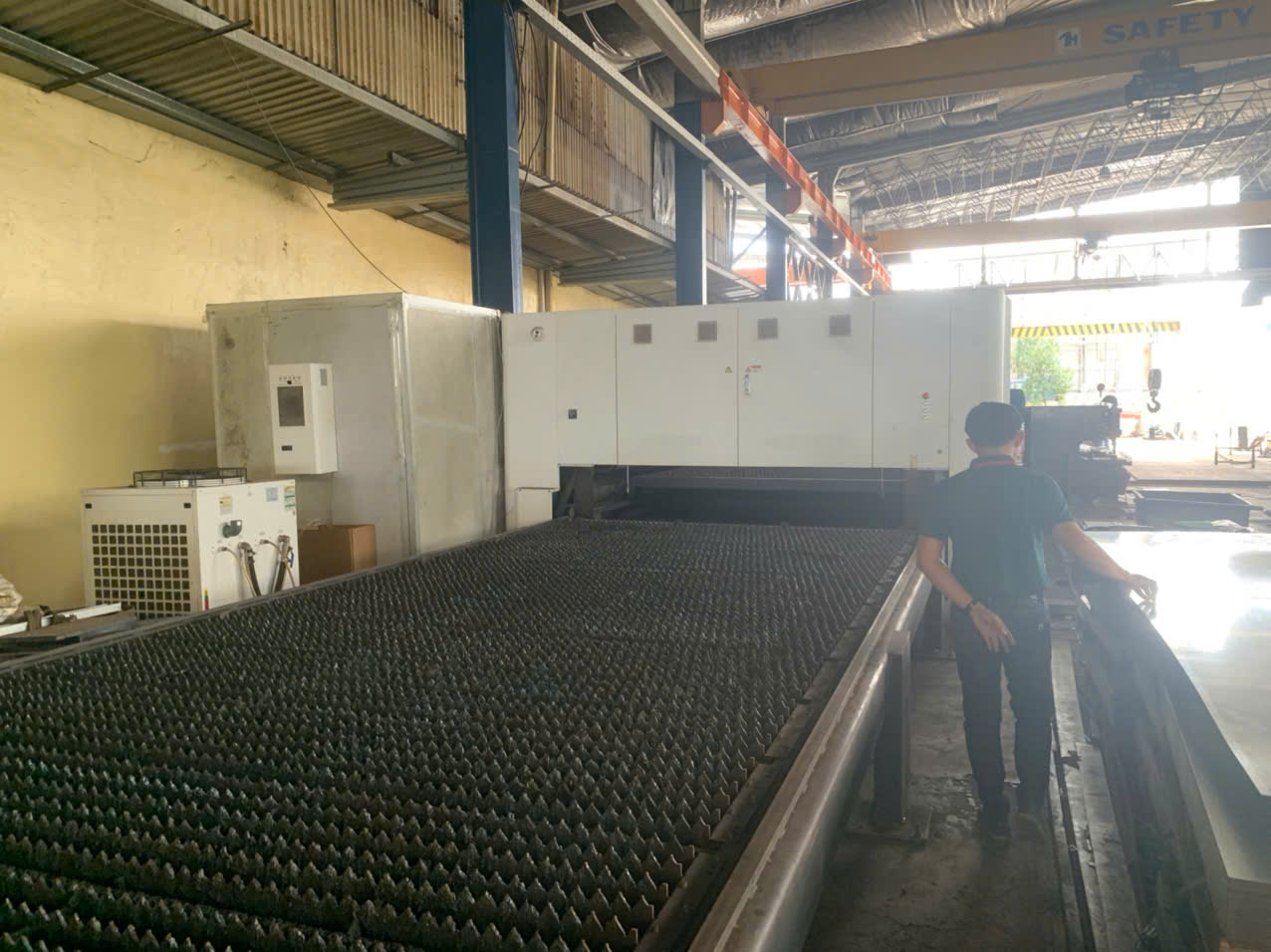
Tooling Costs: Vietnam vs. US vs. China
The progressive die is the biggest upfront investment. Tooling cost depends on part complexity, number of stations, material thickness, and die life requirements.
Progressive die tooling is the main upfront cost, driven by part complexity, station count, material thickness, and required die life. In Vietnam, expect roughly $6,000–14,000 for simple dies and $28,000–60,000 for complex ones — comparable to China and well below US pricing.
| Die Complexity | US Cost | China Cost | Vietnam (DEWIN) | Die Life |
|---|---|---|---|---|
| Simple (4–6 stations, flat parts) | $15,000–30,000 | $5,000–12,000 | $6,000–14,000 | 500K–2M strokes |
| Medium (8–12 stations, bends + draws) | $30,000–65,000 | $12,000–28,000 | $14,000–32,000 | 1M–5M strokes |
| Complex (15–25 stations, deep draw + tight tol.) | $65,000–150,000 | $25,000–55,000 | $28,000–60,000 | 3M–10M strokes |
Vietnam vs. China on tooling: Prices are comparable, but Vietnam toolmakers increasingly use wire EDM and CNC-machined die components (rather than manual grinding), yielding more consistent die quality. Lead times are similar: 6–10 weeks for medium complexity.
Per-Part Cost: Real Examples from Vietnam
These are actual part cost ranges from our Vietnam stamping suppliers in early 2026, at various volumes:
| Part Type | Material | 10K pcs | 100K pcs | 1M pcs |
|---|---|---|---|---|
| Electrical contact, 15×8mm | C2600 brass, 0.5mm | $0.08–0.12 | $0.03–0.05 | $0.015–0.025 |
| Automotive bracket, 80×60mm | SPCC steel, 1.2mm | $0.35–0.55 | $0.12–0.20 | $0.06–0.10 |
| Heat sink fin assembly, 120×40mm | AL1100, 0.8mm | $0.45–0.70 | $0.18–0.28 | $0.08–0.14 |
| Deep-drawn motor housing, ∅50×35mm | SPCE steel, 1.5mm | $0.80–1.20 | $0.30–0.48 | $0.15–0.25 |
| Stainless clip, 30×15mm | SUS304, 0.8mm | $0.15–0.25 | $0.06–0.10 | $0.03–0.05 |
Excludes tooling amortization and shipping. Includes material, stamping, and basic deburring.
Design Rules for Progressive Stamping
Following these rules keeps your tooling cost down and your parts manufacturable. Violating them doesn't always mean "impossible" — but it means expensive dies, shorter die life, and higher scrap rates.
Material Thickness
- Sweet spot: 0.3–4.0mm for most progressive dies
- Below 0.2mm: Wrinkling and feeding issues — requires specialized tooling with spring-loaded strippers
- Above 6.0mm: Tonnage requirements jump exponentially. Consider fine blanking or transfer stamping instead
- Consistency matters: Specify material thickness tolerance (typically ±10% of nominal). Out-of-spec thickness causes dimensional drift across all features
Hole and Feature Sizes
- Minimum hole diameter: ≥ material thickness (e.g., 1.0mm hole in 1.0mm steel). Smaller is possible but reduces punch life dramatically
- Hole-to-edge distance: ≥ 1.5× material thickness minimum. Closer causes edge deformation
- Hole-to-hole distance: ≥ 2× material thickness for clean slugs
- Slot width: ≥ 1.5× material thickness to prevent punch breakage
Bend Rules
- Minimum bend radius: ≥ 1× material thickness for steel, ≥ 0.5× for aluminum, ≥ 2× for stainless steel
- Bend-to-edge distance: ≥ 2.5× material thickness + bend radius. Closer causes tearing
- Bend-to-hole distance: ≥ 3× material thickness from hole edge to bend line. Holes too close distort during bending
- Grain direction: Bend perpendicular to rolling direction when possible. Parallel bends in stainless steel often crack
Draw Depth
- First draw: Maximum depth ≈ 40–50% of blank diameter for steel, 35–45% for stainless
- Each subsequent redraw: 20–30% depth reduction from previous draw
- Deep draws (>2× diameter): Require multiple draw stations with intermediate annealing — adds $3,000–8,000 to die cost
- Wall thinning: Expect 10–15% wall thinning in drawn sections. Design wall thickness requirements from the thinned value, not nominal
Materials for Progressive Stamping in Vietnam
Vietnam sources coil stock from POSCO (Korea), Nippon Steel (Japan), and domestic mills. Availability is excellent for standard grades:
- Cold-rolled steel (SPCC/SPCE/SPCD): $0.70–0.95/kg — the default for brackets, housings, structural parts. SPCE for deep drawing.
- Galvanized steel (SGCC): $0.85–1.15/kg — corrosion protection without post-plating
- Stainless steel (SUS304/SUS301): $2.80–3.50/kg — SUS301 preferred for spring clips (higher yield strength, better springback control)
- Aluminum (A1100/A5052): $2.50–3.20/kg — heat sinks, electronics housings, lightweight brackets. A5052 for structural applications.
- Brass (C2600/C2680): $4.50–6.00/kg — electrical contacts, connectors, decorative parts
- Phosphor bronze (C5191/C5210): $8.00–11.00/kg — precision springs and contacts requiring fatigue resistance
- Copper (C1100): $7.50–9.50/kg — bus bars, electrical conductors, heat spreaders
Quality Control for Stamped Parts
Progressive stamping quality depends on die maintenance and in-process monitoring. Here's what to require from your Vietnam supplier:
- In-die sensors: Misfeed detection, slug retention sensors, and tonnage monitoring should stop the press automatically on anomalies
- SPC (Statistical Process Control): Critical dimensions measured every 500–2,000 parts with Cp/Cpk ≥ 1.33
- First article inspection: Full dimensional report per drawing at production start and after any die maintenance
- Die maintenance schedule: Defined stroke counts for sharpening (typically every 50K–200K strokes depending on material)
- Material incoming inspection: Thickness, hardness, and chemistry verification against mill test certificates
- Vision inspection: For critical features, automated vision systems catch defects at press speed that manual inspection misses
Secondary Operations Available in Vietnam
- Tapping and threading: In-die tapping up to M6, post-stamping for larger threads. $0.01–0.05/hole
- Hardware insertion (PEM nuts/studs): In-die or post-press. $0.02–0.08/insert
- Welding: Spot welding, projection welding, MIG/TIG for assemblies. $0.05–0.30/weld
- Plating: Zinc (clear/yellow/black), nickel, tin, gold flash. $0.02–0.15/part for small components
- Powder coating: $0.10–0.50/part depending on size. Wide color range available.
- E-coating: $0.05–0.20/part — excellent for automotive corrosion requirements
- Assembly: Riveting, screwing, adhesive bonding into sub-assemblies
Lead Times: Tooling Through Production
| Phase | Timeline | Notes |
|---|---|---|
| Die design + review | 1–2 weeks | Strip layout review is critical — request it before build approval |
| Die build (simple) | 4–6 weeks | 4–6 station dies, standard materials |
| Die build (complex) | 8–12 weeks | 15+ station dies, tight tolerances, deep draws |
| Tryout + first articles | 1–2 weeks | Sample approval before production release |
| Production (100K pcs) | 3–7 business days | Progressive stamping is fast — once running, output is thousands/hour |
| Shipping (sea freight) | 18–25 days to US West Coast | Stamped parts pack efficiently — lower freight cost per unit |
Tariff Considerations for US Importers
Stamped metal parts from China face Section 301 tariffs of 25% on top of standard duties (HTS 7326 for steel articles, 7616 for aluminum). Vietnam-origin stamped parts enter at MFN rates typically 2–6% depending on classification. The math is straightforward:
- $0.20 part from China: $0.20 + 25% + 3.4% MFN = $0.257 landed
- $0.18 part from Vietnam: $0.18 + 3.4% MFN = $0.186 landed
- Net savings: 28% lower landed cost — at 1M annual volume, that's $71,000 saved
Source Progressive-Stamped Parts from Vietnam
DEWIN connects US buyers with vetted Vietnam stamping facilities running 30–300 ton progressive presses with in-die monitoring, SPC quality systems, and complete secondary operation capabilities. Send us your part drawing for tooling and piece-price quotation within 5 business days.
Frequently Asked Questions
How long does progressive die tooling take in Vietnam?
Tooling lead time for a medium-complexity progressive die in Vietnam is 6–10 weeks, similar to China. That breaks down as 1–2 weeks for die design and strip-layout review, 4–6 weeks of build for a simple die or 8–12 weeks for a complex one, then 1–2 weeks of tryout and first articles before production release.
What material thickness works best for progressive die stamping?
Progressive dies work best on material 0.3–4.0mm thick. Below 0.2mm, wrinkling and feeding issues require specialized tooling with spring-loaded strippers; above 6.0mm, tonnage requirements jump exponentially and fine blanking or transfer stamping becomes the better option. Specify a thickness tolerance too, typically ±10% of nominal, because out-of-spec stock causes dimensional drift across all features.
Can Vietnam stamping suppliers add threads and hardware in-house?
Vietnam stamping suppliers tap threads in-die up to M6 and post-stamping for larger threads, at $0.01–0.05 per hole, and install PEM nuts or studs in-die or post-press for $0.02–0.08 per insert. Spot, projection, and MIG/TIG welding runs $0.05–0.30 per weld. Plating, powder coating, e-coating, and sub-assembly work are also available.
How much wall thinning should I expect in a deep-drawn stamped part?
Deep-drawn sections thin by 10–15%, so design wall thickness requirements from the thinned value, not the nominal stock. First-draw depth is capped near 40–50% of blank diameter for steel and 35–45% for stainless, with 20–30% depth reduction on each subsequent redraw. Draws deeper than 2× diameter need multiple draw stations plus intermediate annealing, adding $3,000–8,000 to the die.