Packaging customization options for stamping parts saved one of my projects last year. A client’s brackets arrived scratched twice before we redesigned the pack. Bad packaging quietly destroys good parts—and your margins.
Packaging customization options for stamping parts include VCI anti-rust bags, custom foam or divided trays, tape-and-reel systems, exact-count polybags, orientation-specific inserts, branded and barcoded labels, corrugated cartons, wooden crates, and returnable dunnage—each matched to part geometry, surface finish, volume, and shipping distance.
Let me walk you through the options that matter most. I will cover damage prevention, branding, corrosion protection, and U.S. compliance, in that order.
How Do I Choose the Right Packaging to Prevent Damage During Shipping from Asia?
A container from our Vietnam facility spends three to five weeks at sea before it reaches a U.S. port. Our team plans packaging around that reality, not around the loading dock.
Choose packaging based on part geometry, weight, and surface sensitivity: use divided trays or foam inserts for delicate or nesting parts, bulk polybags in cartons for rugged parts, and reinforced cartons on pallets with stretch wrap and banding to survive ocean transit vibration and stacking.
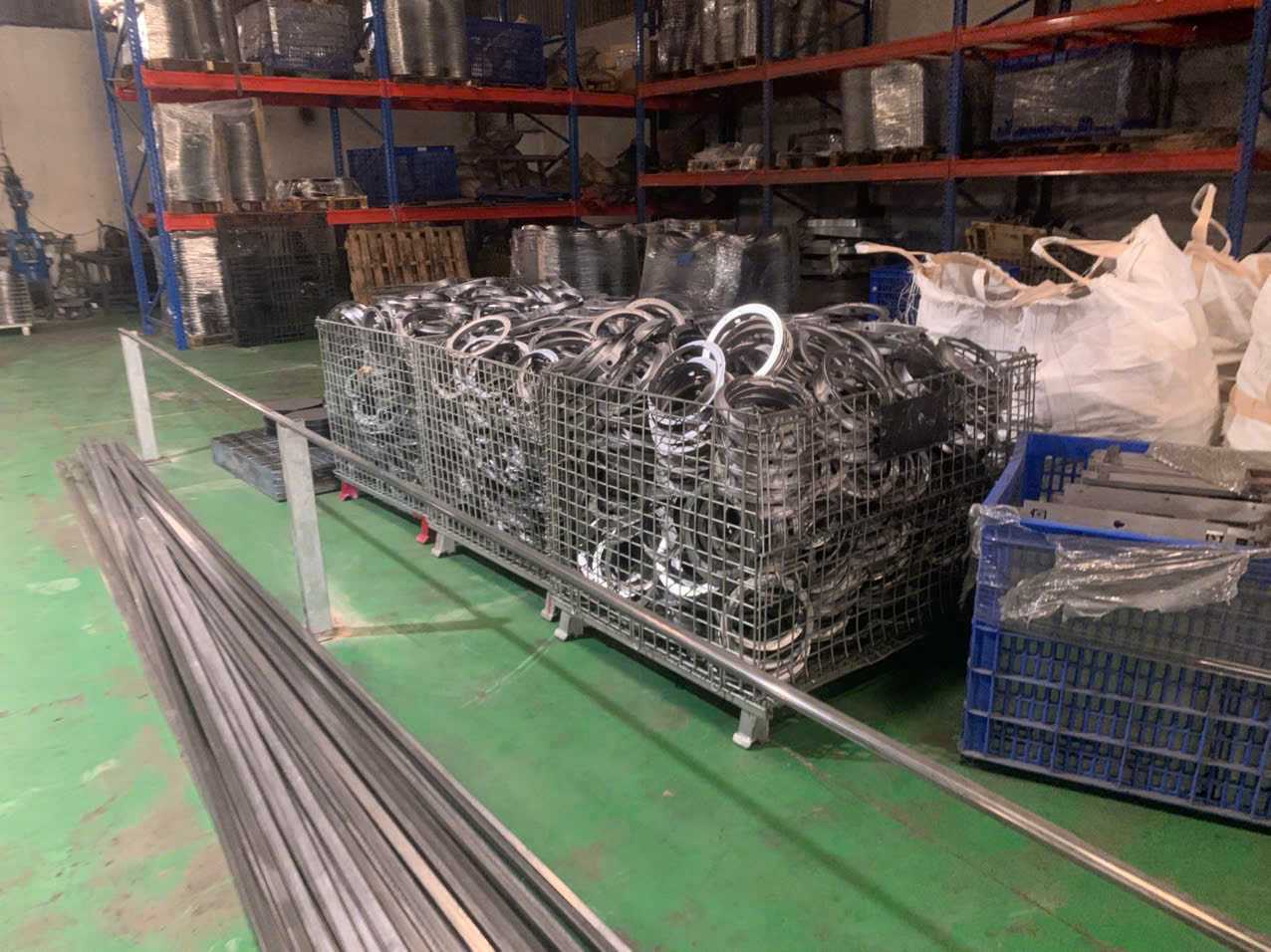
Stamped parts fail in transit for predictable reasons. Thin flanges bend under stacking pressure. Sharp edges scratch neighboring parts. Zigzag brackets like the ones we produce love to nest and tangle inside a loose bag. Ocean freight 1 adds vibration, humidity swings, and rough handling at two ports. So the packaging has to do real engineering work.
Match the Packaging Format to the Part
Start with the part itself. A flat, sturdy galvanized bracket can ride in a bulk polybag inside a carton. A part with a raised lip or hook, like a panel-gripping clip, needs separation. In our experience exporting to the U.S., we ask three questions before quoting packaging: Can the parts scratch each other? Can they tangle? Can they deform under weight? Any "yes" pushes us away from bulk packaging.
| Part Characteristic | Recommended Packaging | Why It Works |
|---|---|---|
| Rugged, flat, non-nesting | Bulk polybags in cartons | Lowest cost, parts tolerate contact |
| Thin flanges, easy to bend | Divided trays or layer pads | Prevents stacking pressure on tabs |
| Interlocking or hooked shapes | Egg-crate inserts or cell dividers | Stops nesting and tangling |
| Cosmetic or plated surfaces | Foam-lined trays, paper interleaving | Eliminates metal-on-metal rubbing |
| Small precision parts, high volume | Tape-and-reel or tubes | Protects and feeds automation |
| Heavy or oversized stampings | Wooden crates, plywood boxes, pallets | Structural strength for weight |
Plan for the Full Journey
The outer pack matters as much as the inner pack. We spec double-wall corrugated cartons 2 for most ocean shipments, keep carton weight manageable for manual handling, and palletize with corner boards, stretch wrap, and banding. For fragile geometries, we run drop and stacking checks before the first mass shipment. One trial carton tested early is cheaper than one claim filed later.
Can I Get Custom Labeling and Branding on My Stamping Parts Packaging?
A purchasing manager once told me his warehouse team wasted hours matching unlabeled cartons to purchase orders. We fixed it with a simple barcode label spec, and his receiving time dropped noticeably.
Yes. Stamping suppliers can add custom labels with part numbers, lot codes, barcodes, and quantities, plus printed logos on cartons, branded polybags, retail-ready blister packs, and customer-supplied packaging. Labeling supports traceability, warehouse scanning, and brand presentation at minimal added cost.

Labeling is the cheapest customization with the highest operational payoff. On our production line, every carton leaving final inspection carries a label tied to the inspection record. That link matters. When a client questions a lot six months later, we trace it back to the press run, the coil material, and the QC report in minutes.
What You Can Customize
Here is the typical menu we offer clients sourcing custom parts through Vietnam and other Asian countries:
- Part identification labels — your part number 3, revision level, and description exactly as they appear on your drawing.
- Lot and batch codes — essential for PPAP 4-controlled parts and for isolating any quality issue to a single production run.
- Barcodes and QR codes — formatted for your WMS or ERP scanning, including UPC codes 5 for retail-bound items.
- Quantity and exact-count marking — each container packed to a verified count, which simplifies inventory and prevents shortage disputes.
- Brand printing — your logo on cartons, printed polybags, or header cards, so the box reflects your company, not the factory's.
- Kitting labels — when we pack multiple part numbers as an assembly kit, each kit gets its own consolidated label.
Neutral or Blind Packaging
Many of our U.S. clients are distributors. They do not want their end customers seeing the factory's name. We routinely ship in blind packaging: no supplier marks, only the client's branding and required regulatory information. If you supply your own packaging artwork or even your own pre-printed boxes, a capable supplier should accept both. We ask for label specs during the quoting stage, because retrofitting a labeling system after production starts always costs more.
What Anti-Rust and Moisture Protection Options Should I Request for Metal Stamped Parts?
Humidity in Southeast Asia routinely exceeds eighty percent, and a sealed container crossing the Pacific becomes a condensation chamber. Our packing team treats corrosion protection as a standard line item, not an afterthought.
Request VCI (vapor corrosion inhibitor) bags or paper as the baseline, plus desiccant packs inside sealed liners. For bare steel, add rust-preventive oil coating; for long storage, use vacuum-sealed VCI packs. Match the method to the metal—steel, galvanized, stainless, or aluminum each differ.

Rust claims are painful because the parts were perfect when they left the press. The damage happens silently inside the container. Temperature drops at night, moisture condenses on cold metal, and by the time the carton is opened in Ohio, bare steel edges show orange bloom. Even galvanized and stainless parts are not immune—cut edges and stress points can still stain or corrode under prolonged wet exposure.
Protection Methods Compared
| Protection Method | Best For | Duration | Cost Level | Notes |
|---|---|---|---|---|
| VCI bags or VCI paper | Steel, galvanized parts | 6–24 months sealed | Low–Medium | Clean, dry parts on arrival; no residue |
| Rust-preventive oil | Bare carbon steel | 3–12 months | Low | May need degreasing before assembly |
| Desiccant packs | All metals, added insurance | Trip duration | Low | Always pair with a sealed liner |
| Vacuum-sealed VCI packs | Long storage, high-value parts | 12+ months | Medium–High | Best barrier against humidity cycles |
| Sealed poly liners + desiccant | Stainless, aluminum | Trip duration | Low | Prevents staining and water marks |
Match Protection to the Metal and the Process
The right choice depends on what happens after arrival. If your parts go straight to an assembly line, VCI bags are ideal because parts arrive dry and ready to handle. If parts will sit in a warehouse for a year, we recommend vacuum-sealed VCI with desiccant. If a light oil film is acceptable in your process, oiling is the cheapest robust option for bare steel. One caution from our final inspection process: parts must be completely dry and fingerprint-free before sealing. Trapped moisture or skin oils inside a VCI bag will still corrode. That is why our packing happens in a controlled step after final inspection, with handlers wearing gloves for bare-steel and plated parts.
How Do I Ensure My Packaging Meets U.S. Import and Retail Requirements?
Compliance surprises hurt. Early in our door-to-door logistics service, we watched a shipment get flagged over wood packaging documentation, and that lesson shaped our packing checklist ever since.
Use ISPM 15 heat-treated and stamped wood pallets or crates, mark country of origin clearly, include accurate carton markings matching commercial invoices, and follow customer-specific routing guides. For retail, add UPC barcodes, retail-ready labeling, and packaging that passes drop and stacking tests.
U.S. import compliance for packaging splits into three layers: government rules, carrier realities, and customer requirements. Miss any layer and you face delays, chargebacks, or refused deliveries. Here is how we handle each one when we manage door-to-door shipments for our U.S. clients.
The Three Compliance Layers
| Layer | Key Requirements | Consequence of Failure |
|---|---|---|
| U.S. Customs / Government | ISPM 15 6 wood treatment stamps, country-of-origin marking, accurate descriptions matching invoices | Container fumigation, re-export, fines, clearance delays |
| Carrier / Freight | Carton weight limits, pallet dimensions, secure banding and wrapping | Damage claims denied, handling surcharges |
| Customer / Retail | Routing guides, label placement, UPC barcodes, packing slips, carton content rules | Chargebacks, refused receipts, delisting |
Country of Origin and Documentation
Every carton needs clear country-of-origin marking country of origin 7—for our clients, that is typically "Made in Vietnam" or another non-China Asian origin. This marking must match the commercial invoice and the certificate of origin, because customs officers do compare them. Given current tariff scrutiny on Asian imports, consistent and truthful origin marking is not optional. We photograph carton markings before every container is sealed, so our clients have documented proof.
Retail-Specific Additions
If your stamped parts sell through hardware retailers or e-commerce, plan further ahead. Big-box retailers publish routing guides that dictate label position, barcode symbology, and even tape color. Amazon FBA has its own carton weight and labeling rules. We build these requirements into the packaging spec during OEM co-development, then verify them at final inspection. A checklist step at the factory costs minutes; a chargeback from a U.S. retailer costs real money and goodwill.
Frequently Asked Questions
How Do I Choose the Right Packaging to Prevent Damage During Shipping from Asia?
A container from our Vietnam facility spends three to five weeks at sea before it reaches a U.S. port. Our team plans packaging around that reality, not around the loading dock.
Can I Get Custom Labeling and Branding on My Stamping Parts Packaging?
A purchasing manager once told me his warehouse team wasted hours matching unlabeled cartons to purchase orders. We fixed it with a simple barcode label spec , and his receiving time dropped noticeably.
What Anti-Rust and Moisture Protection Options Should I Request for Metal Stamped Parts?
Humidity in Southeast Asia routinely exceeds eighty percent, and a sealed container crossing the Pacific becomes a condensation chamber. Our packing team treats corrosion protection as a standard line item, not an afterthought.
Have a STEP Model or 2D Drawing for This Project?
Share your drawing, material, quantity and finishing requirements to begin a manufacturing quote. Confirm pricing, delivery and inspection requirements during the review.
This article is part of DEWIN's technical manufacturing engineering knowledge base. Factory-specific details come from each factory's profile page — please verify current information there or with our team.