
Material selection is the first decision on every sheet metal drawing, and it drives cost, lead time, and manufacturability more than any tolerance callout. This guide is for design engineers and sourcing managers specifying parts for Vietnamese fabrication. It covers the four main material families, the grades Vietnamese fabricators actually stock (SPCC, SS304/316, AL5052/6061 and their relatives), how gauge and thickness standards translate between US drawings and metric mills, and what to expect on material certification.
To choose sheet metal material for Vietnam fabrication, match the family to function — carbon steel for coated cost parts, stainless for corrosion, aluminum for weight or anodizing, copper/brass for conductivity — specify locally stocked grades, dimension thickness in millimeters, and require EN 10204 3.1 mill certs.
Key takeaways:
- Vietnam’s verified partner facility ecosystem provides Tier-1 precision manufacturing with direct engineering transparency and relief from Section 301 Chinese punitive tariffs for qualifying goods.
- Technical documentation must pair 3D models with 2D drawings detailing critical GD&T datums, tolerance limits, and material specs.
- On-site supplier auditing (50-point Dolphin Audit across QCLDM) verifies machinery capacity, CMM metrology, and material traceability.
- Sourcing through DEWIN guarantees Delaware LLC contracting, streamlined RFQ turnaround and engineering review turnaround, and door-to-door DDP logistics.
Key Takeaways
- Vietnamese fabricators quote fastest on locally stocked grades: SPCC/SGCC carbon steel, SUS304/316 stainless, and AL5052/6061 — specifying exotic grades adds weeks of material lead time.
- Vietnamese mills and service centers work in millimeters; put metric thickness on your drawings and treat US gauge numbers as reference only.
- AL5052 bends; AL6061-T6 breaks — choose 5052 for formed enclosures and 6061 for flat structural or machined-and-formed hybrids.
- SS316 costs meaningfully more than SS304 and is only justified by chloride, marine, or chemical exposure.
- Always require mill certificates (EN 10204 3.1 type) on the PO — traceability is standard practice at verified partner factories but must be requested explicitly.
What Are the Four Sheet Metal Material Families?
Carbon steel is the default for painted or plated industrial parts: brackets, chassis, enclosures, frames. Cold-rolled SPCC (the JIS equivalent of DC01/CRS) gives clean surfaces for powder coating; hot-dip galvanized SGCC adds zinc protection for parts that will not be painted after cutting. It is the cheapest family and every Vietnamese fabricator stocks it.
Stainless steel buys corrosion resistance and a finished appearance without coating. SS304 (SUS304 in JIS notation, the naming most Vietnamese suppliers use) handles the vast majority of food equipment, architectural, and general outdoor applications. SS316 adds ~2% molybdenum for chloride and chemical resistance — specify it for marine, coastal, and process-industry parts, not by default. For deeper detail on grades and finishing, see our guide to stainless steel machining in Vietnam.
Aluminum is the choice when weight matters or when anodizing is the desired finish. AL5052-H32 is the sheet metal workhorse — excellent formability and corrosion resistance. AL6061-T6 is stronger and machines beautifully but cracks on tight bends; it belongs in flat plates, machined parts, and weldments more than in formed enclosures.
Copper and brass are specified for conductivity and appearance rather than structure: busbars, grounding straps, EMI shielding, decorative panels. They cost several times more than steel per kilogram, so designs usually confine them to the parts of an assembly that genuinely need their properties.
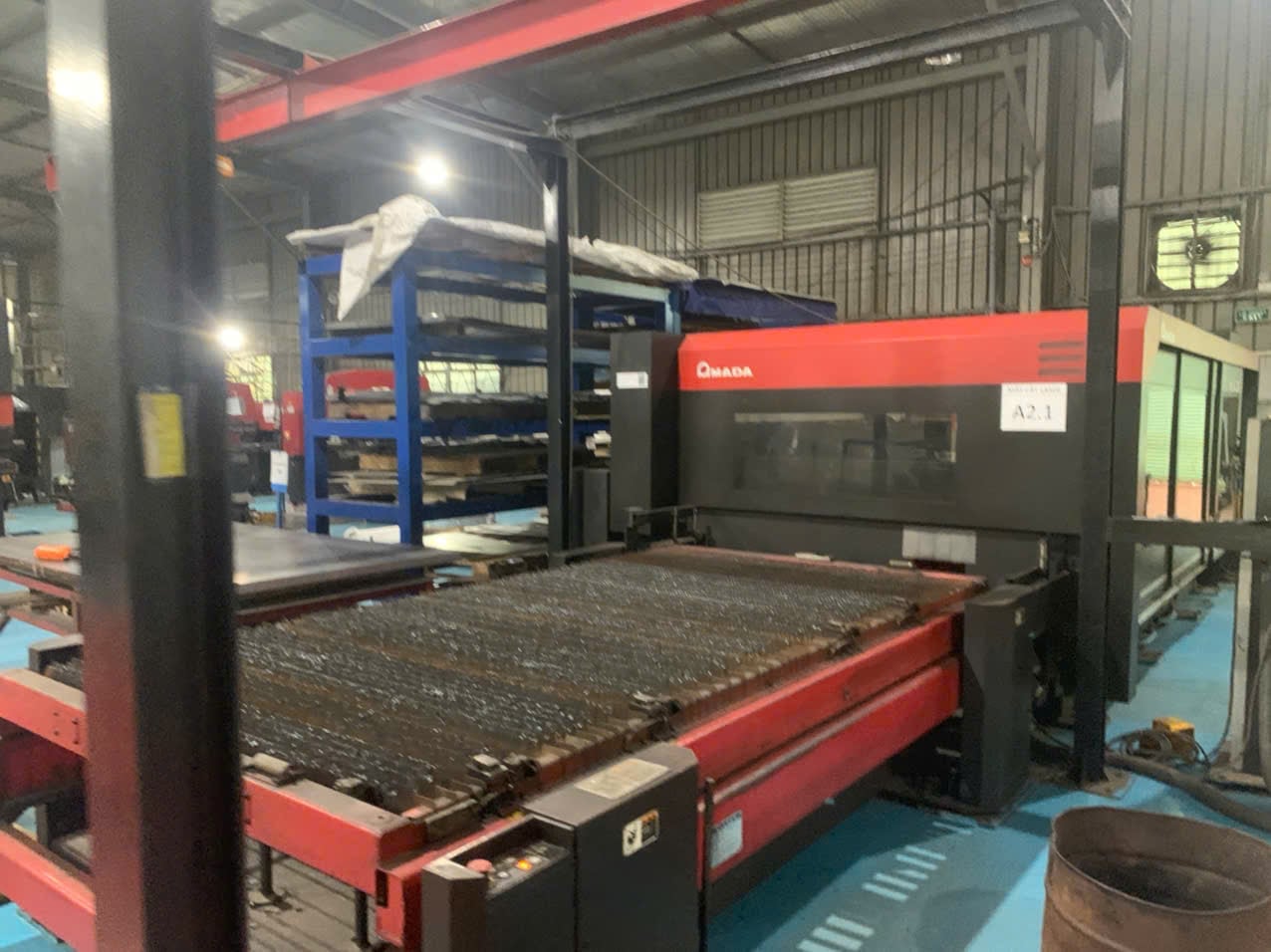
Which Grades and Finishes Do Vietnamese Fabricators Stock?
This table covers the grades most commonly stocked by Vietnamese fabricators and the finishes each accepts.
| Material | Common Grades in Vietnam | Typical Applications | Relative Cost | Compatible Finishes |
|---|---|---|---|---|
| Cold-rolled carbon steel | SPCC (JIS) / DC01 / CRS | Brackets, enclosures, chassis, frames | $ | Powder coat, wet paint, zinc plating, e-coating |
| Galvanized steel | SGCC (hot-dip), SECC (electro-galvanized) | Outdoor housings, HVAC, ducting, panels | $ | Powder coat (with prep); cut edges exposed |
| Stainless steel | SUS304 / SS304, SUS316 / SS316, 430 for low-cost decorative | Food equipment, medical trays, marine hardware, architectural trim | $$$ | Brushed/#4, mirror polish, bead blast, passivation, electropolish |
| Aluminum (forming) | AL5052-H32 | Formed enclosures, panels, marine parts | $$ | Anodize (clear/color), powder coat, chromate conversion |
| Aluminum (structural) | AL6061-T6 | Flat plates, machined brackets, weldments, heat sinks | $$ | Anodize, powder coat; avoid tight bends |
| Copper | C1100 (electrolytic tough pitch) | Busbars, grounding, thermal spreaders | $$$$ | Tin or nickel plating, clear lacquer |
| Brass | C2680 / C26800 | Decorative panels, terminals, EMI gaskets | $$$$ | Nickel/chrome plating, lacquer, patina |
Two practical notes. Galvanized steel’s zinc layer is applied at the mill, so laser-cut edges and weld zones lose protection — plan for touch-up or choose post-fabrication plating on bare SPCC instead. And anodizing only works on aluminum; if a drawing calls for anodized carbon steel, the finish callout and the material callout are fighting each other. Browse the full materials library for property data on each grade.
Aluminum vs Copper: Which Wins on Conductivity and Cost?
Engineers designing electrical and thermal hardware often weigh aluminum against copper. Copper conducts roughly 60% better by volume, but aluminum conducts nearly twice as well per kilogram and costs a fraction as much — which is why busbars in cost-sensitive switchgear are increasingly aluminum with plated contact faces, while high-density, space-constrained current paths stay copper. For thermal applications, aluminum 6061 or 5052 heat spreaders handle most electronics cooling; copper earns its cost only where heat flux is extreme and space is tight. Mechanically, copper and brass work-harden quickly and demand generous bend radii, while 5052 aluminum forms easily — another reason enclosures stay aluminum and conductors stay copper.
Copper conducts about 60% better by volume, but aluminum conducts nearly twice as well per kilogram at a fraction of the cost — so aluminum wins cost-sensitive busbars and most heat spreaders, while copper wins only where current density or heat flux is extreme.
How Do Gauge and Metric Thickness Translate for Vietnamese Mills?
US drawings often specify gauge numbers; Vietnamese mills, service centers, and fabricators quote in millimeters. Worse, gauge-to-thickness conversion differs between steel, stainless, and aluminum. Put the metric thickness on the drawing and avoid the ambiguity entirely.
Vietnamese mills and service centers work in millimeters, and a US gauge number converts to a different thickness for steel, stainless, and aluminum. Dimension the drawing in metric aligned to common stock (1.0, 1.5, 2.0, 3.0 mm) so the part quotes from shelf material the same day.
| Gauge (steel) | Steel (mm) | Stainless (mm) | Aluminum (mm) | Common Vietnam stock (mm) |
|---|---|---|---|---|
| 20 ga | 0.91 | 0.95 | 0.81 | 0.8, 1.0 |
| 18 ga | 1.21 | 1.27 | 1.02 | 1.2 |
| 16 ga | 1.52 | 1.59 | 1.29 | 1.5 |
| 14 ga | 1.90 | 1.98 | 1.63 | 2.0 |
| 12 ga | 2.66 | 2.78 | 2.05 | 2.5, 3.0 |
| 10 ga | 3.42 | 3.57 | 2.59 | 3.0, 4.0 |
Note that common metric stock (1.0, 1.5, 2.0, 3.0 mm) does not map exactly to gauge thicknesses. A drawing demanding 1.21 mm ±0.05 forces special material procurement; a drawing that says 1.2 mm or accepts 1.0/1.5 mm alternates gets quoted from stock the same day.
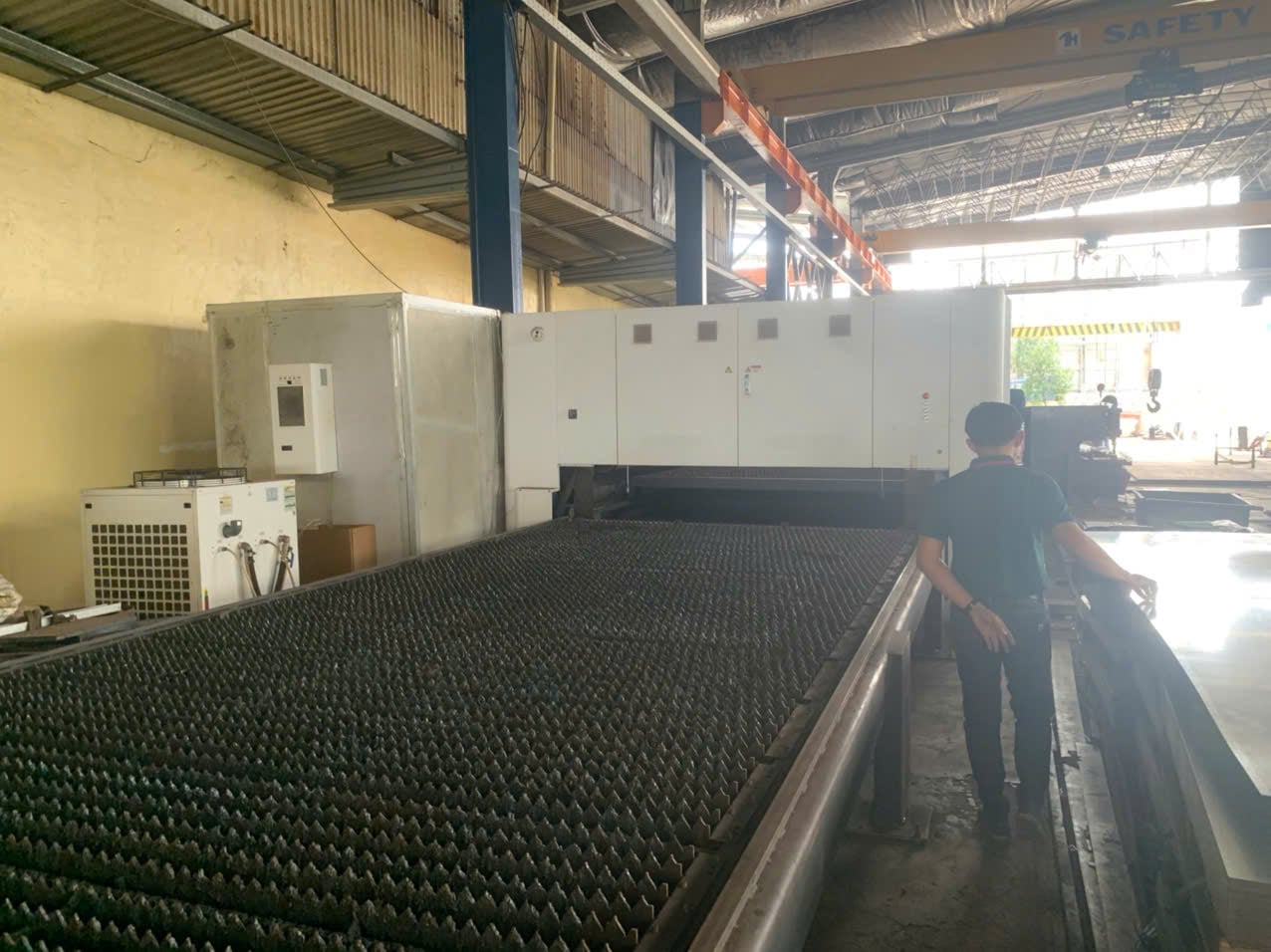
Lightweight vs heavy-duty design: below roughly 3 mm you are in press-brake-and-laser territory where stiffness comes from geometry — flanges, hems, ribs, and bends stiffen thin sheet far more efficiently than added thickness. From 3–6 mm, bend radii grow, springback increases, and welding starts replacing tab-and-slot joints. Above 6 mm you are in plate fabrication: plasma or high-power laser cutting, heavy press brake bending with wide V-dies, and structural welding standards. If your part carries structural load, it is usually cheaper to move up one thickness and simplify the geometry than to engineer a thin, feature-dense part — but for covers and enclosures the opposite holds. Formed features also interact with process choice: high-volume parts with repeated forms belong in metal stamping rather than press brake work.
.jpg)
What Mill Certificates and Traceability Should I Expect?
Every production order from Vietnam should ship with material certification, and audited fabricators handle this routinely — but you must specify it on the PO, not assume it.
Expect EN 10204 Type 3.1 mill certificates (or the JIS equivalent) giving chemistry and mechanical properties for the specific heat, with the heat number traceable to your parts through the fabricator’s material log. It is standard at verified partner factories, but you must request it on the PO.
- EN 10204 Type 3.1 certificates (or the equivalent JIS mill sheet) are the standard expectation: chemical composition and mechanical properties for the specific heat/lot, issued by the mill.
- Traceability: the cert’s heat number should be linkable to your parts through the fabricator’s material log. For regulated industries, require heat numbers on packing lists or stamped on parts.
- Watch-outs: certs naming a different grade “equivalent” to the one ordered (SUS304 and 304 are fine; a 201-series stainless offered as “304 equivalent” is not), photocopied certs with no heat correlation, and missing certs on galvanized material where coating weight matters.
Material verification is one of the areas covered in DEWIN’s 50-point Dolphin Audit — factories in the network, drawn from 179+ audited suppliers and gated to QCLDM Tier 1–2, maintain material logs that link every production lot to its mill certificate.
Material Selection Checklist
- Match family to function: carbon steel + coating for cost, stainless for corrosion without coating, aluminum for weight/anodize, copper/brass for conductivity
- Specify grades stocked in Vietnam (SPCC, SGCC, SUS304/316, AL5052-H32, AL6061-T6) unless the application demands otherwise
- Dimension thickness in millimeters aligned to metric stock sizes
- Check finish/material compatibility (no anodize on steel; plan edge protection on galvanized)
- Verify bend radius against alloy and temper (≥1t for 5052; generous radii or no bends for 6061-T6)
- Require EN 10204 3.1 mill certs with heat traceability on the PO
- Flag any chloride, food-contact, or medical exposure that pushes SS304 → SS316
FAQ
What are the main benefits of sourcing sheet metal materials for vietnam: grades and gauges in Vietnam?
Vietnam offers competitive machine-hour rates, a rapidly modernizing precision supplier ecosystem, relief from Section 301 Chinese punitive tariffs for qualifying goods into the United States, and preferential trade terms under EVFTA and CPTPP. Audited suppliers in the DEWIN network maintain ISO 9001, AS9100, and IATF 16949 certifications.
How does DEWIN ensure quality and dimensional accuracy?
Every manufacturing facility undergoes the rigorous 50-point Dolphin Audit evaluating Quality, Cost, Logistics, Delivery, and Management (QCLDM). Critical dimensions are verified using on-site 3D CMM inspection, optical comparators, and full material test reports (MTRs) before shipment.
What file formats and information are required for a streamlined RFQ turnaround and engineering review?
To generate a binding quotation within 24 hours, submit 3D CAD files in neutral STEP (AP214/AP242) or IGES format alongside 2D PDF technical drawings specifying critical tolerances, surface finishes, thread callouts, and raw material grades.