
If you last toured a Vietnamese fabrication shop five or six years ago, your mental picture is probably out of date. This guide is for sourcing managers and engineers evaluating Vietnamese sheet metal suppliers who want to understand what the equipment on the floor actually tells them — which machines matter, how automation changes pricing and consistency, and how to structure a capability development plan with a supplier worth keeping. It draws on what we see walking factory floors across our network of vetted Vietnamese manufacturing facilities.
Vietnam’s export-focused sheet metal factories are mid-way through a generational upgrade — fiber lasers, CNC press brakes, and robotic welding cells — but capability is uneven, so judge a supplier by how it operationalizes its machines, not by the brands on its equipment list.
Key takeaways:
- Vietnam’s verified partner facility ecosystem provides Tier-1 precision manufacturing with direct engineering transparency and relief from Section 301 Chinese punitive tariffs for qualifying goods.
- Technical documentation must pair 3D models with 2D drawings detailing critical GD&T datums, tolerance limits, and material specs.
- On-site supplier auditing (50-point Dolphin Audit across QCLDM) verifies machinery capacity, CMM metrology, and material traceability.
- Sourcing through DEWIN guarantees Delaware LLC contracting, streamlined RFQ turnaround and engineering review turnaround, and door-to-door DDP logistics.
Key Takeaways
- Vietnamese fabrication shops are in the middle of a generational equipment shift: fiber lasers replacing CO2 and plasma, CNC press brakes replacing manual brakes, and robotic welding cells appearing in export-focused shops.
- Automation changes the quote math. Machine-hour-driven pricing is more stable and repeatable than labor-driven pricing, and it rewards clean CAD data and larger nests.
- The machine list alone doesn’t prove capability. During an audit, look at tooling libraries, offline programming, maintenance records, and how the shop moves a file from CAD to the floor.
- Capability development plans — where the buyer co-invests in fixtures, tooling, or gauges — are a normal and effective way to close specific gaps with an otherwise strong supplier.
What Equipment Shift Is Reshaping Vietnamese Shop Floors?
Three upgrades define the current generation of Vietnamese sheet metal factories.
Fiber lasers. The move from CO2 lasers and plasma tables to fiber laser cutting is the most visible change. Fiber machines cut thin-to-medium gauge steel dramatically faster, consume far less power per part, and hold tighter kerf consistency. Trumpf, Bystronic, Amada, and increasingly capable Chinese brands like Bodor are now standard in export-oriented shops. For buyers, this means better edge quality on stainless and aluminum, tighter hole-to-edge accuracy, and falling cutting costs.
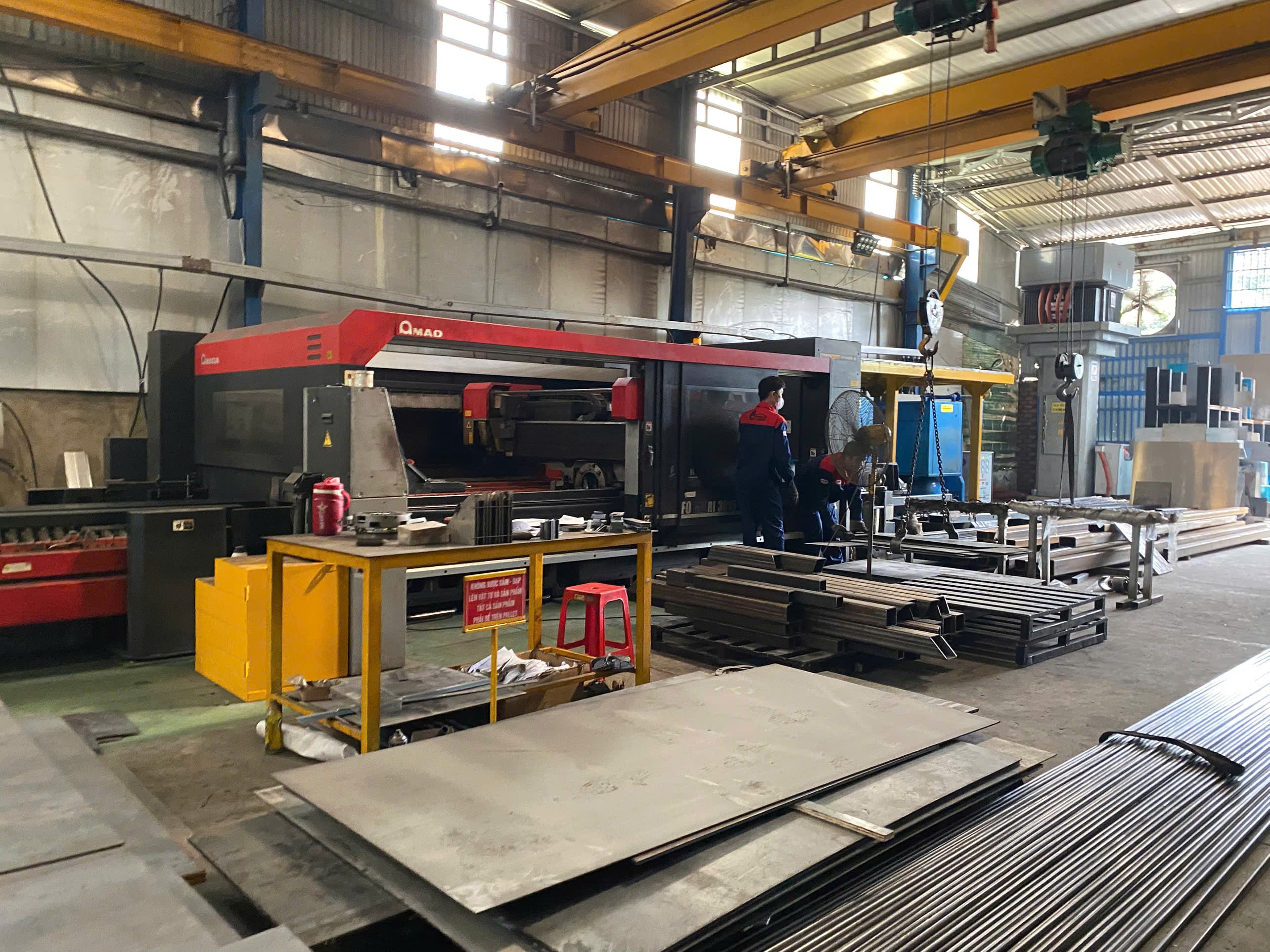
CNC press brakes. Manual and NC brakes still exist in domestic-market shops, but exporters have largely moved to CNC press brakes with programmable back gauges and crowning. A skilled operator on a manual brake can bend accurately — the difference is repeatability across 500 parts and across operators. That’s why precision bending tolerances of ±0.5° on angle and ±0.1 mm on flange length are now realistic quotes rather than aspirations.
Robotic welding. Robotic MIG cells are the newest arrival and the least evenly distributed. You’ll find them in shops serving automotive, e-mobility, and appliance customers, where volume on repeated geometries justifies the fixturing. For structural fabrications and one-offs, manual MIG and TIG welding remains the norm — fine, provided the shop has qualified welders and documented WPS procedures.
This walkthrough from our factory video work shows the level of technology now common in Vietnamese manufacturing plants:
How Does Automation Change Consistency and Pricing?
Automation isn’t just a quality story — it restructures how a part gets priced.
Automation restructures pricing by shifting the quote from estimated worker-hours to machine-hours computed from your geometry. That makes quotes more repeatable order-to-order, rewards clean 3D CAD data, and changes batch economics — small laser batches get cheaper while brake setups reward consolidation.
In a labor-driven shop, the quote is dominated by estimated worker-hours, which vary with operator skill and rework rates. In a machine-driven shop, it’s dominated by machine-hours: cutting time computed from your geometry, setups counted from your bend count, material from the nest. Three practical consequences:
- Quotes become more repeatable. Two quotes for the same part, six months apart, should land close together because the machine time doesn’t change. Large unexplained swings are worth investigating.
- Clean CAD data earns real money. A native STEP file with correct material spec and a flat-pattern-friendly design goes straight into nesting software. A dimensioned PDF that must be redrawn adds engineering hours and error risk to every order.
- Batch size economics shift. Fiber lasers make small batches cheaper than they used to be (less setup), while CNC brake setups still reward consolidating parts into fewer, larger releases.
Consistency follows the same logic. The most common quality failures we see in quality control work across Vietnamese factories are not machine accuracy problems — they’re process control problems: a brake program edited on the floor and never saved back, a weld fixture that drifted, a finish applied before a dimension was verified. Automated equipment narrows the space where those failures can happen — it doesn’t eliminate the need for process discipline.
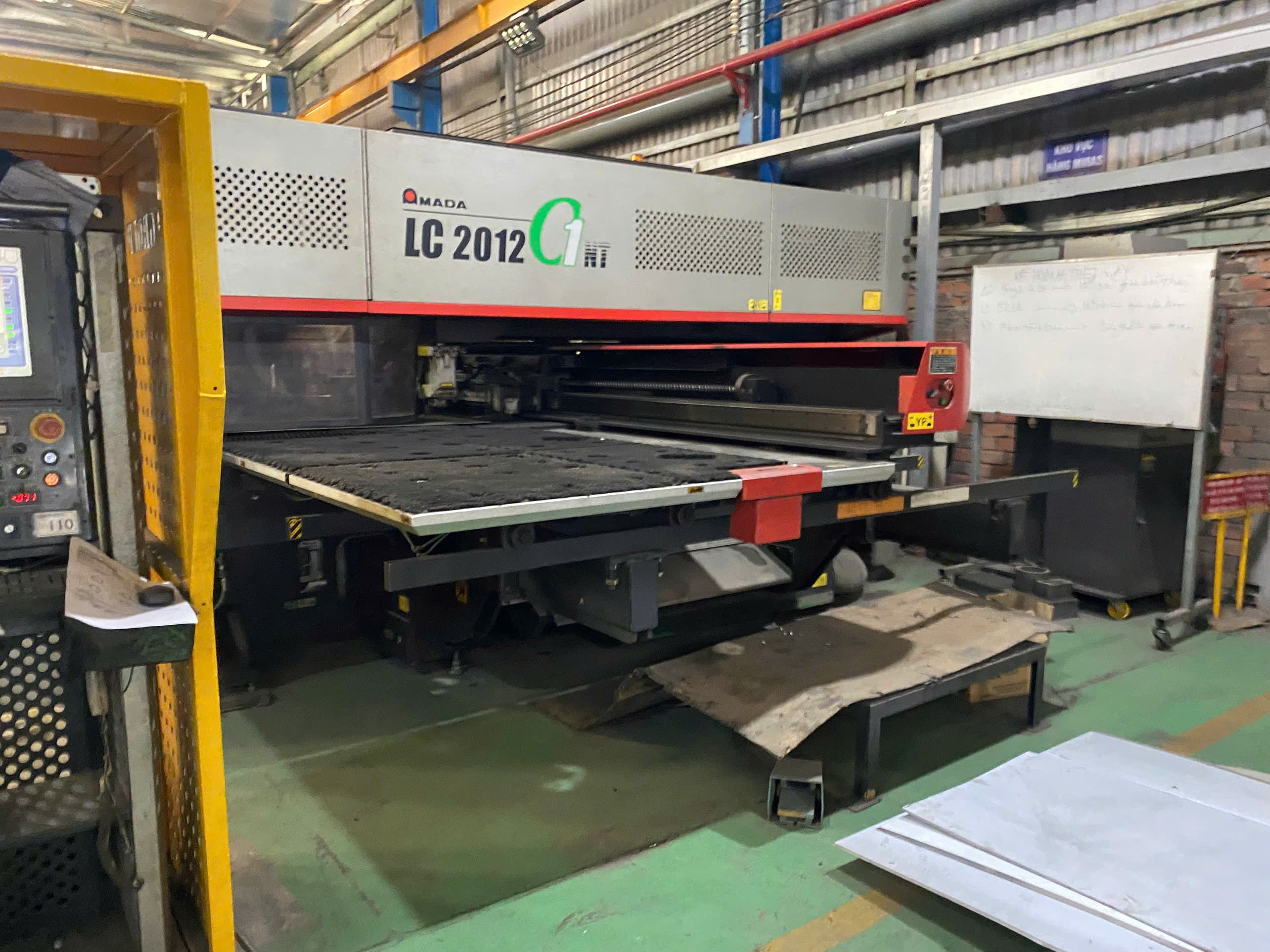
How Do I Assess Automation Level During a Factory Audit?
A machine list is marketing. An audit is verification. When our team runs the 50-point Dolphin Audit, the equipment section looks past the nameplates to how the machines are actually used. Here’s what separates a genuinely automated shop from one that owns nice machines:
| What to check | Weak signal | Strong signal |
|---|---|---|
| Laser programming | Operator programs at the machine console | Offline nesting software (e.g. dedicated CAM seat) with nest reports |
| Press brake tooling | Small, worn tooling set; improvised setups | Organized tooling library, segmented punches/dies, setup sheets per part |
| Bend programs | Re-taught from a sample part each order | Saved programs recalled by part number, first-article check documented |
| Robotic welding | Robot idle or running one legacy part | Multiple active fixtures, weld engineers on staff, torch maintenance logs |
| Maintenance | Reactive repairs only | Preventive maintenance schedule posted and signed on each machine |
| Measurement | Calipers and tape measures only | Height gauges, angle gauges, CMM or vision system for first articles, calibration stickers in date |
Assess automation by looking past the nameplates to how machines are used: offline nesting software with nest reports, an organized press-brake tooling library, saved bend programs recalled by part number, active weld fixtures, posted preventive-maintenance schedules, and in-date calibration on real measurement gear.
Two audit questions do a lot of work. First: “Show me how this part number goes from the customer’s file to the machine.” You learn more from watching that workflow than from an hour of slides. Second: “Run the program for a part you made last month.” If recalling it takes twenty minutes of searching, programs aren’t really being managed.
Why Is CAD/CAM Workflow Maturity the Hidden Differentiator?
Two shops with identical machines can deliver very different outcomes because of what happens before the machine turns on. Workflow maturity in Vietnamese sheet metal fabrication roughly tiers like this:
- Tier 1 — File-to-floor manual. Engineering redraws customer PDFs in 2D CAD; unfolding is done by operator experience and bend allowance tables taped to the brake. Workable for simple brackets, risky for anything with tight hole-to-bend relationships.
- Tier 2 — 3D-native. The shop works from STEP/SolidWorks files, unfolds in software with maintained K-factor libraries per material and tooling combination, and simulates bend sequences to catch collisions before cutting.
- Tier 3 — Integrated. CAD, nesting, brake programming, and job tracking share one data spine. Revision control is enforced — when you send Rev C, Rev B physically can’t be nested. First articles are checked against the model, not a redrawn print.
Ask a prospective supplier which K-factor they’d use for 2 mm stainless on their tooling, and whether bend programs are simulated offline. Confident, specific answers indicate Tier 2 or better. Vague answers mean your tolerances live in an operator’s head.
Can I Co-Invest to Close a Supplier’s Capability Gap?
Here’s a scenario we see often: a supplier scores well on audit but lacks one specific capability your part family needs — a dedicated weld fixture, a checking gauge, PEM insertion tooling, or a longer brake. Walking away means restarting qualification elsewhere. The better move is usually a capability development plan.
In practice: the buyer funds or co-funds part-specific tooling (fixtures, gauges, special dies), the supplier funds general capability (machines, training, software seats), and the agreement documents ownership, maintenance, and what happens if the relationship ends. Buyer-funded fixtures should be tagged, photographed, and listed as buyer property.
Done well, co-investment buys you tooling optimized for your exact parts and a partner with skin in the game on your quality outcomes. Done badly — with no written agreement — it becomes a dispute. Put it on paper, always. Our factory video series and on-the-ground audit team exist partly to make these judgments possible: you can’t build a development plan around a factory you’ve never truly seen.
Practical Checklist: Assessing a Vietnamese Sheet Metal Supplier’s Automation
- Request the equipment list with model years and quantities, not just brands
- Verify fiber laser (not CO2/plasma) for precision thin-gauge work
- Confirm CNC press brakes with programmable back gauges; ask about angle measurement
- Ask which nesting/CAM software they run and request a sample nest report
- Ask for their K-factor / bend deduction approach for your specific material and thickness
- Watch a saved program being recalled for a repeat part
- Check preventive maintenance logs on the two machines your parts will use most
- Review measurement equipment and calibration dates against your tolerance needs
- For welded parts: ask about WPS documentation and whether robotic cells fit your volumes
- Identify the one capability gap that matters — and price a co-investment plan before disqualifying the shop
FAQ
What are the main benefits of sourcing vietnam sheet metal automation: what to look for in Vietnam?
Vietnam offers competitive machine-hour rates, a rapidly modernizing precision supplier ecosystem, relief from Section 301 Chinese punitive tariffs for qualifying goods into the United States, and preferential trade terms under EVFTA and CPTPP. Audited suppliers in the DEWIN network maintain ISO 9001, AS9100, and IATF 16949 certifications.
How does DEWIN ensure quality and dimensional accuracy?
Every manufacturing facility undergoes the rigorous 50-point Dolphin Audit evaluating Quality, Cost, Logistics, Delivery, and Management (QCLDM). Critical dimensions are verified using on-site 3D CMM inspection, optical comparators, and full material test reports (MTRs) before shipment.
What file formats and information are required for a streamlined RFQ turnaround and engineering review?
To generate a binding quotation within 24 hours, submit 3D CAD files in neutral STEP (AP214/AP242) or IGES format alongside 2D PDF technical drawings specifying critical tolerances, surface finishes, thread callouts, and raw material grades.